On this page
Henri Moissan wrote that "Magnesia may be fused and kept liquid in a carbon crucible without being reduced." In 1908 Roland Edgar Slade showed that this was only half true. Carbon does take oxygen from magnesium oxide, but the magnesium and carbon monoxide react back as they cool, so the metal vanishes before anyone sees it. His paper, "The Reducibility of Magnesium Oxide by Carbon", J. Chem. Soc. Trans. 93, 327–333, is the Ellingham diagram in action.
Why did chemists think carbon could not reduce magnesia?
Slade begins: "of all the metallic oxides, magnesia has longest withstood attempts to effect its direct reduction." He quotes Moissan's line from The Electric Furnace. We read the whole paper and checked its numbers in the scanned 1908 volume.
The clue came from damaged equipment. Slade had lined carbon crucibles with magnesia and found the walls "considerably corroded in those places where they had been in contact with the strongly heated magnesia." His explanation was that any products "might escape notice on account of the ready volatility of magnesium and the ease with which it reacts with carbon monoxide".
The paper gives his name as "Roland Edgar Slade, M.Sc." and his address as the Electro-Chemical Laboratory, The University, Manchester. We have not checked other details of his life. His temperatures were read with an optical pyrometer, so treat them as approximate, as he did.
How did Slade catch the magnesium?
He had to remove the magnesium, the CO, or both before they could meet again. He tried four ways.
Dissolve it in copper. Molten copper took up the magnesium as an alloy. "In all experiments above 1700°, an alloy containing magnesium was obtained", with 1.6% Mg at 1883°. A blank of magnesia and copper with no carbon took up no magnesium.
Watch the onset. In a stream of hydrogen, fumes appeared "at about 1670°". He concluded that reduction "probably begins a little below 1700°", below the melting point of magnesia.
Pump the gas away. In an evacuated glass globe, the pressure stayed below 80 mm of mercury and the rod was at about 1900°. The globe became "coated with a bright silver-like mirror" that "dissolved readily with effervescence in dilute hydrochloric acid". The gas pumped out was 57.4% CO, 38.1% H₂ and 4.4% N₂.
Absorb the CO. With 60 g of aluminium in the charge, CO was removed as 6Al + 3CO → Al₄C₃ + Al₂O₃ (6 Al, 3 C, 3 O on each side). He collected 2 g of magnesium powder plus 2 g of melted metal, which analysed as 99.45% Mg. Without the aluminium he found "a mixture of magnesia and carbon" instead.
His own conclusion: magnesia "is reduced by carbon, not only at the high temperature of the electric arc, but as low as 1700°."
Worked example: at what temperature does ΔG° become zero?
The reaction is:
MgO(s) + C(s) → Mg(g) + CO(g)
Check: 1 Mg, 1 O and 1 C on each side. At these temperatures magnesium is a gas, since the NIST tables give liquid magnesium only up to 1366 K. Use the 298 K values from the NIST WebBook for MgO, Mg, CO and graphite.
ΔH°. ΔfH°: MgO(s) −601.60, Mg(g) +147.1, CO(g) −110.53 kJ mol⁻¹, and 0 for graphite. ΔH° = 147.1 − 110.53 + 601.60 = +638.2 kJ.
ΔS°. S°: Mg(g) 148.65, CO 197.66, MgO 26.95, graphite 5.6 J K⁻¹ mol⁻¹. ΔS° = 148.65 + 197.66 − 26.95 − 5.6 = +313.8 J K⁻¹.
Crossover. ΔG° = ΔH° − TΔS° = 0 when T = 638 170 ÷ 313.76 = 2034 K, about 1761 °C.
At Slade's onset. At 1973 K (1700 °C), ΔG° = 638.2 − 1973 × 0.3138 = +19.1 kJ, so K = e^(−19 100 ÷ (8.314 × 1973)) = 0.31. K = p(Mg) × p(CO) in bar, so each gas can build up to √0.31 = 0.56 bar. A gas stream that carries the products away keeps them below that, and the reaction keeps going.
At low pressure. If each gas is held at 0.05 bar, ΔG = ΔG° + RT ln(0.05 × 0.05) = 0 when T = 638 170 ÷ (313.76 + 8.314 × 5.99) = 1755 K, about 1482 °C. That is why a vacuum helps. The actual partial pressures in Slade's globe are not known, so this is an illustration.
These are estimates. They treat ΔH° and ΔS° as fixed at their 298 K values, and the 5.6 for graphite is a NIST average.
Why does the magnesium turn back into MgO on cooling?
Reverse the reaction: Mg(g) + CO(g) → MgO(s) + C(s) has ΔH° = −638.2 kJ and ΔS° = −313.8 J K⁻¹. Below 2034 K, the −TΔS° term is no longer large enough, and ΔG° turns negative. At 1500 K it is −638.2 + 1500 × 0.3138 = −167.5 kJ.
So the large positive ΔS° that drives the forward reaction at high temperature works against it as soon as the gases cool. That is the Class 11 rule for a reaction with ΔH > 0 and ΔS > 0, explained in the temperature at which a reaction becomes spontaneous. The magnesium vapour and CO, still mixed, simply run the reaction backwards, which is why Slade kept finding magnesia and carbon in his condenser.
How does this look on an Ellingham diagram?
Write both oxide-forming reactions per mole of O₂, using NIST's S° of 205.15 J K⁻¹ mol⁻¹ for O₂:
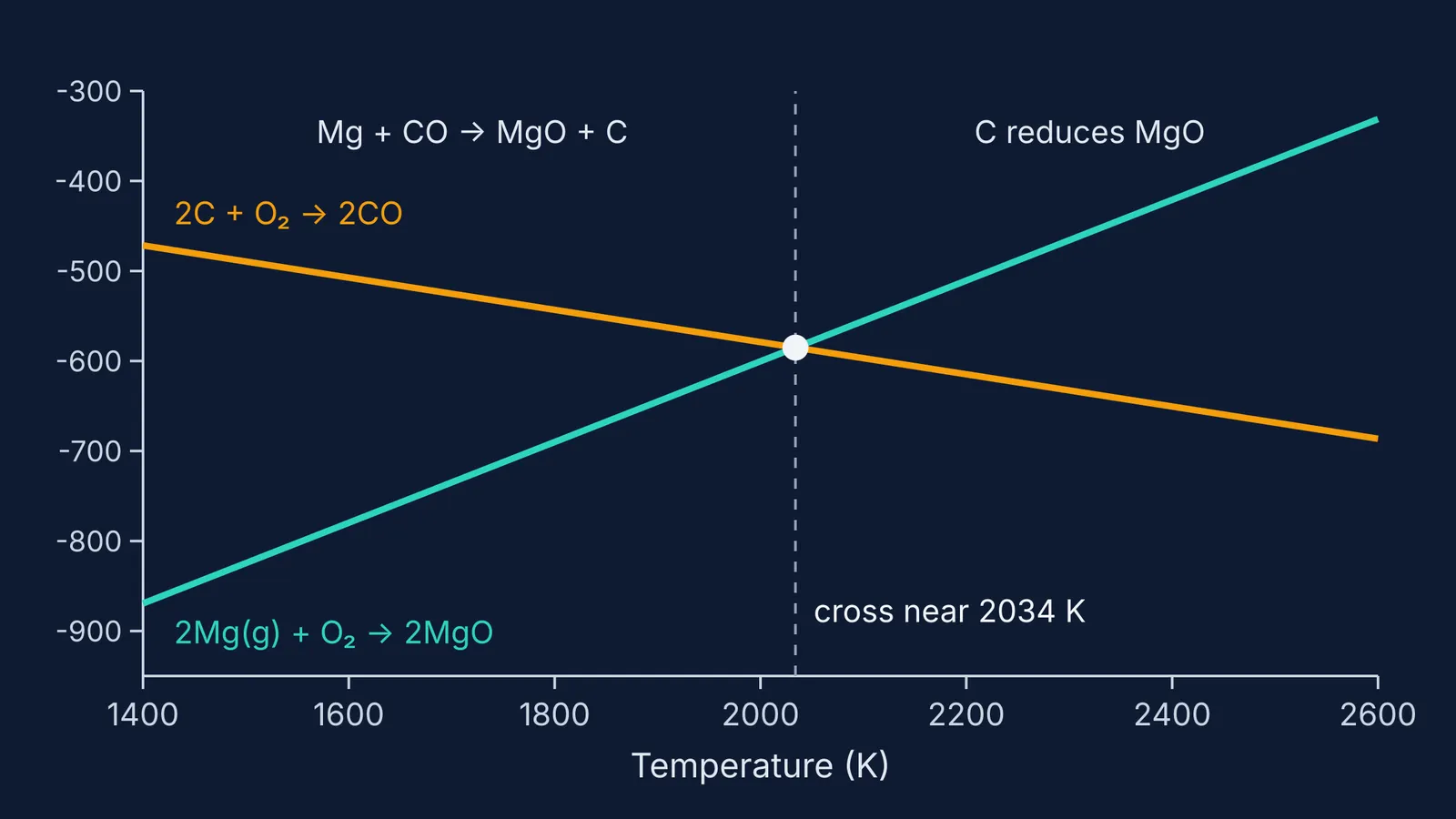
2C + O₂ → 2CO: ΔH° = −221.1 kJ, ΔS° = +179.0 J K⁻¹. One mole of gas becomes two, so the line slopes down.
2Mg(g) + O₂ → 2MgO(s): ΔH° = −1497.4 kJ, ΔS° = −448.6 J K⁻¹. Three moles of gas become a solid, so the line climbs steeply.
Subtract the second from the first and you get twice the reduction reaction, so the lines cross at the same 2034 K, near −585 kJ. At 1500 K the carbon line (−489.5 kJ) lies far above the magnesium line (−824.6 kJ), so magnesium wins the oxygen. At 2300 K the order flips (−632.7 against −465.7 kJ), and carbon can reduce MgO. If the reading rule is new, start with how to read an Ellingham diagram.
For more ΔG° and Ellingham questions with full working, the Fermi Problem Library has a step-by-step solver that explains the reasoning.
Why does Slade's paper matter for JEE and NEET?
Class 12 Isolation of Elements: above the crossing temperature carbon can reduce an oxide; the CO line slopes down because gas is made.
Class 11 Thermodynamics: T = ΔH°/ΔS° for ΔG° = 0, and the sign of ΔG° on either side.
Class 11 Equilibrium: removing gaseous products pulls the reaction forward. The silicon route in the Pidgeon process is the practical sequel.
To revise ΔG° and Ellingham ideas for JEE Main and Advanced, use the Concept Library on Fermi Test Prep.
Quick checklist
MgO + C → Mg(g) + CO: ΔH° ≈ +638 kJ, ΔS° ≈ +314 J K⁻¹.
ΔG° = 0 near 2034 K (about 1761 °C), an estimate from 298 K data.
Slade saw reduction begin a little below 1700 °C, with the products swept away.
On cooling, Mg + CO → MgO + C is spontaneous, so the metal disappears.
Vacuum, a gas stream or an absorber for CO lets the magnesium survive.