On this page
If you study for NEET, you learn that ninhydrin turns amino acids a deep blue-violet. The reagent first appeared in two papers by Siegfried Ruhemann in the Journal of the Chemical Society, Transactions, volume 97, in 1910: "Cyclic di- and tri-ketones" on pages 1438 to 1449 (DOI) and "Triketohydrindene hydrate" on pages 2025 to 2031 (DOI). Both are free to read in the Internet Archive scan of the volume. He was not looking for an amino acid test. All quotations below are from those two papers.
Who was Siegfried Ruhemann?
The papers give his name and his address, the University Chemical Laboratory, Cambridge. We found no primary source for other details of his life, so we leave them out.
What was Ruhemann trying to make?
He wanted a ketone that "closely resembles isatin" in structure. He started from α-hydrindone (indan-1-one today), which has two CH₂ groups in its five-membered ring. He expected to turn one CH₂ into C=O and get 1,2-diketohydrindene.
It did not. "The experiment, however, led to the remarkable result that, in the presence of potassium hydroxide or sodium carbonate, p-nitrosodimethylaniline mainly attacks both methylene groups of α-hydrindone." When he treated the product with mineral acid, "it is readily decomposed, and yields the hydrate of triketohydrindene."
Triketohydrindene hydrate is ninhydrin. Today it is named 2,2-dihydroxyindane-1,3-dione. He found it formed "colourless prisms" which, on heating, "turn red at 125°, froth at 139°, and melt and decompose at 239–240°".
Why is ninhydrin a stable hydrate?
Ninhydrin is a gem-diol: two OH groups sit on the same carbon. Most gem-diols lose water easily. The hydration is:
C₉H₄O₃ + H₂O → C₉H₆O₄
Check the balance: 9 C, 6 H and 4 O on each side.
Ruhemann's second paper argues that the water sits on the middle carbonyl, C-2. Hydration at "any other ketonic group of the triketone would produce a coloured compound owing to the proximity of two ketonic groups, whereas triketohydrindene hydrate is colourless". He added that PCl₅ gives the colourless 2,2-dichloro compound, and that guanidine, benzamidine and HCN add on, as carbonyl groups do.
The usual explanation today is that the central C=O sits between two other C=O groups, which pull electron density away from it. That carbon is very electron-poor, so adding water to it is favoured. Chloral hydrate is stable for a similar reason, as explained in why chloral hydrate is an unusually stable gem-diol.
Why does ninhydrin reduce Fehling's and Tollens' reagents?
"The triketone readily reduces Fehling's solution and ammoniacal silver solutions." That looks odd, because these tests are usually positive for aldehydes, not ketones. Ruhemann's explanation was that the ring opens to phenylglyoxal-o-carboxylic acid, HO₂C–C₆H₄–CO–CHO. This open form has a real CHO group, and it is "finally oxidised to phthalonic acid", HO₂C–C₆H₄–CO–CO₂H.
The open acid, C₉H₆O₄, has the same formula as the hydrate. Its oxidation needs only one extra oxygen atom, giving C₉H₆O₅. For the general rules, see Tollens' and Fehling's tests.
With ammonia, he noted, the solution "turns a deep reddish-violet".
How did Ruhemann discover the amino acid test?
In the second paper he wrote: "On mixing a slightly warmed aqueous solution of triketohydrindene hydrate and glycine, an intense blue colour develops immediately." He then tried alanine, valine, leucine, tyrosine, phenylalanine (which he called α-amino-β-phenylpropionic acid), aspartic and glutamic acids, tryptophan and cystine. Cystine dissolves poorly, so it had to be boiled with the reagent. He thanks "Dr. Hopkins" for several of these amino acids, without giving a first name.
The test was sensitive. The blue was "still perceptible" with a solution of "1 part of triketohydrindene hydrate dissolved in 15,000 parts of water". That is about 67 mg per litre, or 3.7 × 10⁻⁴ mol L⁻¹ of ninhydrin (M = 178.14 g mol⁻¹).
He also found where it failed. Two β-amino acids reacted more slowly, and one gave only a faint violet after long boiling. Phenylglycine and hippuric acid, which he grouped as "substituted amino-acids", gave no colour, and neither did o-aminobenzoic acid. He concluded that the reaction "depends on the amino-group of the amino-acid being intact". Peptone and normal human urine were positive.
He did not know how it worked: "The chemical nature of the colour reaction has not yet been ascertained." Two points are often mixed up with 1910. He described the colour as blue. The name "Ruhemann's purple" and its structure came later. He also tested no imino acid, so the yellow colour of proline is not in these papers. The modern mechanism and the proline exception are covered in the ninhydrin test for amino acids.
Worked example: is it the triketone or its hydrate?
Ruhemann burned 0.2083 g of the dried crystals and got 0.4637 g of CO₂ and 0.0640 g of H₂O. Use C = 12.011, H = 1.008 and O = 15.999.
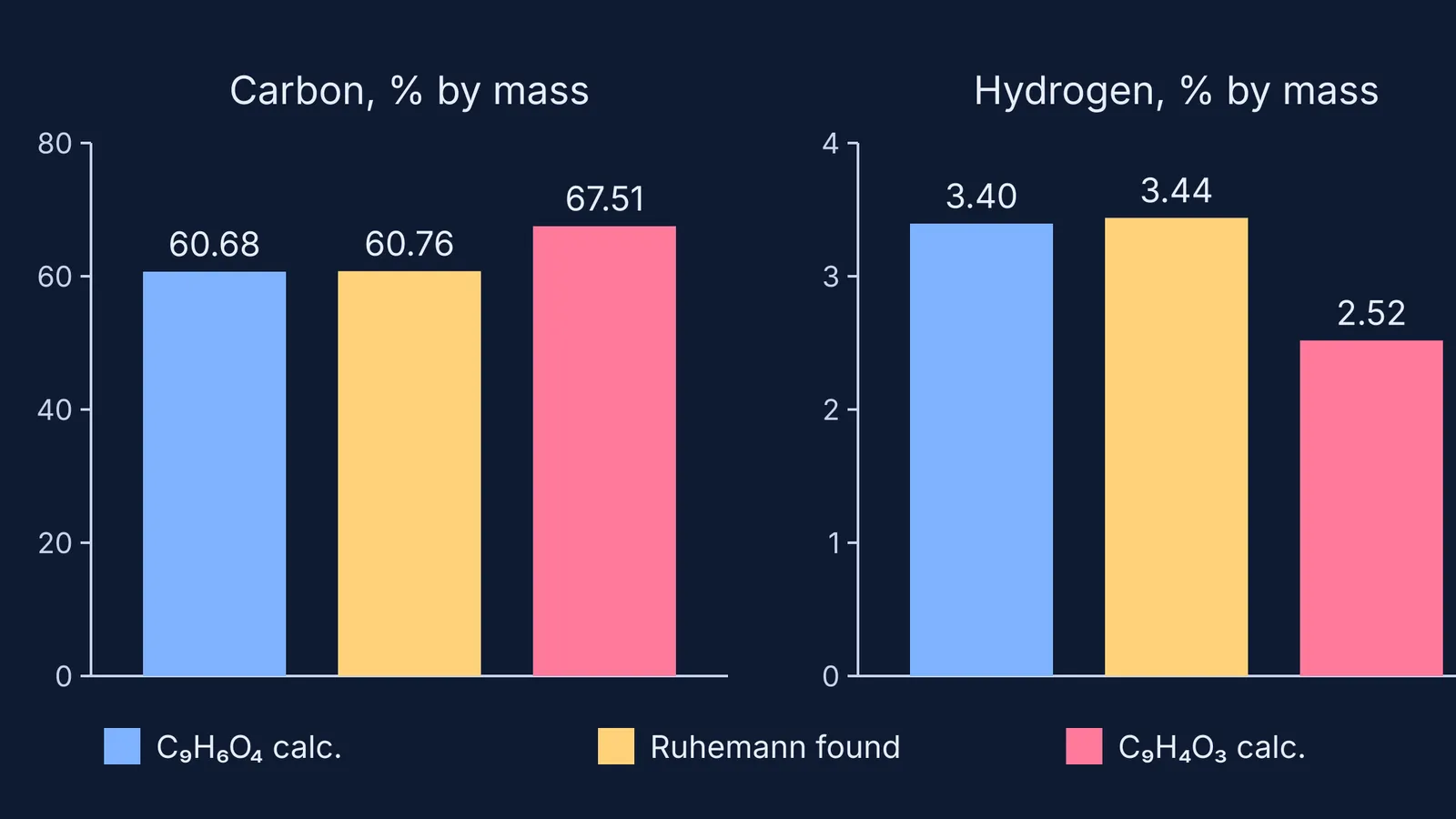
Carbon. Mass of C = 0.4637 × 12.011 ÷ 44.009 = 0.1266 g. Percentage = 0.1266 ÷ 0.2083 × 100 = 60.76 %.
Hydrogen. Mass of H = 0.0640 × 2.016 ÷ 18.015 = 0.00716 g. Percentage = 3.44 %.
Oxygen by difference. 100 − 60.76 − 3.44 = 35.80 %.
Mole ratio. C: 60.76 ÷ 12.011 = 5.059. H: 3.44 ÷ 1.008 = 3.411. O: 35.80 ÷ 15.999 = 2.238.
Divide by the smallest. C 2.26, H 1.52, O 1. Multiply by 4 to get 9.04 : 6.10 : 4, so the empirical formula is C₉H₆O₄.
Compare the candidates. C₉H₆O₄ (the hydrate) needs 60.68 % C and 3.40 % H. The anhydrous triketone, C₉H₄O₃, would need 67.51 % C and 2.52 % H. The analysis matches the hydrate, not the triketone.
Ruhemann printed 60.71 % C and 3.41 % H found, against 60.67 % and 3.37 % required. The small last-digit differences come from older atomic masses and rounding.
Try it yourself. For the guanidine adduct, C₁₀H₉O₃N₃, 0.1945 g gave 32.6 cm³ of N₂ at 20 °C and 754.5 mm Hg. Treated as dry gas, that is 19.38 % N. Subtracting the full vapour pressure of water at 20 °C (about 17.5 mm Hg) gives 18.93 %. The formula needs 19.17 %, and he reported 19.02 %. The paper does not say how he corrected the volume. The method is explained in the history of the Dumas nitrogen method.
For more combustion analysis and empirical formula problems, the Fermi Problem Library has a step-by-step solver that explains the reasoning at each stage.
What should you write in the exam?
A safe one-line answer: ninhydrin is 2,2-dihydroxyindane-1,3-dione, a stable gem-diol, and on warming it gives a blue-violet colour with α-amino acids that have a free NH₂ group. If you are preparing for JEE Main and Advanced as well, Fermi Test Prep is built for that, with an AI tutor.
Quick checklist
Ruhemann, J. Chem. Soc. Trans. 97, 1438 and 2025 (1910), from Cambridge.
He wanted 1,2-diketohydrindene; both CH₂ groups reacted and acid gave triketohydrindene hydrate, ninhydrin.
It is colourless, a gem-diol at C-2, and reduces Fehling's and Tollens' reagents via a ring-opened aldehyde.
Glycine and other α-amino acids gave "an intense blue colour"; the test works at 1 part in 15,000 of water.
No colour with substituted amino acids or o-aminobenzoic acid; the NH₂ must be free.
Analysis: 60.76 % C and 3.44 % H fit C₉H₆O₄, not C₉H₄O₃.
"Ruhemann's purple" and the proline result are not in the 1910 papers.