

On this page
If you run a paper chromatography experiment to separate the amino acids in a protein, you face an immediate problem: amino acids are colourless. When you look at the paper after the experiment is finished, it looks exactly the same as it did before you started. To see where the different compounds have travelled on the paper, you must use a visualising agent.
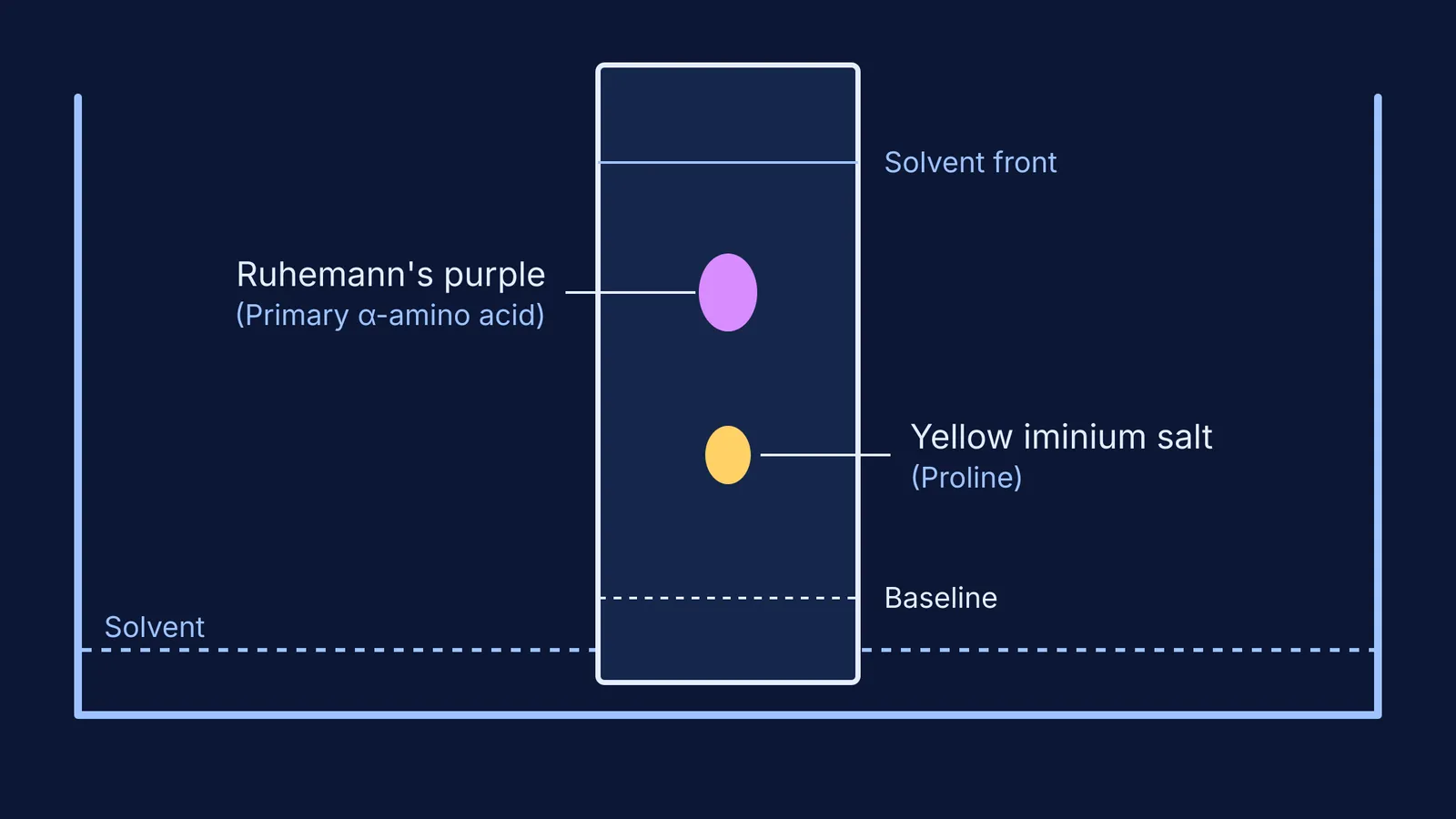
The standard reagent for this purpose is ninhydrin. When you spray a ninhydrin solution onto the chromatography paper and apply heat, brightly coloured spots begin to appear. For the vast majority of amino acids, you will see a deep purple spot develop on the paper. However, if your sample contains the amino acid proline, that specific spot will turn yellow instead of purple.
Understanding why this difference occurs requires looking at the molecular structure of the amino acids. Here is the chemistry behind the ninhydrin test, why proline behaves differently, and how to use these facts in organic chemistry and biochemistry.
What is the ninhydrin test for amino acids?
The ninhydrin test is a sensitive chemical reaction used to detect the presence of ammonia or primary and secondary amines. Because all naturally occurring amino acids contain amine groups in their structure, it is the standard laboratory assay for detecting them.
This reaction is also heavily used in forensic science. When forensic investigators need to develop latent fingerprints on porous surfaces like paper, they apply a ninhydrin solution. The ninhydrin reacts with the amino acids present in the tiny amounts of human sweat left behind by the fingers, producing a visible purple print.
When testing biological molecules in a lab, you might extract a tissue sample and separate it into an acid-soluble pool vs acid-insoluble fraction. The free amino acids end up in the acid-soluble pool, and performing the ninhydrin test can quickly confirm their presence in that fraction.
Why do most amino acids produce Ruhemann's purple?
The majority of amino acids, known as the α-amino acids, contain a primary amine group (-NH₂) attached to their alpha carbon. Examples include common amino acids such as glycine, alanine, and valine.
When these amino acids are heated with ninhydrin (systematically known as 2,2-dihydroxyindane-1,3-dione), the ninhydrin acts as an oxidising agent. The amino acid undergoes a process called oxidative deamination and decarboxylation. During this reaction, the amino acid is broken down, releasing carbon dioxide (CO₂), an aldehyde, and free ammonia (NH₃).
The released free ammonia is the crucial ingredient for the next step. It condenses with one molecule of unreacted ninhydrin and one molecule of reduced ninhydrin (called hydrindantin) to form a complex molecule known as Ruhemann's purple. This specific chromophore absorbs light strongly, which our eyes perceive as a deep blue or violet colour.
Why does proline give a yellow colour?
Proline and its closely related derivative hydroxyproline are notable exceptions to this rule. Instead of producing the characteristic Ruhemann's purple, they react with the ninhydrin reagent to produce a yellow or orange colour.
This distinct difference happens because proline is technically an imino acid. Rather than having a free primary amine group, its nitrogen atom is locked into a rigid five-membered pyrrolidine ring, making it a secondary amine. Because it lacks that essential free -NH₂ group, it cannot undergo the standard oxidative deamination required to release free ammonia.
Since no free ammonia is produced, Ruhemann's purple cannot be formed. Instead, the proline molecule forms a substituted iminium salt directly with the ninhydrin molecule. This completely different molecular structure creates the characteristic yellow colour.
If you are struggling to picture the shapes of these molecules and how they interact, the Fermi Concept Library has a lesson on every concept in chemistry, so you can see exactly why the locked ring in proline stops the normal reaction pathway early.
How is the ninhydrin test used in chromatography?
In analytical techniques like paper chromatography and Thin Layer Chromatography (TLC), ninhydrin is widely used as a developing reagent to make the colourless amino acids visible.
Once the mobile solvent has carried the mixture of amino acids up the paper and the paper has dried, you cannot see where the individual compounds have stopped. By lightly spraying the paper with a ninhydrin solution and gently heating it, the chemical reaction takes place and the spots reveal themselves.
You can then measure the exact distance each spot travelled from the baseline. This allows you to calculate its retention factor (Rf) value, which is used to identify the specific amino acid by comparing it to known standard values.
Just as the Ester Test for Alcohol and Carboxylic Acid relies on a distinct smell to identify a functional group, the ninhydrin test relies on a distinct colour. A purple spot tells you a primary α-amino acid is present, while a yellow spot definitively marks the position of proline on the chromatogram.


