

On this page
In organic chemistry courses for JEE and NEET, one fundamental rule is drilled early: compounds containing two hydroxyl (-OH) groups on the same carbon atom, called geminal diols or gem-diols, are notoriously unstable. When synthesized in aqueous solution, they spontaneously eliminate water to regenerate the carbonyl double bond (C=O).
Why are most gem-diols chemically unstable?
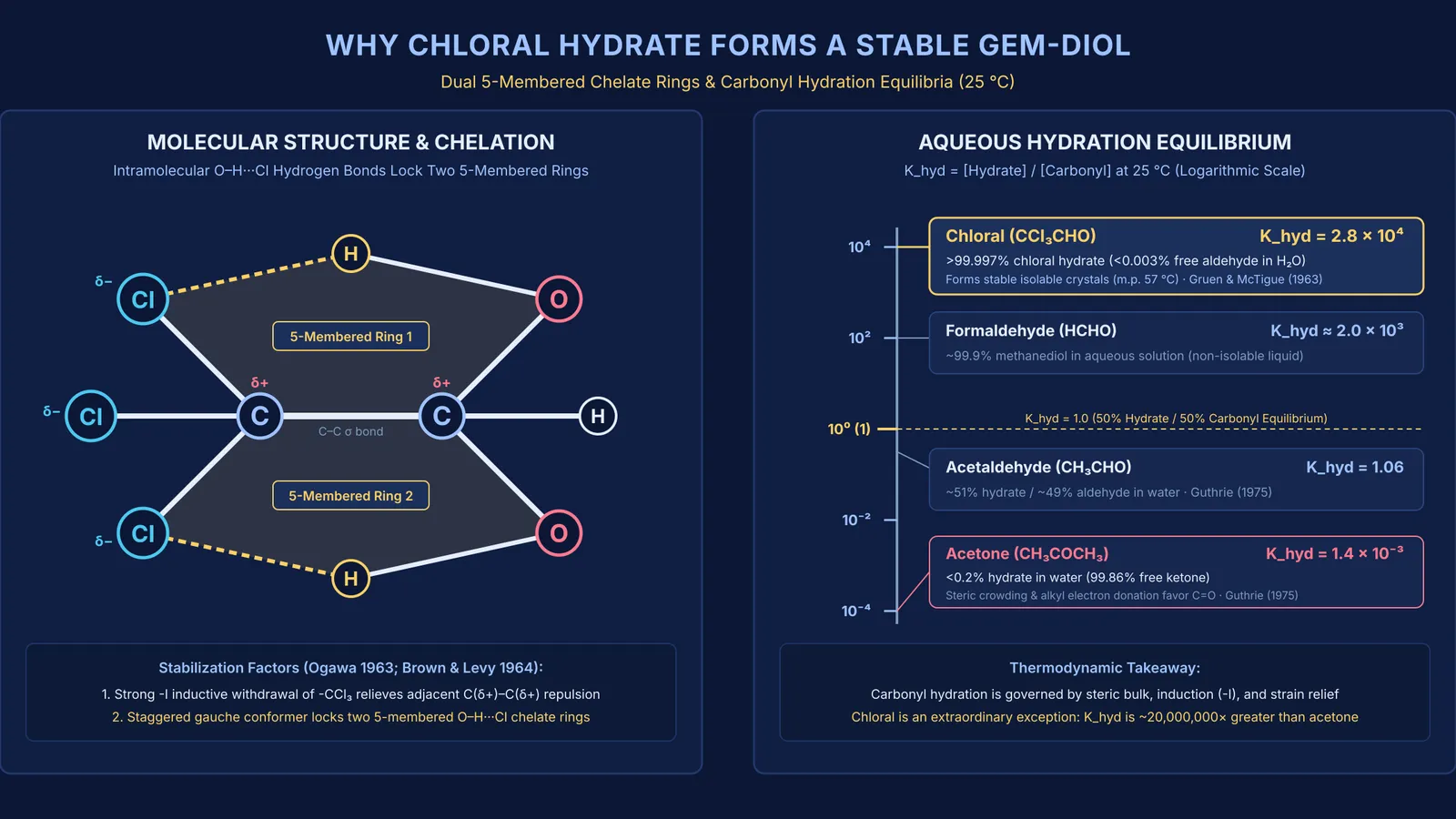
For most carbonyls, geminal diol formation is thermodynamically unfavorable. As compiled by Guthrie (1975), the aqueous hydration equilibrium constant (K_hyd = [hydrate]/[carbonyl]) for acetone is only 1.4 × 10⁻³, meaning less than 0.2% exists as a hydrate in water. For acetaldehyde, K_hyd is approximately 1.06, leaving roughly equal parts aldehyde and diol in solution. Chloral hydrate (CCl₃CH(OH)₂), first synthesized by Justus von Liebig, shatters this trend by forming a stable crystalline solid melting at 57 °C.
This general instability arises from two thermodynamic and structural penalties:
Bond energies and entropy: A carbon-oxygen double bond possesses substantial resonance stabilization and bond strength. Cleaving a C=O pi-bond to form two C-O single bonds is energetically uphill, and the entropy gain of shedding a water molecule into solution favors dehydration.
Geminal dipole repulsion: Placing two electronegative oxygen atoms on the same sp³ carbon forces their lone pairs and polarized C-O bond dipoles into close proximity, causing electrostatic repulsion.
How does the trichloromethyl group alter hydration equilibrium?
The stability reversal begins with the three chlorine atoms on the adjacent alpha-carbon. Chlorine possesses strong electronegativity, so the trichloromethyl (-CCl₃) group exerts a powerful electron-withdrawing inductive effect (-I effect).
In chloral (CCl₃CHO), the carbonyl carbon is strongly electrophilic. The adjacent -CCl₃ group pulls electron density through the C-C sigma bond, creating a large partial positive charge (δ⁺) on the carbonyl carbon. Because the alpha-carbon also carries partial positive character from three C-Cl bonds, strong electrostatic repulsion arises between the adjacent carbons in the planar sp² state.
Hydration relieves this strain. When water attacks the carbonyl carbon, hybridization changes from planar sp² to tetrahedral sp³:
Nucleophilic addition disperses positive charge across two hydroxyl groups and the trichloromethyl framework.
Tetrahedral geometry spreads the substituents apart, increasing distance between chlorines and oxygens and easing electrostatic tension.
Measurements by Gruen and McTigue (1963) revealed that chloral's hydration constant in water reaches 2.8 × 10⁴ at 25 °C. At equilibrium, more than 99.997% exists as chloral hydrate, leaving less than 0.003% as free aldehyde. The reaction is so exothermic that mixing liquid chloral with water releases heat and rapidly solidifies into crystals.
How does hydrogen bonding stabilize chloral hydrate?
Inductive electron withdrawal explains the solution equilibrium, but solid chloral hydrate can also be stored for years without decomposing. Solid-state stability relies on hydrogen bonding.
In exam curricula, chloral hydrate's stability is often attributed to intramolecular hydrogen bonding. Because chlorine atoms carry partial negative charge (δ⁻) and hydroxyl hydrogens carry partial positive charge (δ⁺), localized O-H···Cl interactions form. Early X-ray diffraction by Ogawa (1963) and neutron diffraction by Brown and Levy (1964) established that chloral hydrate adopts a staggered gauche conformation. In this conformer, hydroxyl hydrogens point toward two chlorines, forming two five-membered chelate rings (Cl-C-C-O-H) that lock the molecule against dehydration.
Later crystallographic analysis by O’Nolan et al. (2016) showed that in the crystal lattice, stability is reinforced by an extensive network of intermolecular hydrogen bonds, where diol-diol interactions form centrosymmetric homodimers. This internal chelation is comparable to the phenomenon seen in intramolecular hydrogen bonding in ortho-nitrophenol.
How can you predict gem-diol stability in exam problems?
Competitive chemistry papers frequently test whether a given carbonyl forms an isolable hydrate. You can evaluate candidate molecules using a 4-step framework:
Check steric bulk: Aldehydes hydrate far more readily than ketones because transition to a tetrahedral center causes less steric crowding. Bulky alkyl groups crowd the hydrate and favor the carbonyl.
Evaluate inductive electron withdrawal (-I): Strong electron-withdrawing groups on adjacent carbons, such as -CF₃, -CCl₃, or adjacent carbonyls as in ninhydrin, destabilize the carbonyl carbon and accelerate water addition.
Look for angle strain relief: Small cyclic ketones like cyclopropanone hydrate readily because converting a planar sp² carbonyl to tetrahedral sp³ relieves severe angle strain within the three-membered ring.
Identify hydrogen bonding potential: Check whether the resulting diol hydroxyls can form five- or six-membered chelate rings with adjacent electronegative atoms or participate in stabilized networks.
When you practice carbonyl additions, redox tests like Tollens' and Fehling's tests, or base-catalyzed transformations such as the Cannizzaro reaction, understanding how substituents modify carbonyl reactivity is essential.
To explore reaction mechanisms and substituent effects across organic chemistry, the Fermi Concept Library covers every concept in physics, chemistry, biology, mathematics and computing. For guided practice on carbonyl additions and intermediate stabilities, the Fermi Problem Library provides worked problems with a step-by-step solver that explains the reasoning rather than printing an answer.