On this page
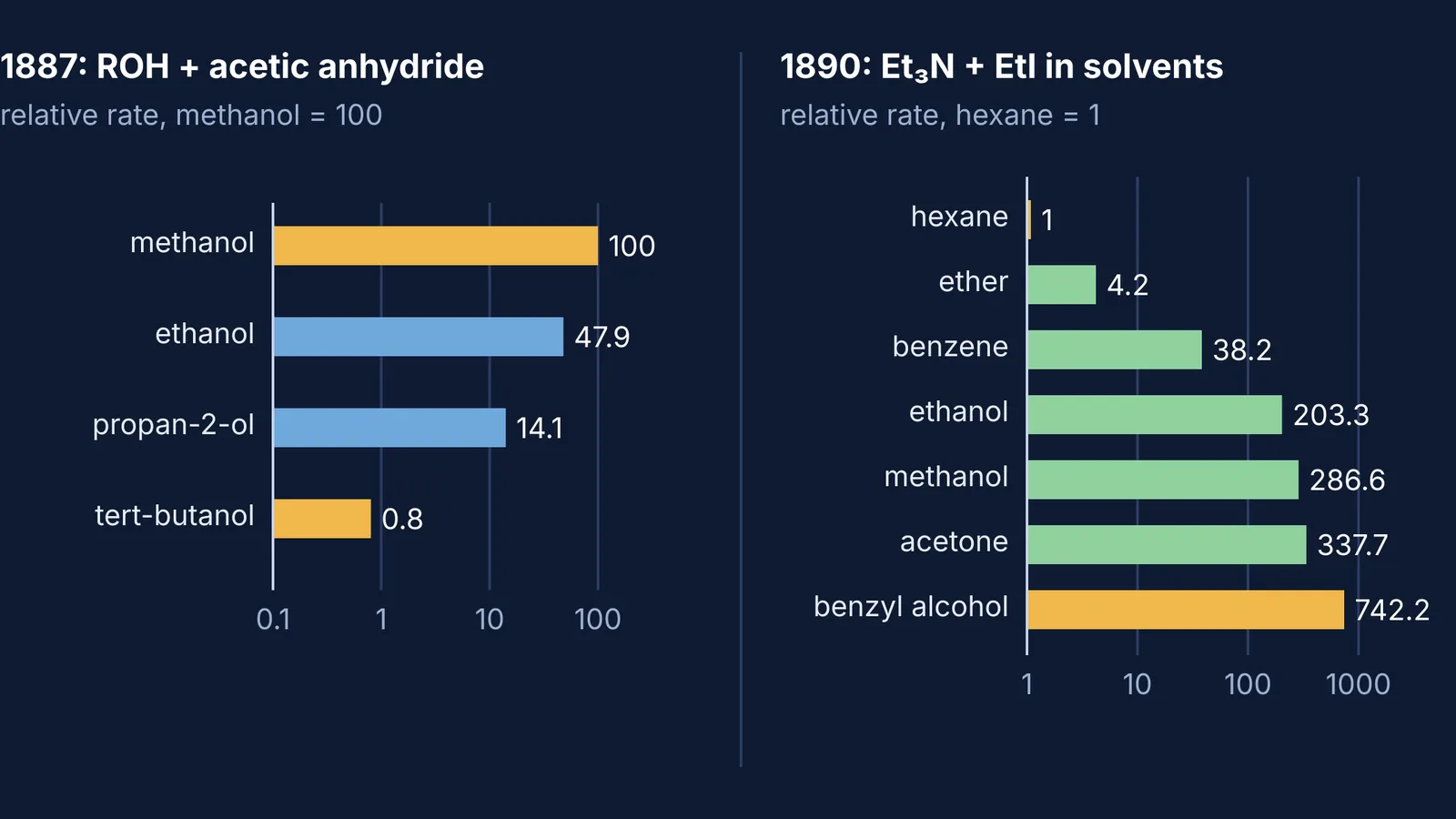
In 1887, in the first volume of the Zeitschrift für physikalische Chemie, St Petersburg chemist Nikolai Menshutkin (he signed in German as N. Menschutkin) published rate constants for acetic anhydride reacting with 19 alcohols. Methanol was the fastest and tert-butanol the slowest, about 116 times slower. In 1890 he took a different reaction, triethylamine with ethyl iodide, ran it in 23 solvents and found it went 742 times faster in benzyl alcohol than in hexane. The first table is the 1° > 2° > 3° esterification order you learn. The second reaction now carries his name, and it showed that a solvent changes how fast a reaction goes.
Quotes are from his papers in Z. phys. Chem. 1 (1887) 611–630 (scan on the Internet Archive) and Z. phys. Chem. 6 (1890) 41 onwards (scan), translated from German by us. The journal's title page lists "D. Mendelejew und N. Menschutkin in St. Petersburg" among its contributors.
How did Menshutkin measure the speed of esterification?
He used an anhydride, so the reaction goes to completion:
(CH₃CO)₂O + C₂H₅OH → CH₃COOC₂H₅ + CH₃COOH
He mixed equal moles of anhydride and alcohol with 15 volumes of dry benzene, sealed the mixture in small tubes and heated them in a glycerol bath at 100 °C. At set times he cooled a tube, smashed it in a stoppered bottle with water and waited 24 hours. Leftover anhydride then became acid, (CH₃CO)₂O + H₂O → 2CH₃COOH, and he titrated all the acid with baryta water and phenolphthalein.
Unreacted anhydride gives two acids, reacted anhydride only one, so the titre falls from 2 to 1 per anhydride as the reaction goes. His blank test: 0.327 g of anhydride should give 0.3847 g of acetic acid, and he found 0.3845 g, 99.94%.
What did his table show about 1°, 2° and 3° alcohols?
His summary table gives k at 100 °C, with methanol = 100 in brackets:
Methanol: 0.1053 (100)
Ethanol: 0.0505 (47.9)
Propan-1-ol: 0.0480 (45.6)
Isobutyl alcohol: 0.0401 (38.1)
Cetyl alcohol, C₁₆: 0.0269 (25.5)
Myricyl alcohol, C₃₀, from carnauba wax: 0.0174 (16.5)
Benzyl alcohol: 0.0280 (26.6)
Propan-2-ol: 0.0148 (14.1)
Butan-2-ol: 0.0123 (11.6)
tert-Butanol: 0.00091 (0.8)
"Of all the alcohols, methyl alcohol shows the largest rate constant," he wrote. Every primary alcohol beat every secondary one. For tertiary alcohols the method was "not suitable", because "the esters of these alcohols are decomposed on heating by the free acetic acid that forms." Even so, tert-butanol was only 25.0% esterified after 6 hours.
The modern reason: the alcohol's oxygen attacks a carbonyl carbon of the anhydride through a crowded tetrahedral intermediate, and branches next to the OH get in the way. The Taft numbers behind this are in why bulky acids and alcohols esterify slowly.
Which rate law did he assume, and does it fit?
He assumed one alcohol meets one anhydride: rate = k[anhydride][alcohol], second order overall. With equal starting amounts this integrates to x/(1 − x) = k′t, where x is the fraction reacted and k′ is k times the starting concentration. His tables list k′ with t in minutes, so his numbers have the unit min⁻¹.
Test it with his propan-2-ol run: 23.8% reacted at 20 minutes, 77.5% at 240 minutes.
Second order at 20 min: 0.238 ÷ 0.762 = 0.3123, and 0.3123 ÷ 20 = 0.0156 min⁻¹.
Second order at 240 min: 0.775 ÷ 0.225 = 3.444, and 3.444 ÷ 240 = 0.0144 min⁻¹. Nearly constant.
First order at 20 min: ln(1 ÷ 0.762) ÷ 20 = 0.0136 min⁻¹.
First order at 240 min: ln(1 ÷ 0.225) ÷ 240 = 0.0062 min⁻¹. It halves, so first order does not fit.
Worked example 1: relative rates and half-lives
For a second-order reaction with equal starts, x = 0.5 gives 1 = k′t½, so t½ = 1 ÷ k′.
Methanol: t½ = 1 ÷ 0.1053 = 9.5 min.
Ethanol: 1 ÷ 0.0505 = 19.8 min. Relative rate 0.0505 ÷ 0.1053 = 0.480, his 47.9.
Propan-2-ol: 1 ÷ 0.0148 = 68 min.
tert-Butanol: 1 ÷ 0.00091 = 1099 min, about 18 hours.
Methanol versus tert-butanol: 0.1053 ÷ 0.00091 = 116.
Unlike first order, this half-life depends on the starting amount: halve the concentration and t½ doubles.
Why did benzyl alcohol speed up the Menshutkin reaction 742 times?
The 1890 reaction makes a salt from two neutral molecules:
(C₂H₅)₃N + C₂H₅I → (C₂H₅)₄N⁺ I⁻
He again used 15 volumes of solvent and 100 °C. Relative to hexane = 1, his values include diethyl ether 4.2, benzene 38.2, ethyl acetate 123.9, ethanol 203.3, methanol 286.6, acetone 337.7, acetophenone 718.7 and benzyl alcohol 742.2. In his words, if the combination goes "with the speed = 1" in hexane, "the same combination takes place in benzyl alcohol solution with 742.2 times the speed."
He did not explain it with charges. He concluded that the change in speed "is determined by their composition and chemical structure", and repeated his 1887 line that a reaction "cannot, so to speak, be separated from the medium in which it takes place."
Why does a polar solvent speed up a reaction that makes ions?
The Menshutkin reaction is SN2. The nitrogen lone pair attacks the CH₂ carbon from the back as iodide leaves, in one step, so rate = k[Et₃N][EtI], the same second-order law Menshutkin fitted. In the transition state, Et₃N···C···I, the nitrogen is becoming positive and the iodine negative. Charge is being created.
A polar solvent lines up its dipoles around those partial charges, lowering the transition state's energy more than that of the neutral reactants. The activation energy drops and the rate rises.
With an anionic nucleophile, as in OH⁻ + CH₃Br, it is the opposite: charge spreads out in the transition state, and a protic solvent that hydrogen-bonds to the anion slows the reaction. That case is covered in polar protic vs aprotic solvents in SN1 and SN2.
Worked example 2: half-lives in hexane and benzyl alcohol
His constants: hexane 0.000180, ethanol 0.0366, benzyl alcohol 0.133.
Hexane: t½ = 1 ÷ 0.000180 = 5556 min, about 93 hours or 3.9 days.
Ethanol: 1 ÷ 0.0366 = 27 min.
Benzyl alcohol: 1 ÷ 0.133 = 7.5 min.
Ratio: 0.133 ÷ 0.000180 = 739, close to his 742.2 from unrounded constants.
Where does this come up in JEE and NEET?
Class 12, Alcohols: esterification and ranking alcohols by rate.
Class 12, Amines: alkylation by alkyl halides ends in a quaternary ammonium salt; the last step is the Menshutkin reaction.
Class 12, Chemical Kinetics: rate constant and half-life. The second-order law is a JEE extension, covered in [how to recognise a second-order reaction from a 1/[A] plot](https://news.fermi.ai/academic-success/second-order-kinetics-1-over-a-plot).
To practise turning rate data into k and t½, the Fermi Problem Library has a step-by-step solver that explains the reasoning. For exam-style practice on these chapters, Fermi Test Prep covers JEE Main and Advanced preparation with an AI tutor.
Quick checklist
1887: 19 alcohols with acetic anhydride; methanol is 116 times faster than tert-butanol.
Second order with equal starts: x/(1 − x) = k′t and t½ = 1/k′.
1890: Et₃N + EtI → Et₄N⁺I⁻, 742.2 times faster in benzyl alcohol than in hexane.
A polar solvent speeds a reaction whose transition state is more polar than its reactants.