On this page
In 1909 two chemists announced that optically pure hyoscyamine should rotate polarised light by 32.1°. The hyoscyamine chemists actually made read about −21°. If both numbers were right, the trade was selling a base with roughly a third of it present as atropine, its racemate. In 1910 Francis Howard Carr and William Colebrook Reynolds, of the Wellcome Chemical Works at Dartford, Kent, showed that the two numbers were never measuring the same thing. Their paper is "The Specific Rotatory Power of Hyoscyamine and the Relation between that of Alkaloids and their Salts", J. Chem. Soc. Trans. 97, 1328–1336. We read it in the scanned 1910 volume and checked its numbers against the page images. This post covers the stereochemistry only, not how the alkaloid acts in the body.
How are hyoscyamine and atropine related?
They are the same compound, C₁₇H₂₃NO₃, in two optical forms. Hyoscyamine is an ester of an alcohol, tropine, and an acid, tropic acid (3-hydroxy-2-phenylpropanoic acid). PubChem names the natural l-form as the (2S)-ester. Atropine, PubChem CID 174174, carries no label at that carbon, because it is the 50:50 mixture of the (S) and (R) esters.
Atropine is racemic hyoscyamine. It is not a different alkaloid, and it is not the "d-form". Carr and Reynolds made d-hyoscyamine by splitting atropine with d-camphorsulphonic acid.
Only one carbon gives the mirror-image pair. It is the tropic-acid carbon carrying H, C₆H₅, CH₂OH and the ester group.
The tropine half is achiral. Its two bridgehead carbons are stereocentres, but a mirror plane runs through N and C-3, so tropine is superimposable on its mirror image, like a meso compound.
If a racemate still feels slippery, our guide to racemic mixtures and their resolution covers the basics.
Why did Barrowcliff and Tutin predict 32.1°?
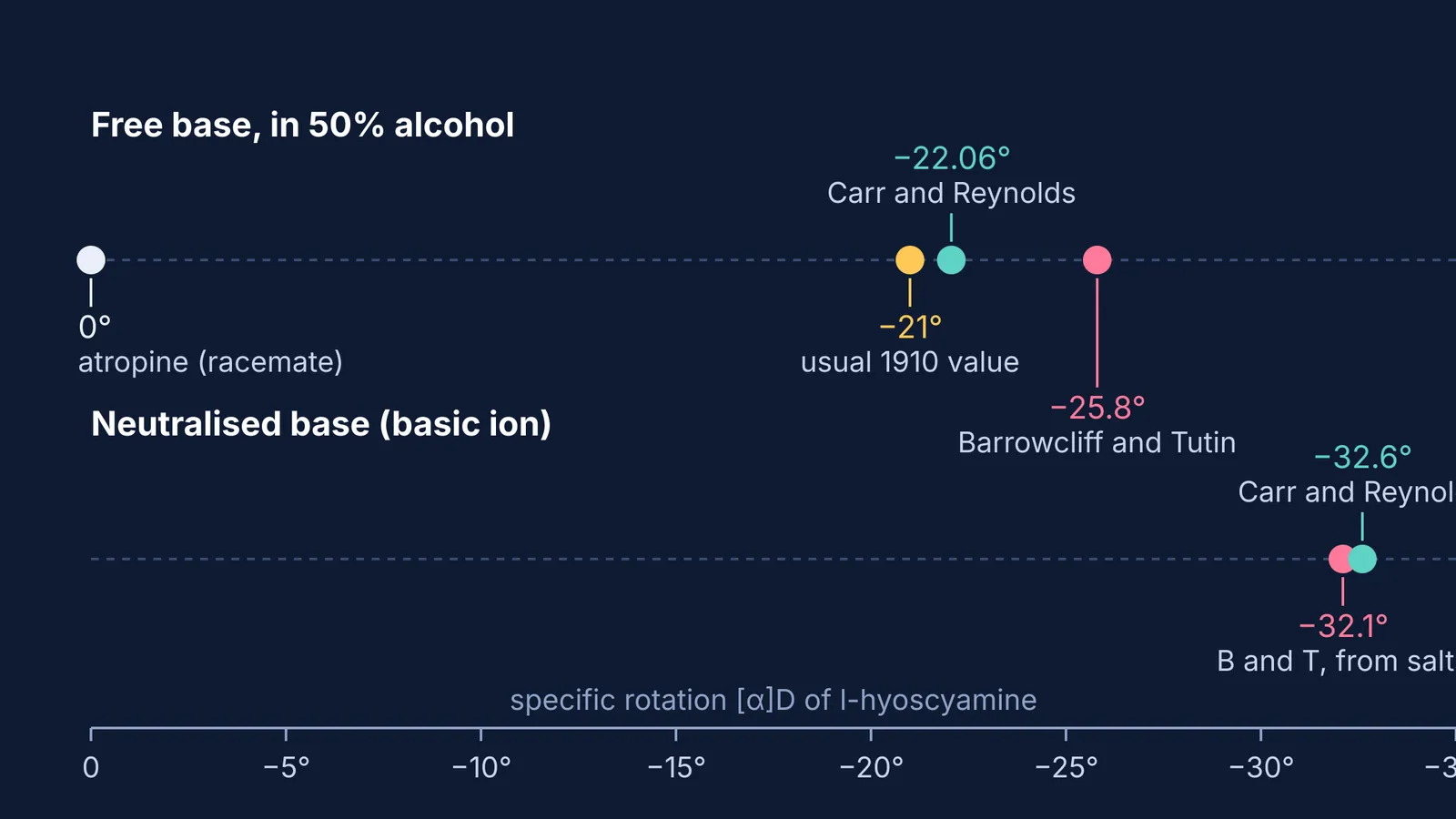
Barrowcliff and Tutin (Trans. 1909, 95, 1966) did not measure the base directly. They measured the d-camphorsulphonate salts in water. A salt in water is split into ions, so they took the salt's molar rotation, subtracted the share belonging to the camphorsulphonate ion, and divided what was left by the mass of the base. That gave "[α]D ±32.1°" for pure hyoscyamine. Their highest crystallised fraction read only −25.8°, so they blamed "unavoidable racemisation occurring in the process of the regeneration of the base".
The hidden assumption was that the free base and the basic ion in its salts rotate light equally. Carr and Reynolds tested exactly that.
What did Carr and Reynolds measure?
They crystallised the camphorsulphonate from acetone until nothing changed, set the base free with ammonia, and recrystallised it twelve times from light petroleum. "During the last six crystallisations, the specific rotatory power was only increased by 0·1°, this substance must be regarded as pure." It melted at 107–108° and gave [α]D −22.06° in 50% alcohol.
Then they neutralised the same base with four different acids. In water it now gave −32.6° with sulphuric acid, −32.4° with sulphurous and hydrochloric acids, and −32.5° with acetic acid. That is Barrowcliff and Tutin's number, reached from a base reading −22°. Both values belong to pure l-hyoscyamine: −22° is the free amine, and about −32.5° is the protonated amine, the "basic ion".
The acetic acid row also explains the −25.8°. Barrowcliff and Tutin had added "a small amount of acetic acid" to their alcohol to stop it being alkaline. Their solution "therefore probably contained a partly neutralised base", which reads higher than the free base.
Worked example: specific rotation and optical purity
Use [α] = α ÷ (l × c), with l in dm and c in g/mL.
The pure base. 1 g made up to 25 mL gives c = 0.04 g/mL. In a 2 dm tube, α = −1.765°. [α] = −1.765 ÷ (2 × 0.04) = −22.06°. Their second run, 4 g in 20 mL in a 1 dm tube with α = −4.41°, gives −22.05°, so dilution changes nothing.
The same base neutralised. 4.015 g per 100 mL (c = 0.04015), 2 dm, α = −2.62°. [α] = −2.62 ÷ 0.0803 = −32.6°, calculated on the mass of base.
A −21° sample judged against −32.1°. Optical purity = 21 ÷ 32.1 = 65.4%, so ee = 65.4%. l = (100 + 65.4) ÷ 2 = 82.7% and d = 17.3%. The racemic part is 2 × 17.3 = 34.6% atropine.
The same sample judged against −22.0°. Optical purity = 21 ÷ 22.0 = 95.5%. l = 97.7%, d = 2.3%, and atropine is only 4.5%.
The trap in one line. Compare even a perfectly pure base (−22.0°) with the ion's −32.5° and you get 22.0 ÷ 32.5 = 67.7% "purity". A pure sample would appear to be one-third racemate.
They also checked the regeneration step for racemisation. A camphorsulphonate reading −7.2° in 7.5% water solution was turned into base (−22.3°), and 1 g of that base was recombined with 0.8408 g of d-camphorsulphonic acid. The solution held the equivalent of 1.803 g of salt in 25 mL and read −1.11° in a 2 dm tube. [α] = −1.11 ÷ (2 × 0.07212) = −7.70°, which they printed as −7.7°. As a check, 1 g of base (M = 289.4) and the anhydrous acid (232.3) give 1 × 521.7 ÷ 289.4 = 1.803 g of salt. The paper concludes that hyoscyamine "does not, after all, possess any considerable susceptibility to racemisation". (Why a base can racemise it at all is textbook chemistry, not something this paper discusses. The H on the tropic-acid carbon sits next to the ester C=O, so base can remove it, and the flat enolate can be protonated from either face.)
Why should a base and its salt rotate light differently?
Rotation depends on the whole molecule, not only on the stereocentre. Adding H⁺ to the nitrogen changes the charge, the electron cloud and how the solvent surrounds the molecule. Carr and Reynolds put it in the language of 1910: in the salt the nitrogen is "quinquevalent", while in the free base "it functions as tervalent even in aqueous solution". Today you would say R₃N and R₃NH⁺.
They found the same base-against-ion gap in cocaine, codeine, hydrastine, nicotine and quinine. Hydrastine showed how far the solvent can push it: dextrorotatory in 50% alcohol, inactive in 95% alcohol and laevorotatory in pure alcohol. So the sign of rotation tells you nothing about R or S.
For more on the formula and practice sets, see enantiomeric excess from specific rotation. Another alkaloid story, where a racemate was split with a chiral acid, is Ladenburg's coniine resolution. If chirality, meso forms and optical activity need a full lesson, the Concept Library covers each one with its place in the map.
Where does this appear in JEE and NEET?
Class 12 Haloalkanes (stereochemistry): optical activity, enantiomers, racemic mixtures and racemisation.
Numericals: [α] = α ÷ (l × c), optical purity = observed [α] ÷ pure [α], and % of each enantiomer = (100 ± ee) ÷ 2.
For timed JEE Main and Advanced practice on these chapters, Fermi Test Prep offers preparation with an AI tutor.
Quick checklist
Atropine is racemic hyoscyamine; only the tropic-acid carbon makes the pair.
Tropine has stereocentres but a mirror plane, so it is achiral.
Pure l-hyoscyamine base: [α]D −22.0° in 50% alcohol. Its basic ion: about −32.5° in water.
Against −32.1°, a −21° sample looks 34.6% atropine; against −22.0°, it is 4.5%.
Compare like with like: same species, same solvent, same wavelength.