On this page
In 1908 William Bone and Hubert Coward passed a slow stream of pure, dry hydrogen over about a tenth of a gram of purified sugar charcoal at 1100–1200 °C for up to 37 hours, and turned as much as 73% of the carbon into methane. Their paper, "The Direct Union of Carbon and Hydrogen. Synthesis of Methane", J. Chem. Soc. Trans. 93, 1975–1993, answered two critics who said C + 2H₂ → CH₄ could not happen at those temperatures. It is also a clean Class 11 lesson: thermodynamics favours methane when it is cold, yet the experiment only works when it is hot.
Quotes and figures here come from the paper, read in the scanned 1908 volume. It is signed from the University of Leeds (Fuel and Metallurgical Department) and Manchester University (Chemical Department).
Who said carbon and hydrogen would not combine?
In 1897 Bone and D. S. Jerdan had reported that "at a temperature of 1200°, or thereabouts, carbon unites directly with hydrogen to form methane". Two challenges followed.
Berthelot, 1905. Marcellin Berthelot heated a few hundredths of a gram of purified carbon in hydrogen at 1325 °C for an hour in a sealed quartz tube and saw no union. He added that in 50 years of trials he had never rigorously observed it with truly pure carbon. Bone and Coward's objection was the tube: Berthelot "acknowledged that between 27 and 40 per cent. of the hydrogen escaped out of the tubes during the hour".
Mayer and Altmayer, 1907. They studied C + 2H₂ ⇌ CH₄ over nickel or cobalt at 475–625 °C, fitted an equilibrium formula and extrapolated it to 850 °C, where it predicted only 1.59% methane. On that basis they suggested Bone and Jerdan's methane came from impurities in the carbon.
Their reply was to "convert a small quantity of highly purified carbon quantitatively, or nearly so, into methane". Most of a sample cannot be impurity.
How did Bone and Coward rule out impurities?
Carbon. Sugar charcoal was heated in dry chlorine for days (one batch for 296 hours at 650 °C), then in hydrogen. It held under 0.1% hydrogen.
Hydrogen. Made by electrolysis at about 0.95 litre per hour and dried; in one run it passed through a spiral cooled in liquid air.
Blanks. Hydrogen through the hot, empty tube gave only 0.006 to 0.03% methane.
Analysis. Palladium foil soaked up most of the hydrogen from a litre of exit gas, and the methane left behind was measured by explosion with oxygen.
Subtraction. In each of three 0.086 g runs they deducted the most methane the hydrogen could have carried (1.4 to 2.3 mL) and the most any impurity could give (0.4 mL). That left 92 to 99 mL per run made from carbon and hydrogen.
One detail matters. The carbon in the main runs carried 10 to 15 per cent of finely divided platinum, which made it more active: in a side-by-side test at 1150 °C, the first hour's gas held 0.75% methane with platinum and 0.35% without. Platinum sped the reaction up, but methane formed without it too.
How much of the carbon became methane?
The final four experiments made 422 mL of methane, "measured at about 20—22° and at atmospheric pressure", from 0.3062 g of carbon. The paper calls this 68.5% of the 616 mL possible. Check it yourself.
Moles of carbon. 0.3062 ÷ 12.011 = 0.02549 mol.
Equation. C + 2H₂ → CH₄. One C and four H on each side, so 1 mol of carbon gives 1 mol of methane.
Volume at 0 °C and 1 atm. 0.02549 × 22.414 L = 0.5714 L.
Correct to 21 °C. At constant pressure V ∝ T, so 571.4 × 294.15 ÷ 273.15 = 615 mL. The paper says 616.
Fraction converted. 422 ÷ 616 = 0.685, or 68.5%.
Read 68.5% carefully. It is the fraction of carbon converted in a flowing system over many hours, not an equilibrium yield. The paper says carbon monoxide in the exit gas, formed when methane attacked the glaze of the hot porcelain tube, accounted for the missing carbon.
Why does low temperature favour methane?
Use NIST values: ΔfH° of methane gas is −74.87 kJ mol⁻¹, and S° is 186.25 J K⁻¹ mol⁻¹ for methane, 130.68 for hydrogen and about 5.6 for graphite.
ΔH° = −74.87 kJ. The reaction is exothermic.
ΔS° = 186.25 − (2 × 130.68) − 5.6 = −80.7 J K⁻¹. It is negative because 2 mol of gas become 1 mol.
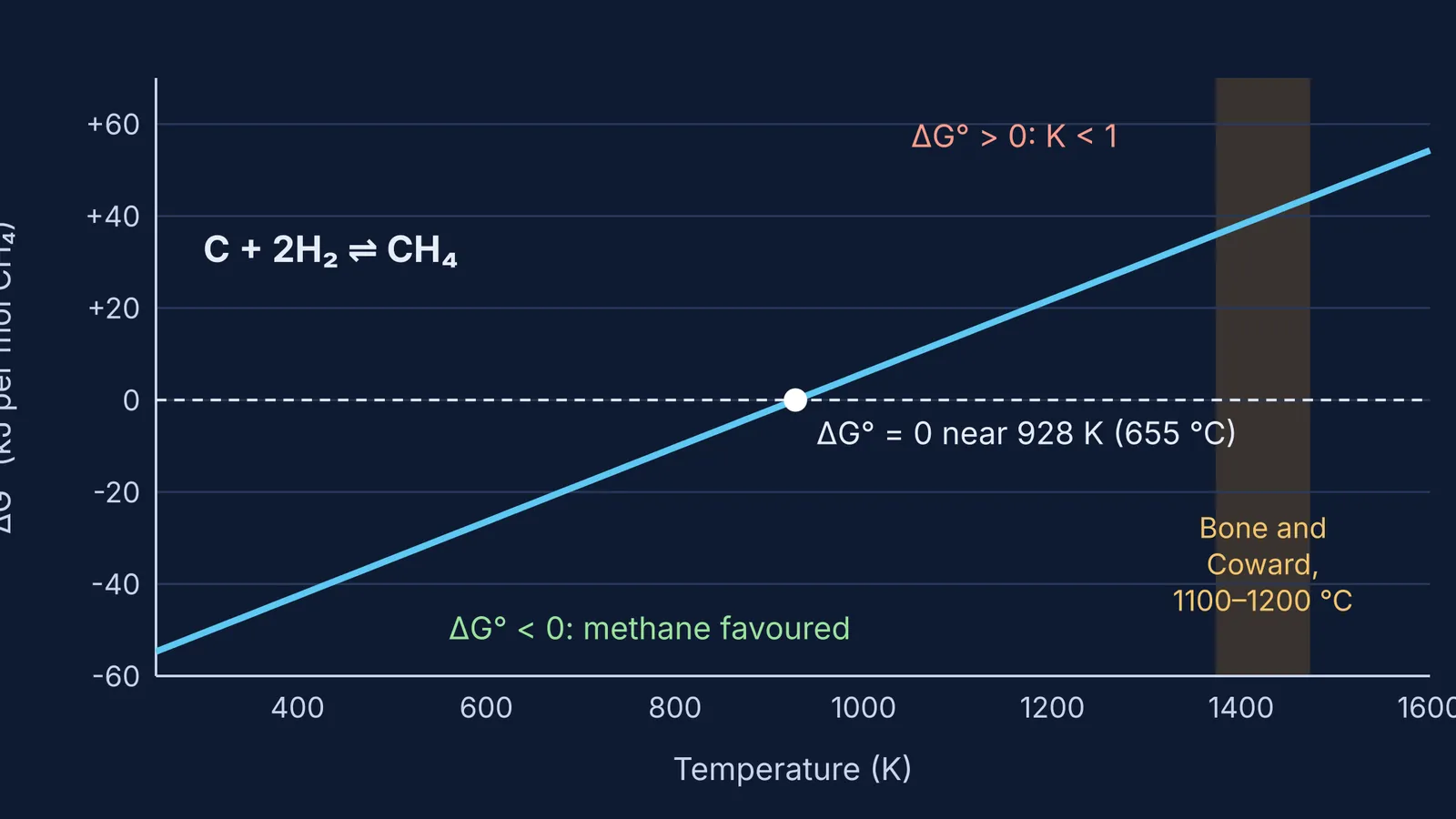
ΔG° = ΔH° − TΔS° = −74.87 + 0.0807T kJ.
At 298 K, ΔG° = −50.8 kJ, so K ≈ 8 × 10⁸. Methane is strongly favoured.
Crossover. ΔG° = 0 when T = 74 870 ÷ 80.71 ≈ 928 K, about 655 °C.
Above 928 K, ΔG° is positive. At 1100 °C (1373 K) it is roughly +36 kJ, so K < 1.
This treats ΔH° and ΔS° as constant, so take 928 K as an estimate. The method is the one in finding the temperature at which a reaction becomes spontaneous. For more problems of this "above or below what temperature" kind, the Fermi Problem Library has a step-by-step solver that explains the reasoning.
If methane is favoured cold, why heat the carbon to 1100 °C?
ΔG° tells you where a reaction is heading, not how fast. At room temperature K is huge, but solid carbon and the strong H–H bond react too slowly to measure. Rate rises steeply with temperature, so Bone and Coward needed heat.
The price is a small K. Above 928 K methane is only a minor part of an equilibrium mixture, though minor is not zero. Their exit gas never held more than about 0.9% methane. The flow saved them: fresh hydrogen kept sweeping methane away, so the gas over the carbon never reached equilibrium. With Q below K, ΔG = ΔG° + RT ln Q stays negative and the forward reaction keeps going. Over 35 hours those small percentages added up to most of the carbon.
Bone and Coward said this themselves: "the question of the condition of equilibrium" at 1100–1200 °C "is not considered in this paper". Mayer and Altmayer's 1.59% at 850 °C and a rough estimate from 298 K data do not agree, and neither has been checked here against high-temperature tables. So this post gives no equilibrium percentage.
What does pressure do to C + 2H₂ ⇌ CH₄?
Carbon is a solid, so it does not appear in Kp: Kp = p(CH₄) ÷ p(H₂)². The change in gas moles is Δn = 1 − 2 = −1.
Double the total pressure of an equilibrium mixture. Each partial pressure doubles, so the top of the fraction doubles and the bottom goes up four times: Q = K ÷ 2. With Q < K, the reaction moves forward to make more methane. This is the Le Chatelier reasoning used for ammonia in why the Haber process uses 450 °C and 200 atm. Pressure moves the position; only temperature changes K.
Quick checklist
Bone and Coward (1908) made 422 mL of CH₄ from 0.3062 g of carbon, 68.5% of 616 mL, and 73% in two runs.
68.5% is carbon converted in a flow, not an equilibrium yield.
ΔS° ≈ −80.7 J K⁻¹ and ΔG° = 0 near 928 K; above it ΔG° > 0.
Heat is for rate; removing methane keeps Q < K.
Δn = −1, so pressure pushes the equilibrium towards methane.