On this page
Young Athlete is Chapter 15 of Khel Praveen, the NCERT Class 9 Physical Education and Well-being book (First Edition, April 2026). It sits in the book's Unit 4, Sports for All, and asks one practical question: how do children and teenagers play serious sport while their bodies are still growing?
What is the Young Athlete chapter about?
The chapter opens with Swami Vivekananda's view that a fit body supports a strong mind, then covers four ideas:
Youth participation and health. Participation grows every year, and many young athletes train year-round, sometimes in one sport. Asthma, heart defects or Type 1 diabetes can first come to light once regular training starts, so the book stresses health checks, warm-ups, rest, injury care, and balanced food and water.
Growth and performance. Height, weight, strength and coordination develop at uneven speeds.
A level playing field. Same-age players can differ a lot in size.
Early specialisation. Committing to one sport very young.
This is a study summary, not medical advice; a doctor or qualified coach should guide real training and health decisions.
How does growth change performance in young athletes?
Khel Praveen names two teenage champions: Simone Biles, a gymnastics champion at 16, and Alina Zagitova, an Olympic gold medallist at 15. Its bigger point: most people improve gradually and peak in their early 20s.
Key terms:
Aerobic capacity: how well the heart and lungs supply oxygen during activity. It rises with growth and training.
Anaerobic capacity: the ability to produce short bursts of power, as in a sprint or a jump. It rises as muscles strengthen.
Maturity timing: below about age 12, maturing early or late makes little difference. In adolescence, early maturers are often stronger and faster, which helps in football, hockey and rugby.
Strength and puberty: before puberty, boys and girls have similar strength; during and after it, boys add more muscle mass.
To keep contests fair and safer, some sports group players by weight, not by age alone. The book gives rugby and combat sports as examples.
Is early specialisation good or bad?
The book presents a debate. Some coaches see an early, serious start in one sport as the route to stardom; many experts point to the costs. The chapter lists five risks:
Overuse injuries from repeating the same movements.
Burnout or losing interest.
Less time with friends, and social isolation.
Leaning too heavily on a coach or parent.
Stunted growth or delayed development.
Its recommendations: try several sports, keep unstructured free play, avoid overtraining, build general strength only under supervision, and make sure adults protect young players from pressure, bullying and abuse. The book adds that many top athletes chose one sport only in their teens.
How much training is too much for your age?
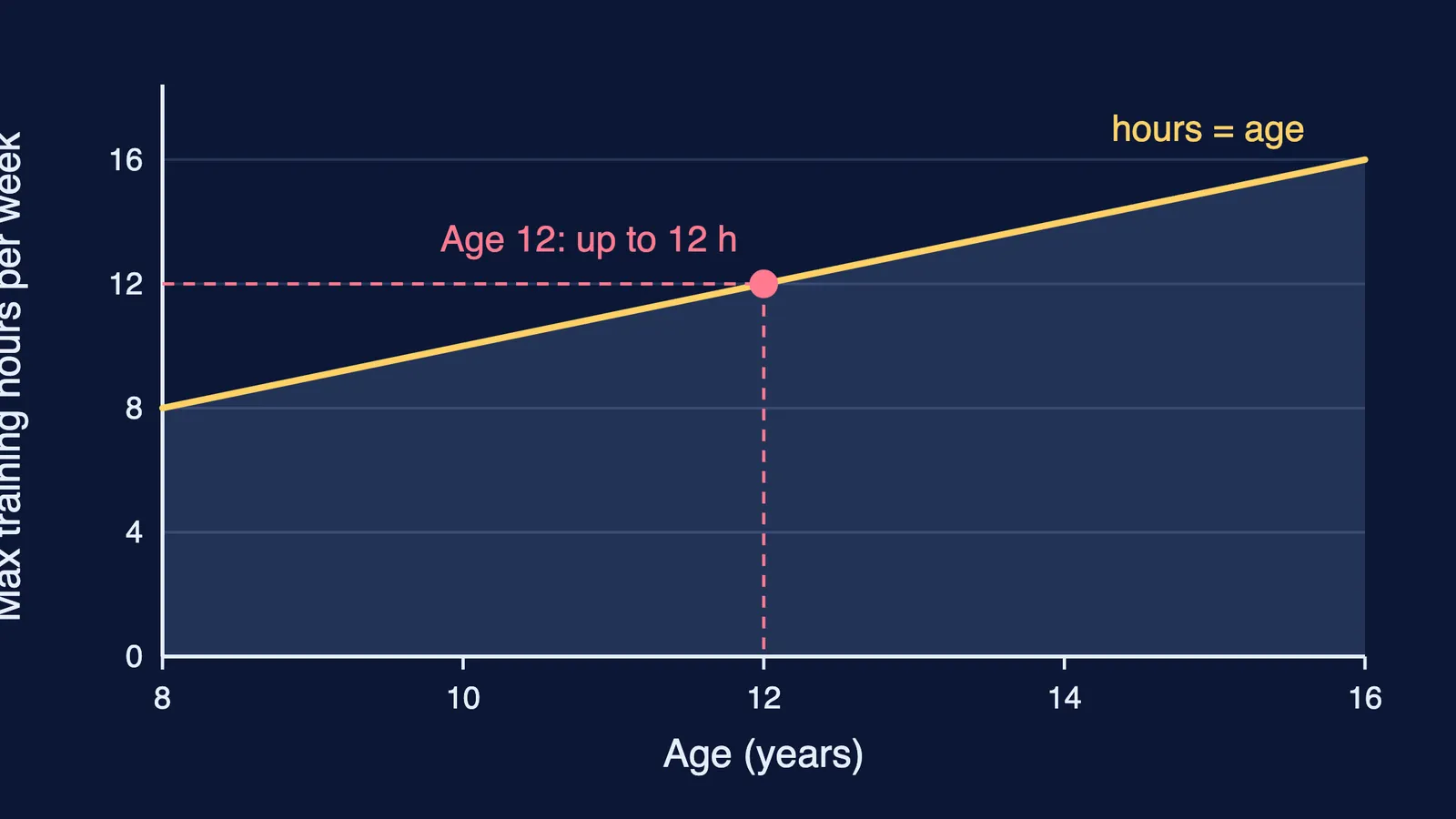
Under balanced training, the book gives a simple rule: a young athlete's weekly training hours should not exceed their age in years. Its example is a 12-year-old, who should stay at or under 12 hours a week. The chart above draws that line.
Worked example, using two invented players. We count matches and tournaments as training; the book does not say.
Meera, 13, badminton: five 2-hour sessions (10 hours) plus a 4-hour weekend tournament gives 14 hours. Her limit under the book's rule is 13, so she is 1 hour over.
Kabir, 15, football: four 1.5-hour sessions (6 hours), a 2-hour match and 2 hours of supervised strength work gives 10 hours. His limit is 15, so he is 5 hours under.
By the book's rule, Meera's week is over the limit and Kabir's is within it.
How is Young Athlete assessed in Class 9 PE?
Physical Education and Well-being is assessed in school. The CBSE 2026-27 curriculum gives theory 20 marks and practical 80 marks. In theory, every unit carries 2 marks (2 × 8 units = 16 marks), and a viva carries 4 marks.
The curriculum has eight units; the book has six. Curriculum Unit 5, Sports for All, matches the book's Unit 4 by name but does not list young athletes; its Unit 3 lists Growth and Development. A unit's 2 marks are not split by chapter, so no figure belongs to this chapter alone.
Read next: children and women in sports for Class 12 and psychology and sports in Class 11, including adolescence.
Practice questions
Mark values are our suggestion, not CBSE's.
Define anaerobic capacity and give one sporting example. (1 mark)
Name two sports the book says group players by weight. (1 mark)
A 14-year-old trains 3 hours on four days and plays a 3-hour match. Does this meet the book's rule? Show the sum. (2 marks)
Why might an early-maturing 13-year-old have an advantage in hockey, and why could that be unfair? (2 marks)
Give three risks of early specialisation and one way the book suggests reducing them. (3 marks)
Answer to Q3: 4 × 3 = 12 hours, plus 3 hours = 15 hours, which is 1 hour over the limit of 14.
Juggling practice with homework? Fermi's AI tutor works out what you already know and builds a plan for the session.