On this page
Unit 2 of CBSE Class 12 Physical Education, Children and Women in Sports, is still on the syllabus. The official CBSE Physical Education (048) curriculum for 2026-27 lists it as Unit 2 with 7 theory marks.
What is in Unit 2 Children and Women in Sports?
The CBSE curriculum names five topics:
Exercise guidelines of WHO for different age groups
Common postural deformities (knock knees, flat foot, round shoulders, lordosis, kyphosis, scoliosis and bow legs) and their corrective measures
Women's participation in sports: physical, psychological and social benefits
Special considerations: menarche and menstrual dysfunction
Female athlete triad: osteoporosis, amenorrhoea and eating disorders
The listed learning outcomes include classifying common postural deformities and identifying corrective measures.
What are the WHO exercise guidelines for different age groups?
The current figures come from the 2020 WHO guidelines, summarised by Bull and colleagues in the British Journal of Sports Medicine.
Children and adolescents (5-17 years): an average of 60 minutes a day of moderate-to-vigorous activity across the week, mostly aerobic, with vigorous activity and muscle- and bone-strengthening activity on at least 3 days a week.
Adults (18-64 years): 150-300 minutes of moderate activity or 75-150 minutes of vigorous activity a week, plus muscle-strengthening on 2 or more days.
Pregnant and postpartum women (with no medical reason to avoid it): at least 150 minutes of moderate aerobic activity through the week.
For 5-17 year olds the 60 minutes is a weekly average, not a fixed daily minimum. The WHO physical activity fact sheet also covers separate guidelines for children under 5.
What are the common postural deformities and their corrective measures?
The descriptions and corrective measures below follow the KVS ZIET Mysuru Class 12 support material, which says these measures should always be done under the supervision of a doctor or physiotherapist.
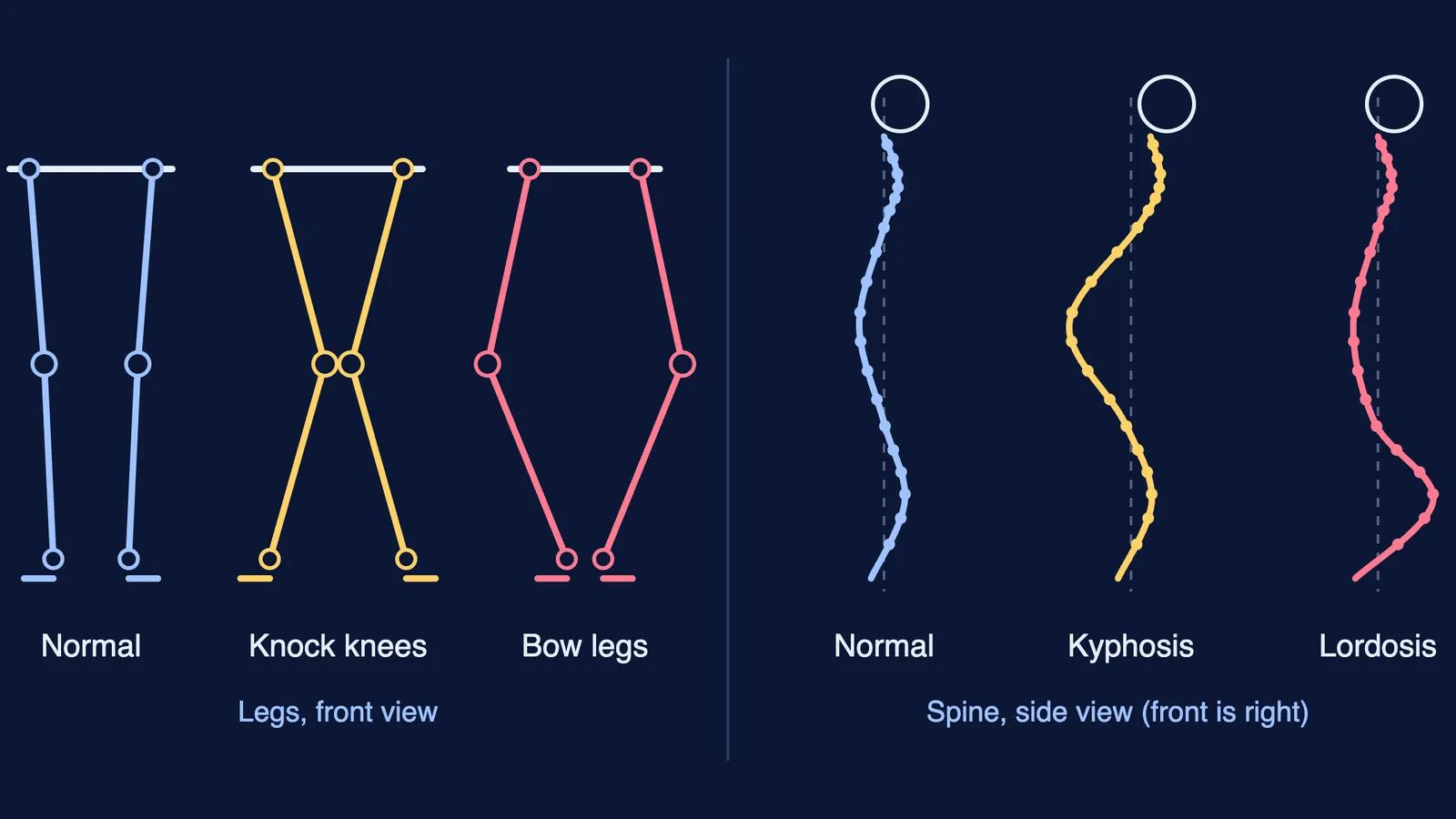
Knock knees (genu valgum): knees touch or angle inward while the ankles stay apart, so the legs form an "X". Textbook measures: leg exercises, horse riding, yoga and weight reduction.
Bow legs: legs curve outward at the knees, the opposite of knock knees. Common in toddlers and may correct on its own. Textbook measures: braces, proper shoes and a healthy diet.
Flat foot: the foot has no arch and the full sole touches the ground. Textbook measures: toe exercises, walking on toes, yoga and massage.
Round shoulders: shoulders bend forward. Textbook measures: stretching, back exercises and Chakrasana.
Kyphosis (hunchback): the upper back curves outward too much. Textbook measures: back-strengthening exercises and Bhujangasana.
Lordosis (sway back): an excessive inward curve of the lower (lumbar) spine. Textbook measures: pelvic exercises, wall pushbacks and yoga.
Scoliosis: the spine bends sideways in a "C" or "S" shape. Textbook measures: side-stretching, hanging from bars and Trikonasana.
A memory trick: knock knees make an "X", bow legs make an "O", kyphosis bends the upper back out, lordosis bends the lower back in, and scoliosis is the only one that bends sideways. If long hours at a desk leave you sore, our guide on how to sit while studying covers everyday setup.
Why does women's participation in sports matter?
The curriculum asks for physical, psychological and social benefits. The KVS material lists stronger bones and lower risk of lifestyle diseases (physical); stress management, confidence and self-esteem (psychological); and teamwork, communication and cooperation (social).
There is a real gap to close. The WHO fact sheet reports that among 11-17 year olds, 28% of girls against 22% of boys reported no active days in the last week (an active day means at least 60 minutes of moderate-to-vigorous activity). Globally, women are less active than men by an average of five percentage points.
What is the female athlete triad?
The 2014 Female Athlete Triad Coalition consensus statement defines it as a medical condition in physically active girls and women with three parts: low energy availability with or without disordered eating, menstrual dysfunction, and low bone mineral density. The CBSE syllabus names the serious endpoints the statement warns each part can lead to: eating disorders, amenorrhoea and osteoporosis. Write both sets of terms in your answer.
The same unit covers menarche (a girl's first period) and menstrual problems such as amenorrhoea and dysmenorrhoea. Learn the definitions for the exam; for any real concern about periods, eating or energy, talk to a doctor.
How do you write a long answer on this unit?
Use this plan for a long answer on postural deformities:
Define posture in one line.
Name the deformity and say what it looks like.
Draw a quick stick figure, like the hero diagram on this page.
Give two causes and three corrective measures.
End with one line saying corrective work should be supervised by a doctor or physiotherapist.
Units link up, so revise this one alongside Training in Sports for Class 12 and Physical Education and Sports for CWSN. If your science subjects need time too, Fermi's AI tutor can work out what you already know and build a plan for the session, so each revision block starts with a clear next step.