On this page
Chapter 23 of *Khel Praveen*, NCERT's new Class 9 Physical Education and Well-being textbook (First Edition, April 2026), closes Unit 6. It asks how yoga helps you choose well and do your best in studies, sport, art and leadership. It is in the Unit 6 PDF on the NCERT site.
Where does Chapter 23 sit in the 2026-27 syllabus?
The CBSE Grade 9 Physical Education and Well-being curriculum for 2026-27 lists Yoga as Unit 7 (the book calls it Unit 6), with 14 hours: 3 theory, 11 practical. Its topics include personal excellence, memory and concentration, willpower and self-esteem, leadership and responsibility, and creativity and critical thinking.
The subject carries 20 theory and 80 practical marks. In theory, every unit carries 2 marks (MCQ, objective or short answer), so 2 × 8 units = 16, plus a 4-mark viva. Those 2 marks cover the whole yoga unit, shared by Chapters 21 to 23. Your school runs the assessment; there is no board paper.
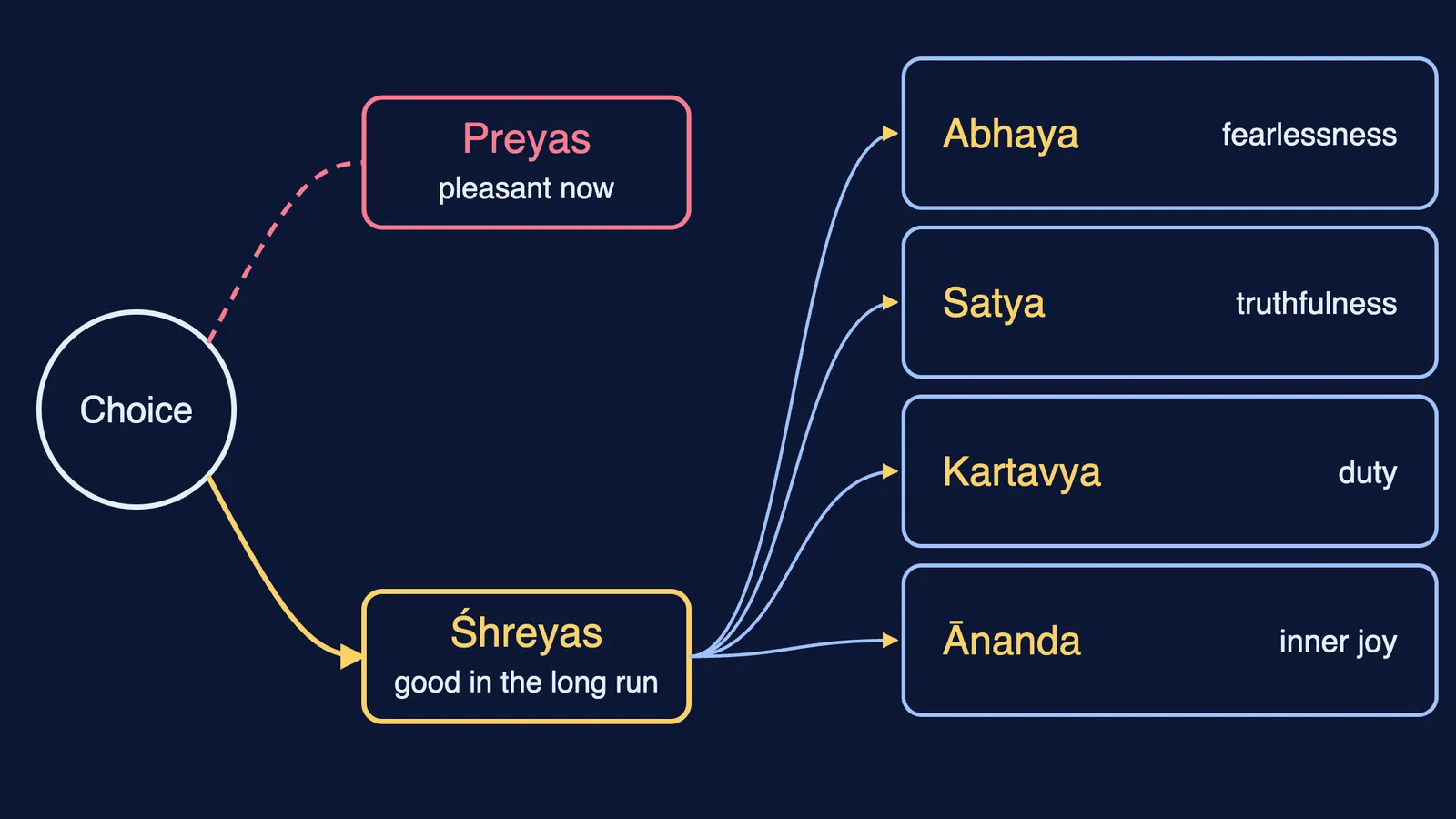
What are Preyas and Śhreyas?
Picture a maths test tomorrow and a phone that keeps lighting up. The book says yogic thought offers two paths here:
Preyas (the pleasant): easy and instantly satisfying, like junk food or endless scrolling. Friendly today, costly tomorrow.
Śhreyas (the good): harder at first because it needs effort (sādhanā) and discipline, but it leads to strength and lasting happiness.
The book defines personal excellence as an ongoing, deliberate choice to grow your abilities, character and skills: a journey, not perfection.
Its central story is Nachiketāḥ, whom Yama tempts with a kingdom, gold, fast chariots and long life so he will stop asking for the highest knowledge. He refuses them as temporary. Excellence starts with saying "no" to distraction.
What are the four pillars of personal excellence?
Choosing Śhreyas repeatedly builds four pillars:
Abhaya (fearlessness): courage, such as resisting peer pressure.
Satya (truthfulness): honesty, including about your limits in a pose.
Kartavya (duty): putting study and service ahead of distractions.
Ānanda (inner joy): lasting calm, unlike the brief thrill of Preyas.
A spelling note: the first edition's pillar diagram prints "Authenatity" and "Futtiliment"; the intended words are authenticity and fulfilment.
How does yoga build focus, energy and willpower?
The chapter traces the struggle to poor awareness and focus, low confidence, narrow goals and distractions, and answers with a bigger purpose plus regular practice. It cites Bhagavad-Gītā 2.50, which calls yoga skill in action, and holds up Chāṇakya and Dr APJ Abdul Kalam as people driven by goals larger than themselves. Then come three shifts:
Ekāgratā (focus): Trāṭaka and prāṇāyāma gather a scattered, lightbulb-like mind into a laser. This is the closest the chapter comes to the curriculum's memory and concentration topic.
Prāṇa (energy): anger, overthinking and scrolling drain you; staying even-minded (samatvam) stops the drain.
Tapas (willpower): holding a pose while your legs tremble teaches you to bear discomfort and recover.
There is no separate section on memory or creativity; creativity gets one example only. A note: an end-of-chapter question asks for "two athletes", but the chapter describes only one, an Olympic shooter.
What is the five-step excellence toolkit?
Each step pairs a trap with a yogic fix:
Tapas (hard work): stay with a dull task for 15 minutes; finish what you start.
Positivity and resilience: take 3 deep breaths before reacting in anger.
Leadership (sevā): leading means serving through selfless action (Karma-Yoga). Help a classmate, volunteer.
Self-confidence (prāṇa): confidence comes from being useful, not from looks. Vīrabhadrāsana, Vṛikṣhāsana and Padmāsana are named here.
Svādhyāya (self-study): ask for feedback; reflect daily.
It adds a 10-minute routine, a six-habit Excellence Tracker, a Sunday Reflection and a seven-day yoga module.
Try it on your week. Pick one real choice, such as sleeping in (Preyas) or the team practice you promised (Śhreyas), and note the pillar and toolkit step involved.
Yoga continues in our Class 11 guide to Ashtanga, kriyas and pranayama, and excellence returns as an Olympic value in the Class 11 Olympism guide.
Practice questions for Chapter 23
Marks are our suggestion.
(1 mark) Meera tells her coach she cannot yet hold Vṛikṣhāsana for the full count. Which pillar is this? *Satya.*
(1 mark) Which practice turns a scattered mind into a "laser"? (a) Śhavāsana (b) Trāṭaka (c) Vakrāsana (d) Bhujaṅgāsana. *(b)*
(2 marks) Label as Preyas or Śhreyas, with reasons: (i) replaying videos instead of revising; (ii) finishing a boring worksheet before playing. *Pleasant now, harmful later; effort now, good later.*
(2 marks) After a match, cones and bibs are left scattered on the school ground and no one has been told to collect them. Using sevā, what does a leader do? *Collects them without waiting to be asked or seeking praise, because it needs doing.*
(2 marks) Give a smaller and a higher goal for learning a musical instrument. Which makes quitting harder? *For example, impressing friends versus playing at community events and teaching younger children; the higher one.*
Planning revision for the week? Fermi's AI tutor works out what you already know and builds a plan for the session.