On this page
Chapter 21 of *Khel Praveen*, NCERT's new Class 9 Physical Education and Well-being textbook (first edition, April 2026), is called Samagra Svāsthya, or Yoga for Holistic Health. It asks whether a student who never falls ill but often feels lonely and stressed is really healthy, and answers no (NCERT Khel Praveen, Unit 6 PDF).
Where does Chapter 21 fit in the 2026-27 syllabus?
The textbook puts Chapter 21 in its Unit 6 with Chapter 22 (Yogamaya Jīvana) and Chapter 23 (Yoga for Personal Excellence). The CBSE curriculum numbers it differently: "Yoga for Holistic Health and Well-being" opens its Unit 7, Yoga, which gets 14 hours (3 theory, 11 practical) (CBSE Physical Education and Well-being curriculum, Grade 9, 2026-27).
The subject carries 100 marks: 20 theory and 80 practical. In theory, each of the 8 units carries 2 marks (MCQ, objective or short answer), 16 in all, plus a 4-mark viva. Those 2 marks are for the whole Yoga unit, shared by all three chapters, and assessment is done in school.
What does health mean in Samagra Svāsthya?
The chapter starts from the World Health Organization's definition, as the book cites it: health is complete physical, mental and social well-being, not just being free of disease or infirmity. It then sorts health into three dimensions:
Physical: good food, regular sleep, exercise, hygiene and stamina.
Mental (emotional and intellectual included): staying calm, coping with stress and handling feelings.
Social: good relationships, cooperation and community responsibility.
The book treats the WHO view as a baseline. Drawing on a verse from the Suśhruta-saṁhitā, it describes the Bhāratīya idea of Svāsthya: balanced body functions, good digestion, and a calm self, senses and mind. Āyurveda, it adds, also includes a spiritual dimension.
What are ease and dis-ease?
"Sva" means self and "stha" means established, so Svāstha means being settled in your own natural balance. The book calls that state ease. Lifestyle, habits and stress can disturb it, which leads to Vyādhi (disease).
The book contrasts them:
Ease: steady routine, good sleep and appetite, calm emotions, a focused mind.
Dis-ease: tiredness, poor sleep and appetite, mood swings, poor focus, low confidence.
Its Ease Meter activity rates four things from 1 (high dis-ease) to 5 (high ease): body, energy, focus and stability. You track scores for 15 days, circle the lowest, and look for reasons behind low and high scores.
Our fictional example: after gaming past midnight, Meera scores body 4, energy 2, focus 2, stability 3, so 11 out of 20. After an early night she scores 4 on each, so 16 out of 20. Her low energy and focus are a prompt to reflect; an earlier bedtime is one of the book's "stay at ease" ideas.
What are the five kośhas in Class 9 PE?
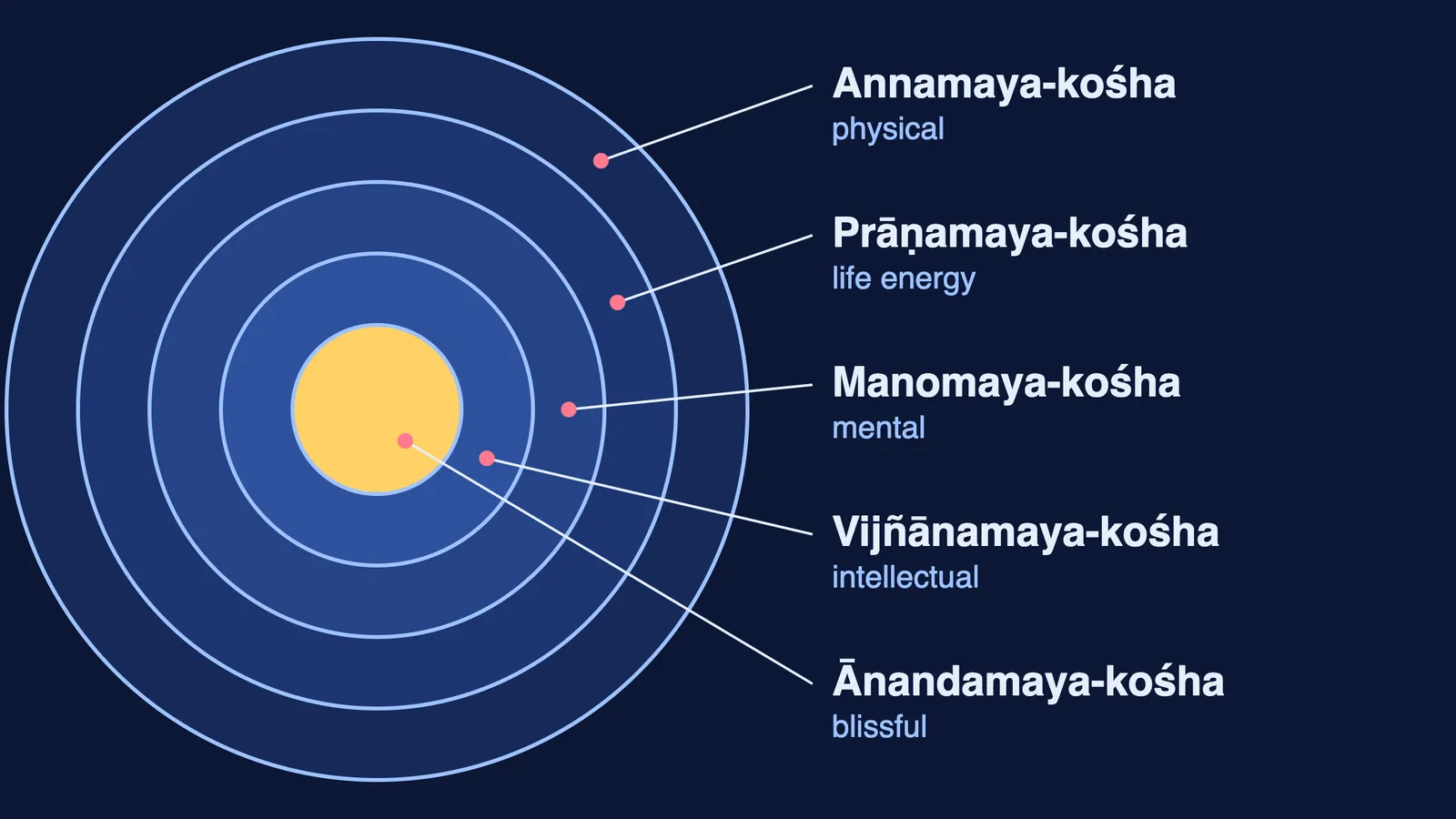
The chapter draws on the Pañchakośha idea from the Taittirīya-Upaniṣhad: five sheaths that together make up a person.
Annamaya-kośha (physical): the body built from food; balanced means a strong, active body.
Prāṇamaya-kośha (life energy): the flow of prāṇa; balanced means steady breath and good stamina.
Manomaya-kośha (mind): thoughts and emotions; balanced means positive feelings and handling stress.
Vijñānamaya-kośha (intellect): wisdom and judgement; balanced means clear thinking and sound decisions.
Ānandamaya-kośha (bliss): the subtlest layer; balanced means inner peace and contentment.
The book also names five prāṇas: Prāṇa (respiration), Apāna (excretion), Samāna (digestion), Udāna (circulation) and Vyāna (nervous system).
Which yoga practices does the chapter name?
Chapter 21 has a five-day "Exploring the Pañchakośha" plan, one kośha per day:
Body: 15 minutes of āsanas and Sūrya-namaskāra, noting how you feel before and after.
Breath: 5 minutes of prāṇāyāma (Nāḍī-śhodhana or Bhastrikā, for example) with hasta-mudrās.
Emotions: journaling about a strong feeling, then Trāṭaka and mantra chanting.
Intellect: discussing an ethical choice, such as studying versus helping a friend.
Inner joy: 5 minutes of silent sitting and writing down one thing you are grateful for.
The chapter gives no step-by-step method. Steps and āsana lists come later in the unit; learn them in practical classes under your teacher.
Practice questions for Chapter 21
Our own questions; marks are our suggestion, since the curriculum fixes 2 theory marks for the whole Yoga unit.
Name the kośha linked to thoughts and emotions. (1 mark)
What do "sva" and "stha" mean in Svāstha? (1 mark)
A classmate says, "I never get sick, so I am fully healthy." Use the chapter's idea of dimensions of health to respond. (2 marks)
Rohan's Ease Meter shows low focus and mood swings all week. Using the chapter's kośha table, name two kośhas this may point to and a day of the five-day plan to start with. (3 marks)
Answer hints: (1) Manomaya-kośha. (2) Self; being established. (3) Health also covers mental and social well-being. (4) Manomaya and Prāṇamaya (both list mood swings and poor focus as imbalance); Day 3 or Day 2.
For the senior version, read yoga in Class 11 physical education and yoga for lifestyle diseases in Class 12.
Revising the whole yoga unit? Fermi's AI tutor works out what you already know and builds a plan for the session.