On this page
You solve y″ − 3y′ + 2y = 0, find e^x and e^(2x), and write y = c₁e^x + c₂e^(2x). That is only right if neither piece is a multiple of the other. The Wronskian settles it.
What is the Wronskian?
The Wronskian of n differentiable functions is the determinant of the matrix formed by the functions and their derivatives up to order n − 1, and it was introduced in 1812 by the Polish mathematician Józef Wroński (Wikipedia: Wronskian).
For two functions it is a 2 × 2 determinant, functions on top and derivatives below: W(f, g) = f·g′ − g·f′. Rusty on determinants? See our Class 12 matrices and determinants key terms.
How does the Wronskian test linear independence?
Two functions f and g are linearly independent on an interval if c·f(x) + k·g(x) = 0 for all x only when c = 0 and k = 0; if some non-zero pair of constants works, they are dependent (Paul's Online Notes: More on the Wronskian).
The test: if W(f, g)(x₀) ≠ 0 for some x₀ in the interval I, then f and g are linearly independent on I. Equivalently, if f and g are linearly dependent on I, then W(f, g)(x) = 0 for every x in I (same source).
The reason: if g = k·f, the second column of the determinant is k times the first, so W is zero everywhere. The converse fails: zero everywhere does not, on its own, prove dependence.
What does Abel's formula say?
Abel's theorem: if y₁ and y₂ are two solutions of y″ + p(t)y′ + q(t)y = 0, then W(y₁, y₂)(t) = W(y₁, y₂)(t₀)·e^(−∫ p dx), the integral running from t₀ to t (Paul's Online Notes: More on the Wronskian).
Why: differentiate W to get W′ = y₁y₂″ − y₂y₁″, substitute y″ = −p·y′ − q·y, and the q terms cancel, leaving W′ = −p·W.
An exponential is never zero. So for two solutions of the same equation, on an interval where p and q are continuous, W is either never zero (constant ≠ 0) or zero everywhere (constant = 0). So one convenient point is enough.
Worked examples: e^x, e^(2x) and cos x, sin x
Example 1: y″ − 3y′ + 2y = 0
Solutions: e^x and e^(2x), from the roots of r² − 3r + 2 = 0.
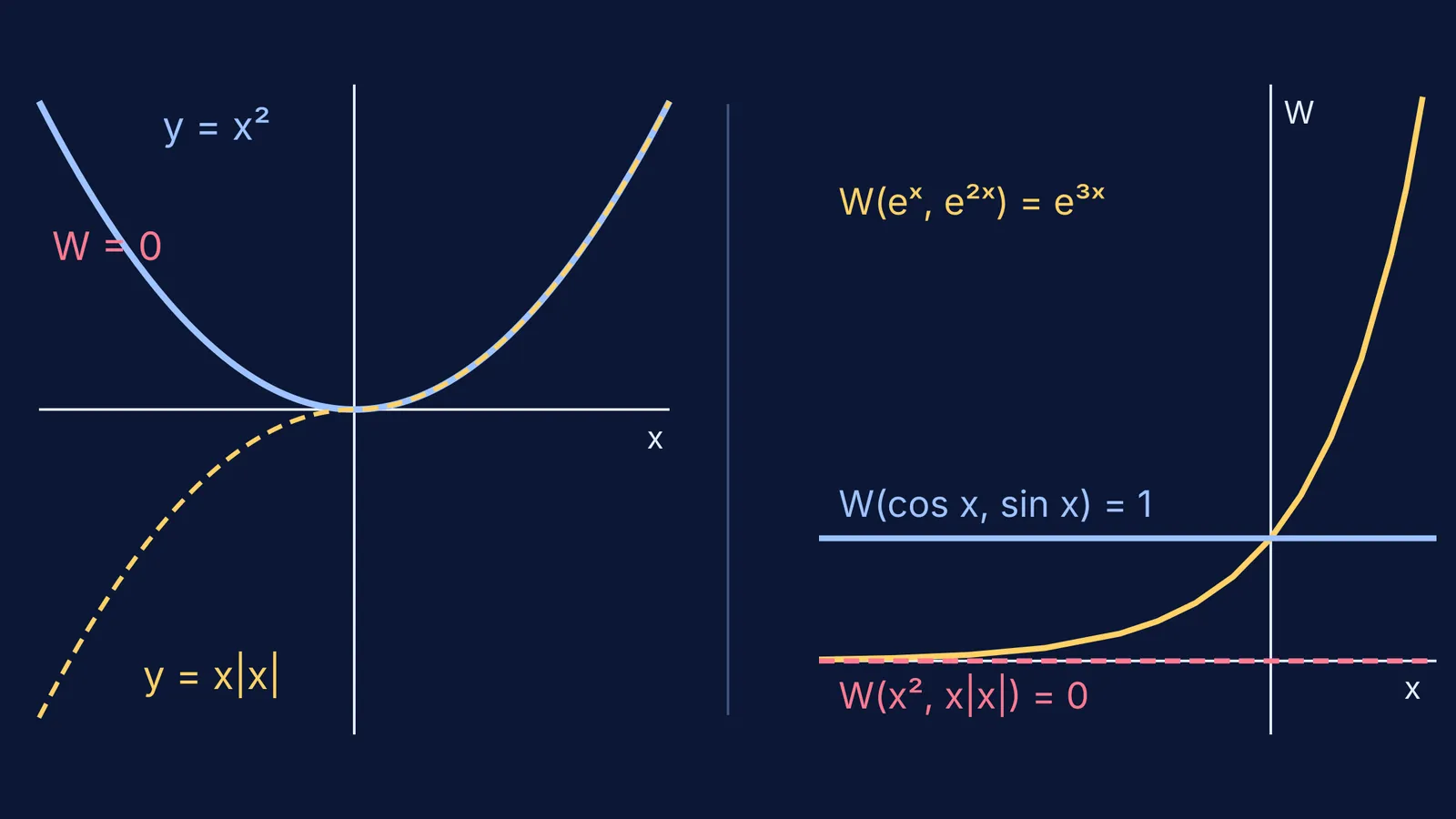
Wronskian: W = e^x·2e^(2x) − e^(2x)·e^x = e^(3x).
Abel check: p = −3, so W = C·e^(3x). It matches with C = 1.
Verdict: e^(3x) is never zero, so the pair is independent.
Example 2: y″ + y = 0
Wronskian of cos x and sin x: W = cos²x + sin²x = 1.
Abel check: p = 0, so W must be constant. It is.
Verdict: independent on the whole real line.
Where they come from: solving second-order linear differential equations.
Can the Wronskian be zero for independent functions?
Yes. Giuseppe Peano pointed out in 1889 that x² and x·|x| have continuous derivatives and a Wronskian that vanishes everywhere, yet they are not linearly dependent in any neighbourhood of 0 (Wikipedia: Wronskian).
For x ≥ 0, x·|x| = x², so W = 0. For x < 0, x·|x| = −x² with derivative −2x, so W = x²·(−2x) − (−x²)·(2x) = 0. Now test independence on (−1, 1): putting x = 1 in c·x² + k·x|x| = 0 gives c + k = 0, and x = −1 gives c − k = 0, so c = k = 0. Independent, with W ≡ 0.
This does not break Abel's formula. Independent solutions of the same homogeneous linear equation, written with y″ first, have a Wronskian that is zero nowhere on the interval, so x² and x|x| cannot both solve one such second-order equation (same source). Quick check, for continuous p and q: both have y(0) = 0 and y′(0) = 0, and the only solution with those starting values is y = 0.
How should you use this in an exam answer?
Write the equation in standard form and read off p(x).
Compute W at the easiest point, often x = 0, and compare with C·e^(−∫p dx).
If W is nonzero there and both functions are solutions, state that they form a fundamental set and write the general solution.
If the functions are not known to be solutions and W ≡ 0, do not conclude dependence; test c·f + k·g = 0 at two points to look for independence.
To revisit determinants or linear combinations, the Fermi Concept Library covers every concept in mathematics, physics, chemistry, biology and computing. If your method goes wrong, the Fermi Problem Library has a step-by-step solver that explains the reasoning.
Next, with the Class 12 differential equations formulas beside you, try e^(−x) and x·e^(−x) for y″ + 2y′ + y = 0.