

On this page
An equation like y″ − 5y′ + 6y = 0 looks like calculus, but you solve it with a quadratic. One trick handles every second-order linear equation with constant coefficients, ay″ + by′ + cy = 0, including the one that describes a mass on a spring.
What is the auxiliary equation, and where does it come from?
Try a solution of the form y = e^(mx). Then y′ = m·e^(mx) and y″ = m²·e^(mx), so every term carries the same factor. Substituting gives e^(mx)(am² + bm + c) = 0.
Since e^(mx) is never zero, the bracket must be zero: am² + bm + c = 0. This quadratic is called the auxiliary equation (many textbooks say characteristic equation). Paul's Online Notes from Lamar University explains that the characteristic equation comes from assuming solutions of the form e^(rt); it simply uses r and t where we use m and x.
A second-order equation needs two independent solutions and two constants, C₁ and C₂. The roots tell you the solutions.
Which of the three cases am I in?
Work out the discriminant D = b² − 4ac. It decides everything.
D > 0, two distinct real roots m₁ and m₂: y = C₁e^(m₁x) + C₂e^(m₂x), the form given in Lamar's notes on real, distinct roots.
D = 0, one repeated root m: y = (C₁ + C₂x)e^(mx). Lamar's repeated-roots section notes that b² − 4ac = 0 is the only way to get a double root.
D < 0, complex roots α ± iβ: y = e^(αx)(C₁ cos βx + C₂ sin βx), as in Lamar's complex-roots section.
Two quick examples. For y″ + 4y′ + 4y = 0 the auxiliary equation is (m + 2)² = 0, so y = (C₁ + C₂x)e^(−2x). For y″ + 2y′ + 5y = 0 the roots are m = −1 ± 2i, so y = e^(−x)(C₁ cos 2x + C₂ sin 2x).
How do you fit initial conditions to the general solution?
Solve y″ − 5y′ + 6y = 0 with y(0) = 1 and y′(0) = 0.
Auxiliary equation: m² − 5m + 6 = 0, which factorises to (m − 2)(m − 3) = 0, so m = 2 or 3.
General solution: y = C₁e^(2x) + C₂e^(3x).
Use y(0) = 1: C₁ + C₂ = 1.
Differentiate first: y′ = 2C₁e^(2x) + 3C₂e^(3x). Then use y′(0) = 0: 2C₁ + 3C₂ = 0.
Solve the pair: C₁ = 3 and C₂ = −2, so y = 3e^(2x) − 2e^(3x).
Check: y(0) = 3 − 2 = 1 and y′(0) = 6 − 6 = 0. Both hold.
How is y″ + ω²y = 0 simple harmonic motion?
For a mass on a spring, Newton's second law plus Hooke's law gives d²x/dt² = −(k/m)x, as derived in OpenStax University Physics, section 15.1. Here m is the mass, not a root. Write ω² = k/m and you have x″ + ω²x = 0.
Since m is taken, call the root r: the auxiliary equation is r² + ω² = 0, so the roots are ±iω: the complex case with α = 0 and β = ω. The solution is x = C₁ cos ωt + C₂ sin ωt, which you can rewrite as A cos(ωt + φ). OpenStax gives the same solution, with angular frequency ω = √(k/m) and period T = 2π√(m/k).
Initial conditions fix the constants: released from rest at x₀, x = x₀ cos ωt; pushed with speed v₀ from the centre, x = (v₀/ω) sin ωt.
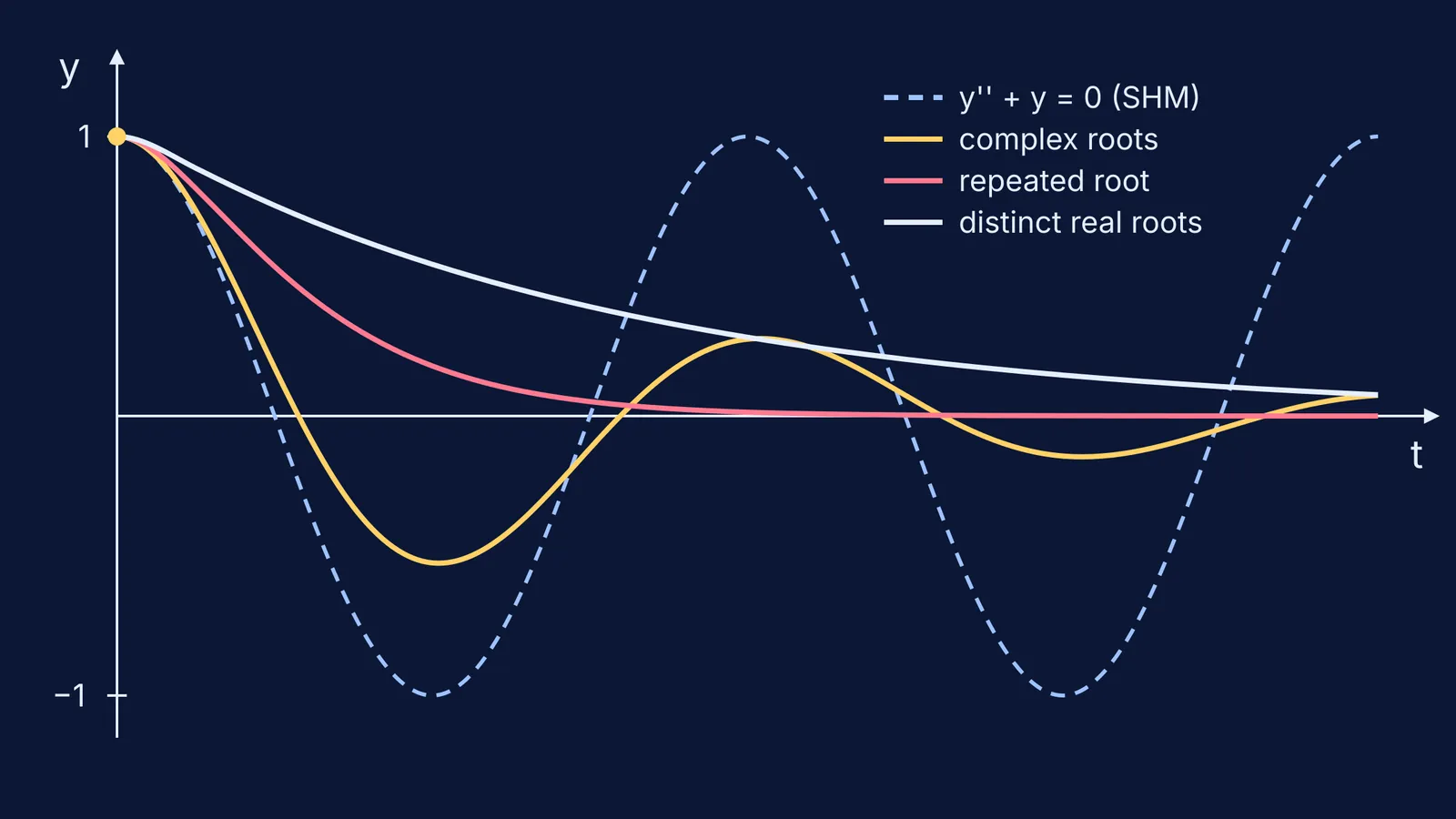
Add friction and the other two cases appear. OpenStax section 15.5 writes the damped oscillator as m·x″ + b·x′ + kx = 0. Its discriminant is b² − 4mk. When b² < 4mk the roots are complex and the oscillation decays; when b² = 4mk the root repeats (critical damping); when b² > 4mk the roots are real and the system creeps back without oscillating (overdamped). The diagram at the top shows all four curves.
If the cases still feel abstract, watching them move helps; the Fermi Simulation Lab has interactive simulations for the ideas that are easier to see than to read.
What should you write in an exam?
Use the same five steps every time:
Rearrange into the form ay″ + by′ + cy = 0.
Write the auxiliary equation by replacing y″ with m², y′ with m and y with 1.
Compute b² − 4ac and name the case.
Write the general solution with two constants.
Differentiate, apply both initial conditions, solve for C₁ and C₂, and substitute back to check.
Revise with the Class 12 differential equations formulas, practise on JEE Advanced differential equations questions with solutions, and check the common SHM and oscillation mistakes in JEE and NEET.
If you get stuck on a step, the Fermi Problem Library has worked problems with a step-by-step solver that explains the reasoning rather than printing an answer.
Pick one equation from each case tonight and take it all the way to the final check.


