On this page
Several terms here are easy to swap: minor and cofactor, singular and skew symmetric, adjoint and inverse. Below are key terms from NCERT's rationalised Chapter 3, Matrices and Chapter 4, Determinants (Reprint 2026-27), each with a small example you can check by hand. For exam strategy, see our Matrices and determinants Class 12 board exam guide.
The CBSE 2026-27 Mathematics syllabus limits determinants to 3 × 3. It and the current chapters omit properties of determinants and elementary row operations, and neither includes Cramer's rule.
What is a matrix, and what does its order mean?
Matrix: numbers or functions set out in rows and columns, in a fixed order. Example: A = [1 2 3; 4 5 6].
Element (entry): aij is the entry in row i, column j. Example: in A, a23 = 6.
Order: rows × columns, m × n. Example: A is 2 × 3. Don't confuse with: 3 × 2, a different shape.
Equal matrices: same order and every matching element equal. Example: [x 2; 3 y] = [5 2; 3 −1] gives x = 5, y = −1.
What are the types of matrices?
Row matrix: exactly one row, order 1 × n. Example: [4 −1 7].
Column matrix: exactly one column, order m × 1.
Square matrix: rows equal columns; an n × n matrix has order n. Only square matrices have determinants.
Diagonal matrix: a square matrix in which every entry off the main diagonal (a11, a22, ..., ann) is zero. Example: [−1 0; 0 2].
Scalar matrix: a diagonal matrix with every diagonal entry the same number k. Example: [3 0; 0 3].
Identity matrix (I or In): the scalar matrix with k = 1. Don't confuse with: zero matrix.
Zero (null) matrix, O: every entry is 0, any order.
How do operations, transpose and symmetry work?
Sum A + B: add matching entries; defined only for the same order.
Scalar multiple kA: multiply every entry by k. Example: 2[1 −3] = [2 −6].
Product AB: defined only when the number of columns of A equals the number of rows of B; (m × n)(n × p) gives m × p.
Non-commutativity: AB and BA need not be equal. Example: A = [1 0; 0 0], B = [0 1; 0 0] give AB = [0 1; 0 0] but BA = O.
Zero product of non-zero matrices: that BA = O shows two non-zero matrices can multiply to O, unlike real numbers. The syllabus keeps these to order 2.
Transpose A′ (or AT): rows become columns. Example: [1 2 3; 4 5 6]′ = [1 4; 2 5; 3 6].
Symmetric matrix: a square matrix with A′ = A, so aij = aji. Example: [1 7; 7 4].
Skew symmetric matrix: a square matrix with A′ = −A; this forces every diagonal entry to be 0. Example: [0 5; −5 0]. Don't confuse with: singular, which is about the determinant.
What do determinant, minor and cofactor mean?
Determinant |A| (det A): the single number attached to a square matrix; |A| is not a modulus. Example: |3 1; 4 2| = 3 × 2 − 1 × 4 = 2.
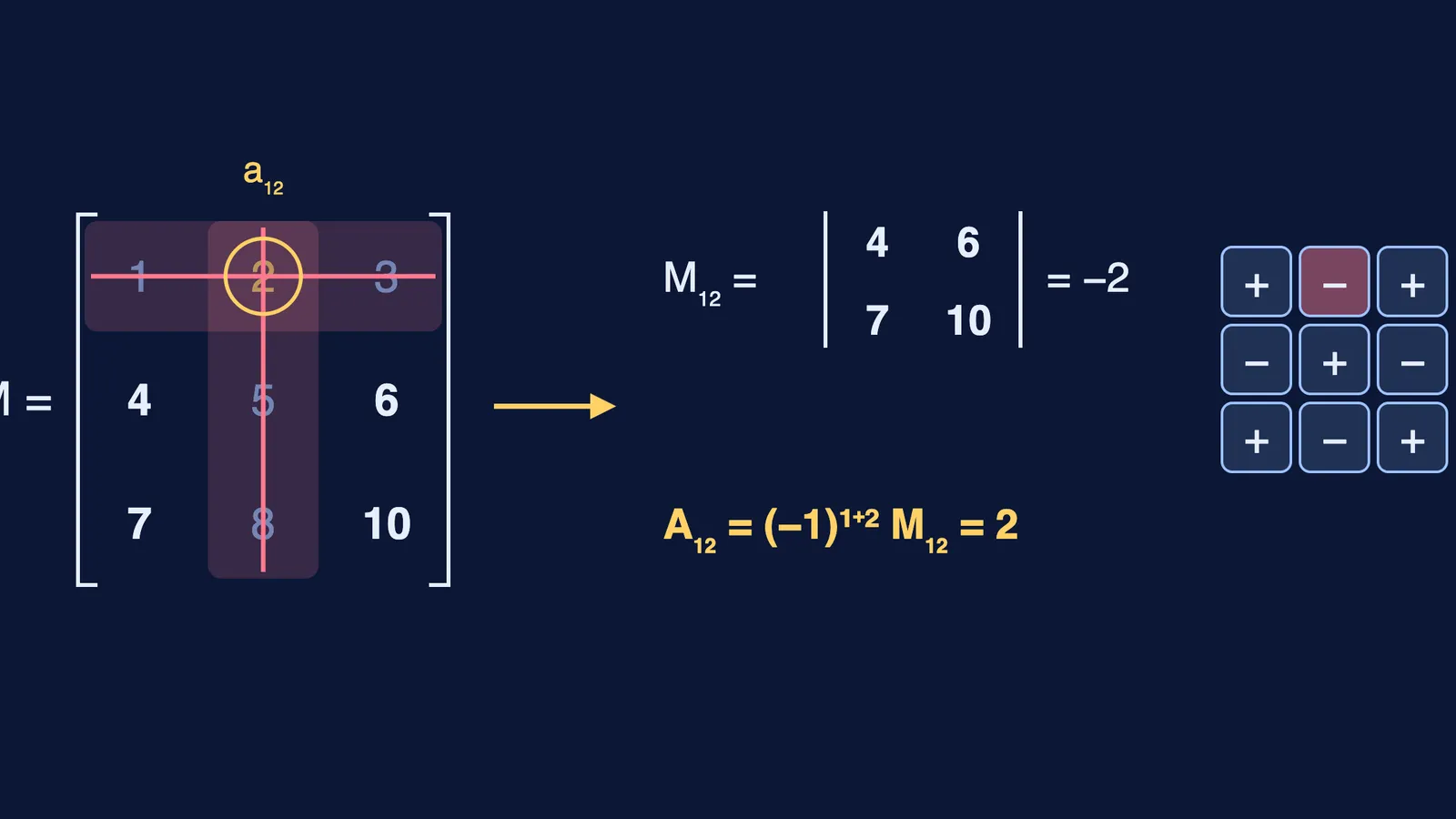
Expansion along a row or column: summing each entry of one row (or column) times its cofactor; every row or column gives the same value. Example: for M = [1 2 3; 4 5 6; 7 8 10], expanding along row 1 gives |M| = −3.
Minor Mij: the determinant left after deleting row i and column j. Example: in M, M12 = |4 6; 7 10| = −2.
Cofactor Aij: (−1)^(i+j) × Mij. Example: A12 = (−1)³ × (−2) = 2. Don't confuse with: the minor; the sign flips only when i + j is odd.
Area of a triangle by determinant: half the absolute value of the determinant with rows (x1, y1, 1), (x2, y2, 1), (x3, y3, 1). Example: (0, 0), (4, 0), (0, 3) give area 6 square units.
Collinear points: the same determinant is 0. Example: (1, 1), (2, 2), (3, 3).
How are adjoint, inverse and linear equations linked?
Adjoint (adj A): the transpose of the matrix of cofactors. Example: for P = [3 1; 4 2], adj P = [2 −1; −4 3]. Don't confuse with: the transpose of P itself.
Singular matrix: a square matrix with |A| = 0. Example: [2 4; 1 2].
Non-singular matrix: a square matrix with |A| ≠ 0. Example: P, with |P| = 2.
Inverse A⁻¹ and invertible matrix: B is the inverse of square matrix A if AB = BA = I. A is invertible exactly when it is non-singular, and then A⁻¹ = (1/|A|) adj A. Example: P⁻¹ = [1 −½; −2 3/2].
Matrix form AX = B: coefficient matrix times the column of unknowns equals the column of constants. Example: 3x + y = 5, 4x + 2y = 8 becomes PX = [5; 8], so X = P⁻¹B gives x = 1, y = 2.
Consistent system: has at least one solution, like the one above.
Inconsistent system: has no solution. Example: x + y = 2, 2x + 2y = 5. Here |A| = 0 and (adj A)B = [−1; 1] ≠ O, so no solution. When |A| = 0 and (adj A)B = O, the system has either infinitely many solutions or none.
More: the properties of the adjoint and inverse of a matrix.
How to learn these terms
Learn pairs together: minor and cofactor, symmetric and skew symmetric, singular and non-singular.
Draw the type ladder: every identity matrix is scalar, every scalar matrix is diagonal, every diagonal matrix is square.
Before multiplying, write both orders and check the middle numbers match.
Take one 3 × 3 matrix and compute all its minors, cofactors and adjoint.
Check each inverse by multiplying back to I.
If a definition still feels shaky, the Fermi Concept Library gives each mathematics concept its own lesson.