On this page
This glossary covers Chapter 5 of the NCERT Class 11 Physics Part I textbook (Reprint 2026-27), listed under Unit IV of the CBSE 2026-27 Class XI Physics syllabus. The rationalised chapter no longer has sections on the various forms of energy or mass-energy equivalence, so those terms are left out.
What is work, and what does the work-energy theorem say?
Source: NCERT sections 5.1 to 5.6.
Scalar (dot) product: multiplying two vectors to get a plain number, A.B = AB cos θ, where θ is the angle between them. It is zero when the vectors are perpendicular.
Work: the size of the displacement multiplied by the part of the force pointing along it, W = F.d = Fd cos θ. A scalar in joules (J), dimensions [ML²T⁻²]. Example: pushing a rigid wall does no work on it, since it does not move.
Positive and negative work: work is positive when the angle between force and displacement is below 90° and negative between 90° and 180°. Example: friction on a sliding block does negative work.
Zero work: when displacement is zero, force is zero, or force is perpendicular to displacement. Example: gravity on a block sliding across a smooth horizontal table.
Work done by a variable force: the area under the force-displacement graph (the integral of F dx). Don't confuse with: work by a constant force, simply Fd cos θ.
Kinetic energy (K): energy a body has because it moves, K = ½mv², in joules. It is never negative.
Work-energy (WE) theorem: the change in kinetic energy equals the work done by the net force, Kf − Ki = W. Example: road friction does negative work on a skidding cycle, stopping it. Don't confuse with: Newton's second law, a vector relation at each instant; the WE theorem is its scalar form and drops direction and time information.
What is the difference between conservative and non-conservative forces?
Source: NCERT sections 5.7 and 5.8.
Potential energy (V): energy stored because of a body's position or configuration. Example: a stretched bow-string.
Gravitational potential energy: mgh for a body at height h near the earth's surface, where h is small enough that g stays constant.
Conservative force: a force whose work depends only on the start and end points, so its work around a closed path is zero; in one dimension F = −dV/dx. Example: gravity, the spring force.
Non-conservative force: a force whose work depends on the path, so no potential energy can be defined for it. Example: friction.
Zero of potential energy: the point you choose to call V = 0, such as the ground for mgh. The choice is free but must stay fixed within one problem.
How are mechanical energy and spring energy linked?
Source: NCERT sections 5.8 and 5.9.
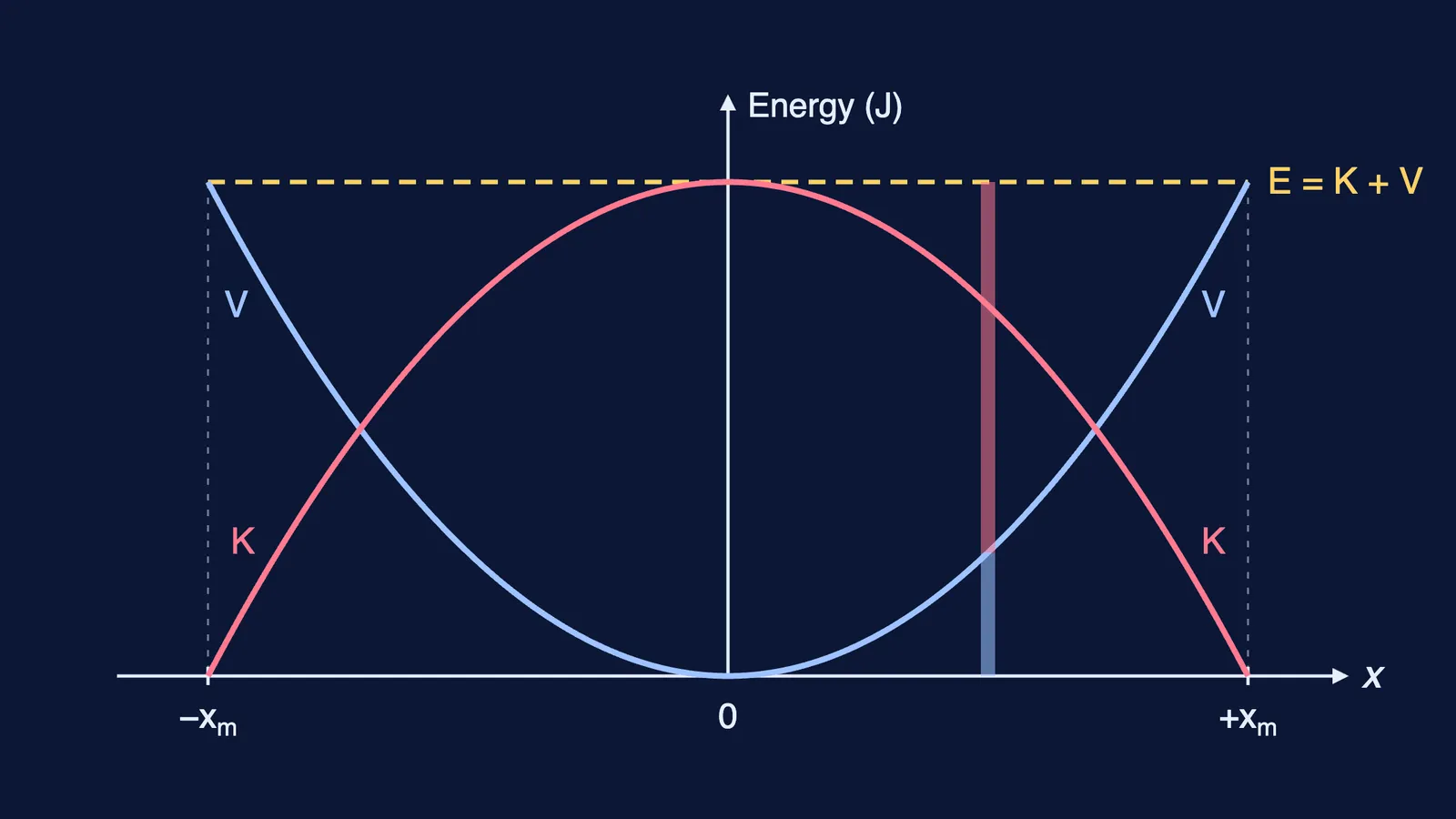
Total mechanical energy (E): kinetic plus potential energy, E = K + V.
Conservation of mechanical energy: E stays constant when only conservative forces do work. Example: a ball dropped from height H lands at √(2gH). With friction, the change in E equals the non-conservative work.
Hooke's law: an ideal spring pushes or pulls back towards equilibrium with a force proportional to the displacement x, Fs = −kx.
Spring constant (k): force per unit extension, in N m⁻¹. A large k means a stiff spring.
Elastic (spring) potential energy: energy stored in a spring stretched or compressed by x, V = ½kx². Don't confuse with: the work done by the spring force while it is stretched, which is −½kx².
Motion in a vertical circle: a bob on a string whirled in a vertical plane. In NCERT Example 5.7, for the string to slacken only at the top, the bob needs √(5gL) at the bottom and √(gL) at the top.
What is power, and how is it different from energy?
Source: NCERT section 5.10.
Power: the rate of doing work or transferring energy, a scalar with dimensions [ML²T⁻³]. Average power is W/t; instantaneous power is dW/dt = F.v.
Watt (W): the SI unit of power; 1 W = 1 J s⁻¹.
Horse-power (hp): an older unit still used for vehicle engines; 1 hp = 746 W.
Kilowatt hour (kWh): the energy a 1 kW device uses in one hour, 3.6 × 10⁶ J. Don't confuse with: the kilowatt, a unit of power.
What are elastic and inelastic collisions?
Source: NCERT section 5.11.
Momentum in collisions: total linear momentum is conserved in every collision, because the bodies exert equal and opposite forces on each other.
Elastic collision: total kinetic energy after equals total kinetic energy before. Don't confuse with: kinetic energy staying constant during contact; it does not, because the bodies deform.
Inelastic collision: part of the kinetic energy turns into other forms such as heat and sound.
Completely inelastic collision: the bodies stick and move together after colliding.
One-dimensional (head-on) collision: all velocities lie along one line. Example: in an elastic head-on collision between equal masses, one at rest, the moving one stops and the other leaves with its speed.
Two-dimensional collision: velocities lie in a plane, so momentum is conserved along x and y separately. Example: equal masses in a glancing elastic collision, one at rest, fly apart at right angles.
How to learn these terms
Sketch a spring's force-extension graph and shade the triangle: its area, ½kx², links variable-force work to spring energy.
For each chapter example, write the angle between force and displacement and mark the work positive, negative or zero, as NCERT Exercise 5.1 asks.
Redraw the energy graph at the top of this post from memory: V rises as ½kx², K falls by the same amount, E stays flat.
Turn each "Don't confuse with" pair into a flashcard.
Label every collision you meet elastic, inelastic or completely inelastic, and say what is conserved.
If a term still feels abstract, the Fermi Concept Library gives each physics concept its own lesson. For the chapter overview, read our Work, Energy and Power Class 11 guide, see how the work-energy theorem solves problems faster than forces, then try these work, energy and power JEE Main practice questions with solutions.