On this page
Most sugar sold in Indian kitchens is plantation white sugar: white crystals made directly at the cane mill, with no separate refinery. Many of those mills keep a sulphur burner on site. They burn sulphur to sulphur dioxide and bubble it through the juice twice, a route called double sulphitation. Each step is NCERT chemistry put to work: a sparingly soluble calcium salt, SO₂ as a reducing bleach, sulphite equilibria and the acid-catalysed hydrolysis of sucrose.
Why does a sugar mill need SO₂ at all?
Our post on how sugarcane becomes white sugar walks through liming, evaporation, crystallisation and centrifuging. Lime alone gives a juice clean enough for raw sugar, but the crystals come out yellow-brown. A refinery whitens sugar by washing, carbon or ion exchange. A sulphitation mill skips the refinery and uses SO₂ for two jobs: helping to precipitate impurities from the juice, and bleaching colour in the syrup.
Not every Indian mill works this way. Some make raw sugar by liming alone (defecation), some use carbonatation, where lime is precipitated with CO₂ as CaCO₃, and some refine. Double sulphitation is a widely used route for plantation white sugar.
What happens inside the juice sulphiter?
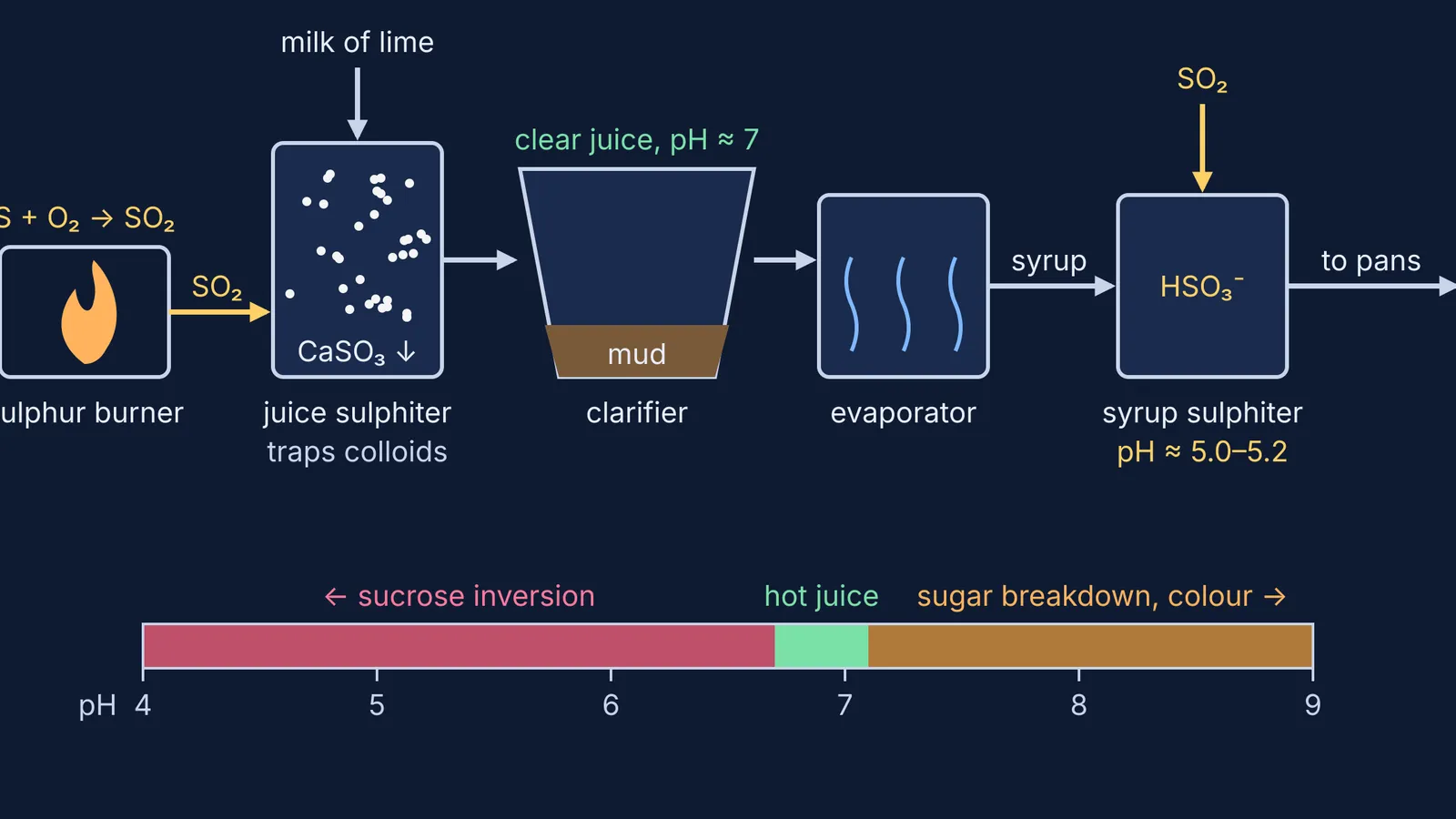
Sulphur is burnt in air in a burner next to the plant:
S + O₂ → SO₂
The raw juice is heated and then treated with milk of lime and SO₂ together. The two neutralise each other and form calcium sulphite:
Ca(OH)₂ + SO₂ → CaSO₃ + H₂O
Check the balance: Ca 1 = 1, S 1 = 1, H 2 = 2, O 4 = 4. Calcium sulphite is sparingly soluble, so it comes out as a fine, bulky precipitate (in practice a hydrate, often written CaSO₃·½H₂O). As it forms, it traps colloids, gums, waxes and some colouring matter and carries them down with it. The mixture goes to a clarifier, where this mud settles and clear juice overflows from the top.
The mill keeps the juice close to neutral. A study by authors from the National Sugar Institute, Kanpur, reports sulphited juice at about pH 6.9 to 7.1 and clear juice at about 6.7 to 6.9 (Vajpayee and Bajpai, IJERT). The exact targets vary from mill to mill.
Why must the juice pH stay near 7?
Hot juice is caught between two opposite dangers.
Too acidic: inversion. H⁺ catalyses the hydrolysis of sucrose: C₁₂H₂₂O₁₁ + H₂O → C₆H₁₂O₆ (glucose) + C₆H₁₂O₆ (fructose). Glucose and fructose do not crystallise with the sucrose, so every inverted molecule is sugar lost to molasses. The rate rises with both temperature and [H⁺], and one pH unit lower means ten times more H⁺. The reaction is explained in why sucrose hydrolysis is called inversion.
Too alkaline: degradation. Cane juice already contains some glucose and fructose. In hot alkaline solution these reducing sugars break down into acids and dark-coloured products, which is exactly the colour the mill is trying to remove.
So the clarified juice is held near neutral, where both reactions are slow.
How does the second sulphitation whiten the syrup?
Evaporators boil the clear juice down to a thick syrup. Before the syrup goes to the vacuum pans, it is sulphited again. This time no lime is added, so the pH drops. The same NSI study reports sulphured syrup kept at about pH 5.0 to 5.2.
At that pH dissolved SO₂ is present almost entirely as bisulphite, HSO₃⁻ (see the worked example). Sulphur here is at +4 and is easily oxidised to +6, so it acts as a reducing agent. It reduces coloured, conjugated molecules to colourless forms. This is the "temporary bleaching" from your textbook, used on purpose. Our post on why chlorine bleaching is permanent but SO₂ bleaching is not explains the mechanism. Bisulphite also adds to the carbonyl groups of reducing sugars, the same bisulphite addition you meet with aldehydes, which slows the browning reactions that would otherwise darken the syrup as it boils.
Worked example: how much sulphur, and which sulphur species?
Part (a). A teaching example: a batch of juice receives 1.0 kg of CaO (as milk of lime), and all of it ends up as CaSO₃. How much SO₂ and sulphur are needed, and how much mud forms? This is a round number for practice, not a real per-tonne-of-cane dose.
CaO + H₂O → Ca(OH)₂, then Ca(OH)₂ + SO₂ → CaSO₃ + H₂O. Overall, CaO + SO₂ → CaSO₃, a 1 : 1 : 1 ratio.
Moles of CaO = 1000 ÷ 56.08 = 17.8 mol.
SO₂ needed = 17.8 mol × 64.06 g/mol = 1.14 kg.
S + O₂ → SO₂ is also 1 : 1, so sulphur burnt = 17.8 × 32.06 = 0.572 kg, about 0.57 kg.
CaSO₃ formed = 17.8 × 120.14 = 2.14 kg on an anhydrous basis. As the hemihydrate (129.15 g/mol) it would be 2.30 kg.
A shortcut: mass of SO₂ = (64.06 ÷ 56.08) × mass of CaO = 1.14 × mass of CaO.
Part (b). Which form of S(IV) is present? Use approximate values pKa₁ ≈ 1.8 (SO₂·H₂O to HSO₃⁻) and pKa₂ ≈ 7.2 (HSO₃⁻ to SO₃²⁻); tables differ slightly.
In the syrup at pH 5.2: [SO₃²⁻]/[HSO₃⁻] = 10^(5.2 − 7.2) = 10⁻² = 0.01.
Also [SO₂]/[HSO₃⁻] = 10^(1.8 − 5.2) = 10^(−3.4) ≈ 0.0004.
So about 99% of the S(IV) is bisulphite.
In the juice at pH 7.0: [SO₃²⁻]/[HSO₃⁻] = 10^(−0.2) = 0.63, so sulphite is about 0.63 ÷ 1.63 = 39% of S(IV).
That difference explains the two stages. At pH 7 there is plenty of SO₃²⁻ to precipitate CaSO₃. At pH 5 almost none is left as sulphite, so the syrup stays clear and the bisulphite does the bleaching.
If buffer and speciation problems slow you down, the Fermi Problem Library has a step-by-step solver that explains the reasoning at each step.
Why do some buyers prefer refined sugar?
Some SO₂ stays in the crystals. India's food regulator caps it: the FSSAI food additive tables set a maximum of 70 ppm sulphur dioxide in plantation white sugar and 20 ppm in refined sugar (FSSAI Appendix A, Table 12.pdf)). The Bureau of Indian Standards specification for plantation white sugar, IS 5982, also lists 70 mg/kg. Check the current notification before quoting a number in a project, as these tables are revised from time to time.
Because sulphitation sugar carries this small residue, some industrial buyers and export markets ask for refined or carbonatation sugar instead. It is a trade-off: one mill, one gas and no refinery, against a whiter, lower-sulphur crystal made with more steps.
Quick checklist
Burner: S + O₂ → SO₂.
Juice sulphitation: Ca(OH)₂ + SO₂ → CaSO₃ + H₂O; the bulky precipitate carries impurities down.
Juice pH is held near 7: acid inverts sucrose, alkali degrades reducing sugars to colour.
Syrup sulphitation at about pH 5: HSO₃⁻ bleaches by reduction.
SO₂ needed = 1.14 × mass of CaO; S burnt = 0.57 × mass of CaO.
[SO₃²⁻]/[HSO₃⁻] = 10^(pH − pKa₂).
The residue limit for plantation white sugar is set by FSSAI.