On this page
You breathe out once and your glasses turn white. The American Academy of Ophthalmology explains it in one line: it happens when warm breath escapes from the top of your mask and lands on the cooler surface of your lens. It is the same physics as a bathroom mirror fogging after a shower or a cold glass that sweats, just a few centimetres from your eyes.
Why do glasses fog up when wearing a mask?
Three things have to happen at once.
Your breath is warm and wet. A 2020 study made 340 measurements from 31 people in Paris and Haifa and found exhaled breath at 31.4 to 35.4 °C, with relative humidity between 41.9% and 91.0% (Mansour et al., Sensors and Actuators B, 2020).
The mask sends it upward. A loose fit over the nose lets breath escape from the top of the mask, straight at your lenses.
The lens is colder than the breath's dew point. The dew point is the temperature to which air must be cooled to reach saturation (US National Weather Service). Below it, the air cannot hold all its water vapour, so the extra condenses on the glass.
The water lands as countless tiny separate droplets, not a smooth sheet. A 2026 review of anti-fog surfaces for medical goggles explains that discrete droplets create many air-water surfaces whose refractive-index mismatch scatters light strongly: that is the fog you see (Guo et al., Frontiers in Bioengineering and Biotechnology, 2026).
New to humidity? Read what relative humidity really means.
When will your glasses fog? A worked example
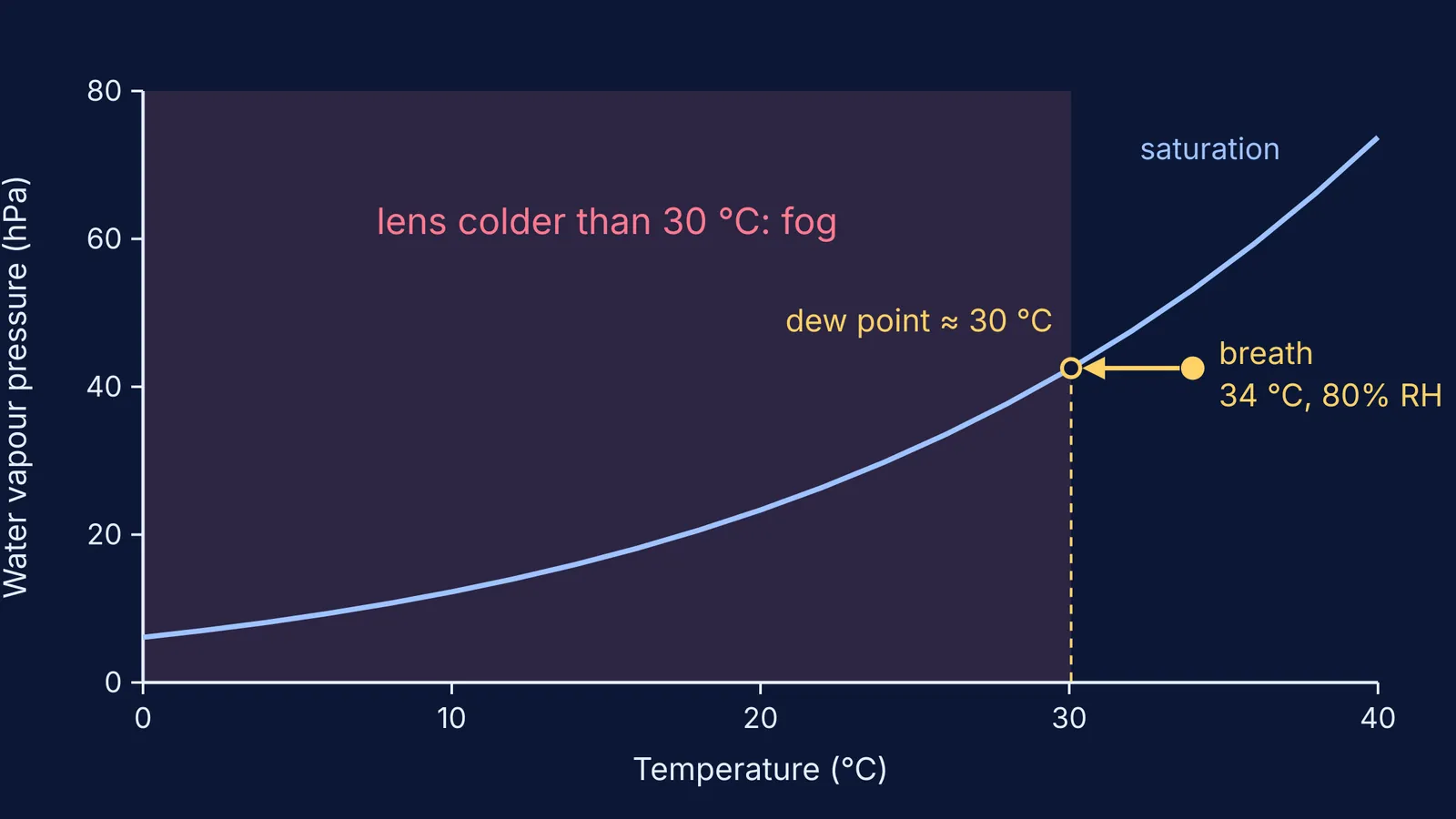
Take breath at 34 °C and 80% relative humidity, inside the range Mansour et al. measured. Find its dew point with the Magnus formula and the constants from Alduchov and Eskridge (1996).
Saturation vapour pressure at 34 °C: 6.1094 × e^(17.625 × 34 ÷ (34 + 243.04)) ≈ 53.1 hPa.
Your breath holds 80% of that: about 42.5 hPa of water vapour.
Cool that air without changing its water content. It saturates where the saturation pressure falls to 42.5 hPa: about 30 °C, its dew point.
Now compare the lens:
Air-conditioned classroom at 24 °C: the lens is about 6 °C below the dew point. It fogs.
Cold winter morning: the lens is far below 30 °C. It fogs readily.
Outdoors at 37 °C, once your frames have warmed up: the lens is above the dew point, so breath cannot condense.
Breath mixes with room air on the way up, lowering its dew point, so these numbers are a rough guide. The colder the lens, the more it fogs.
How do you stop glasses fogging with a mask?
Fix 1: Pinch the nose wire. The AAO advises pinching the top of the mask to fit your nose, or taping the gap at the bridge (AAO). Close the top exit and breath leaves through the sides and bottom instead. A 2014 letter to a surgical journal described tying a surgical mask to seal over the nose and cheekbones, so exhaled air vents sideways, away from eyewear (Jordan and Pritchard-Jones, Annals of the Royal College of Surgeons of England, 2014).
Fix 2: Tuck the mask under your lenses. Pull the mask up over your nose and rest your glasses on top of it; the AAO says this blocks the air from escaping (AAO). The AAO also notes that pushing your glasses forward on your nose lets more air circulate.
Fix 3: Wash the lenses in soapy water. A 2011 letter in the same surgical journal proposed washing spectacles in soapy water just before putting on a mask (Malik and Malik, 2011), and the AAO lists gentle soap-and-water washing too. Soap is a surfactant, and the 2026 review notes that surfactant treatments lower water's surface tension and promote a continuous water film instead of beads. It explains that a continuous water film has far fewer air-water interfaces, so it scatters much less light (Guo et al., 2026).
The 2011 letter's method:
Just before putting on the mask, wash the spectacles with soapy water.
Shake off the excess.
Let them air-dry, or gently dry the lenses with a soft tissue.
Which fix should you try first?
Nose wire, still fogging: Fix 1, pinching with both hands along the whole wire.
Cloth mask with no wire: Fix 2, or tape over the top edge.
Good seal but a cold room: add Fix 3, since even a small leak meets a lens far below the dew point.
Exam day: wash your lenses at home, then pinch the wire, seat your glasses and test with three slow breaths before the paper starts.
Dew point is easier to grasp once you have watched it change: the Fermi Simulation Lab has interactive simulations for ideas that are easier to see than to read.