On this page
In May the geyser seems done before you find a towel. In January you wait and still get lukewarm water. Nothing is wrong with it: it is obeying one line of school physics.
Why does a geyser take longer to heat water in winter?
The heat needed to warm water is Q = mcΔT: mass times specific heat times the temperature rise. Water has to absorb 4,184 joules for one kilogram to rise by 1 °C, according to the USGS Water Science School. If the terms blur, read specific heat vs heat capacity.
A geyser's element delivers heat at a fixed rate, its power P in watts (joules per second). So the heating time is t = Q ÷ P = mcΔT ÷ P. Between seasons, m, c and P stay the same. Only ΔT changes.
ΔT is the gap between the incoming water and the temperature you want. India Meteorological Department normals for New Delhi (Safdarjung, 1991-2020) put the January daily mean temperature at 13.8 °C and May's at 32.7 °C, as tabulated on Wikipedia's Climate of Delhi page. Water in rooftop tanks and pipes drifts towards air temperature, so in winter the geyser starts much lower.
How long does a 15-litre, 2 kW geyser take in summer and winter?
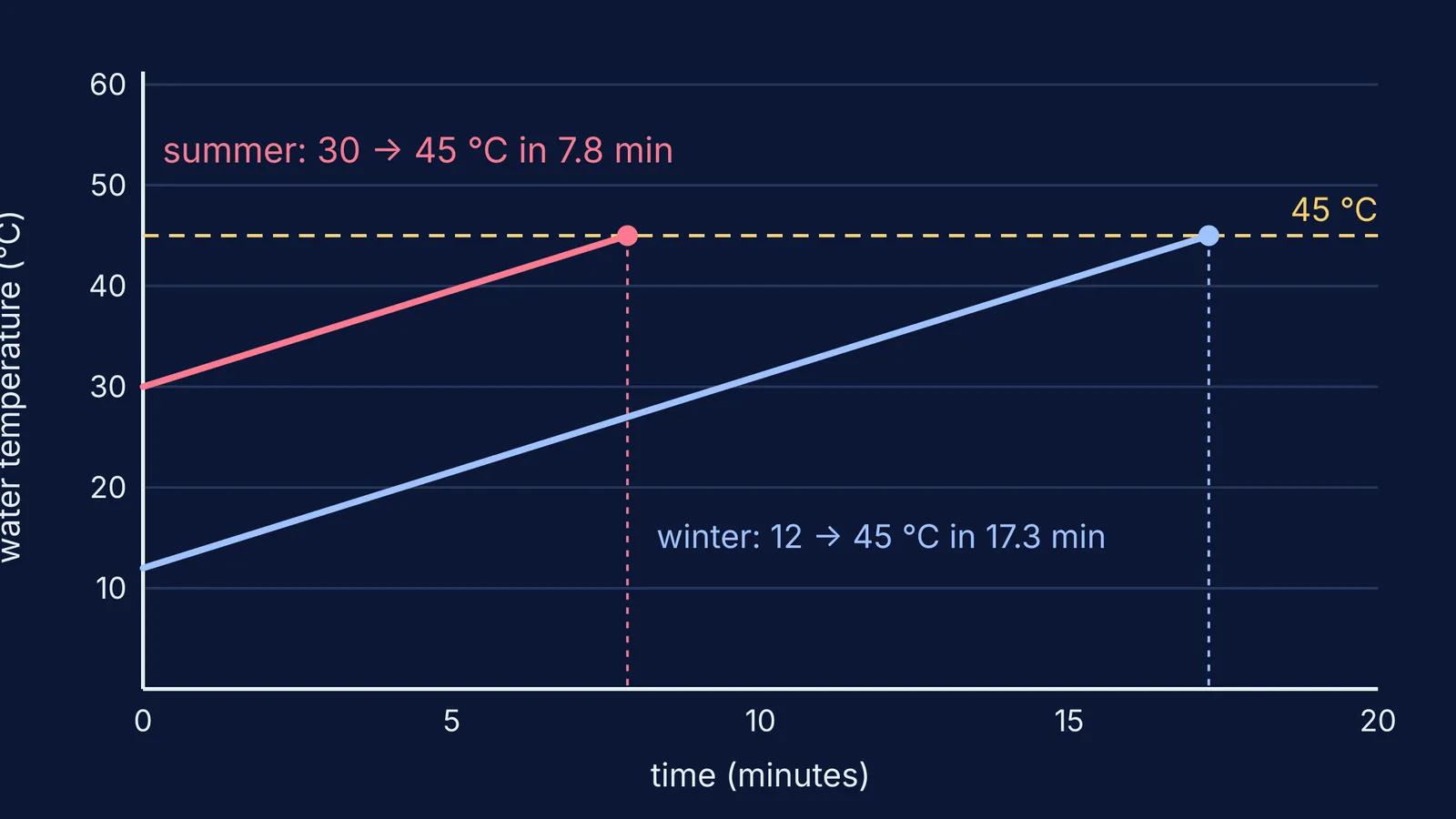
Assume 15 litres of water (about 15 kg), a 2 kW element (2,000 J per second), a 45 °C bath target, and inlet water at 30 °C in summer and 12 °C in winter, round numbers near the Delhi normals above. Take c = 4,184 J/kg°C from the USGS.
Summer: ΔT = 45 − 30 = 15 °C. Q = 15 × 4,184 × 15 = 941,400 J. t = 941,400 ÷ 2,000 ≈ 471 s, about 7.8 minutes.
Winter: ΔT = 45 − 12 = 33 °C. Q = 15 × 4,184 × 33 = 2,071,080 J. t = 2,071,080 ÷ 2,000 ≈ 1,036 s, about 17.3 minutes.
Compare: 33 ÷ 15 = 2.2. Same geyser, same bucket of water, 2.2 times the wait.
On your electricity bill, one kilowatt-hour equals 3.6 megajoules (Wikipedia, kilowatt-hour), so the winter heat-up uses about 0.58 kWh against about 0.26 kWh in summer. Our post on which geyser uses less electricity runs the same bucket maths for instant and storage models.
Does heat loss from the tank make it worse?
Less than you might think during the heat-up. Newton's law of cooling says the rate of heat loss of a body is proportional to the temperature difference between the body and its surroundings (Wikipedia, Newton's law of cooling).
India's Bureau of Energy Efficiency star-rates storage geysers on standing loss: the energy a full, switched-on geyser uses over 24 hours with no water drawn, stated in kWh per 24 hours at a 45 °C temperature difference, as the Citizen consumer and civic Action Group explains. In the current BEE bands listed by VSC Times, a 15-litre geyser earns 3 stars with a standing loss of up to 0.419 kWh a day.
That is a leak of about 0.39 watts for every °C of difference (0.419 kWh × 3.6 MJ ÷ 86,400 s ÷ 45 °C). While heating from 12 °C to 45 °C, the water is on average about 16 °C warmer than a 12 °C bathroom, so it loses roughly 6 W against the element's 2,000 W. That adds only a few seconds.
Where cold weather really costs you is keeping water hot. Hold the tank at 45 °C in a 12 °C bathroom and, by the same scaling, about 0.419 × 33 ÷ 45 ≈ 0.31 kWh leaks away each day. In a 30 °C summer bathroom it is about 0.14 kWh.
How can you get hot water sooner in winter?
Set the thermostat no higher than you need, which shrinks ΔT. CAG notes that every 12 °C reduction can save 3-5% on water-heating costs (CAG).
Switch on earlier: if summer took 8 minutes, give winter a little over twice that.
Switch off after use; standing loss grows with the gap to a cold room.
When buying, more stars means lower standing loss.
Insulate exposed hot-water pipes, as CAG recommends.
How do you solve any how-long-to-heat question?
The same four steps work for geysers, kettles and board-exam numericals:
Write the mass in kg (one litre of water is about one kilogram).
Find ΔT = final − initial temperature. This is where the season enters.
Work out Q = mcΔT with c = 4,184 J/kg°C (USGS).
Divide by power, t = Q ÷ P, then check whether losses are small next to P.
Try it on how long a 1.5 kW kettle takes to boil a litre of water. For more practice, the Fermi Problem Library has worked heat problems with a step-by-step solver that explains the reasoning rather than printing an answer. If specific heat itself feels shaky, the Fermi Concept Library gives each physics concept its own lesson and its place in the map.
Next time the geyser feels slow, look at ΔT before you blame the element.