

On this page
Every winter Indian homes argue about it: is the instant geyser or the storage geyser kinder to the bill? One formula from Class 11 physics and one star-rating table from India's Bureau of Energy Efficiency (BEE) labelling scheme settle it. Both geysers spend the same energy heating your water; only one also spends energy keeping water hot while nobody uses it.
Which geyser uses less electricity?
An electric element turns almost all the electricity it draws into heat, in a tank or in an instant unit, so the energy that ends up in your bucket is the same for both.
An instant geyser heats water only while it flows. Close the tap and it stops.
A storage geyser keeps a tank hot. Heat leaks through the insulation all the time, and the element switches back on to replace it.
That leak has an official name, standing loss, and BEE rates storage geysers by it.
How much energy does it take to heat a bucket of water?
Use Q = m × c × ΔT, where m is the mass of water, c its specific heat capacity and ΔT the rise in temperature.
The specific heat capacity of liquid water at 25 °C is 4.18 kJ per kg per kelvin, which is 0.001162 kWh per kg per kelvin (Engineering ToolBox, specific heat of water).
Water at 20 °C has a density of 998 kg per cubic metre, so one litre has a mass of almost exactly 1 kg (Engineering ToolBox, water density).
Now the worked example. Take a 15-litre bucket, cold water at 20 °C, and a comfortable bath at 40 °C.
Mass: 15 litres ≈ 15 kg.
Temperature rise: 40 − 20 = 20 K.
Energy in joules: 15 × 4,182 × 20 ≈ 1,250,000 J, or about 1.25 MJ.
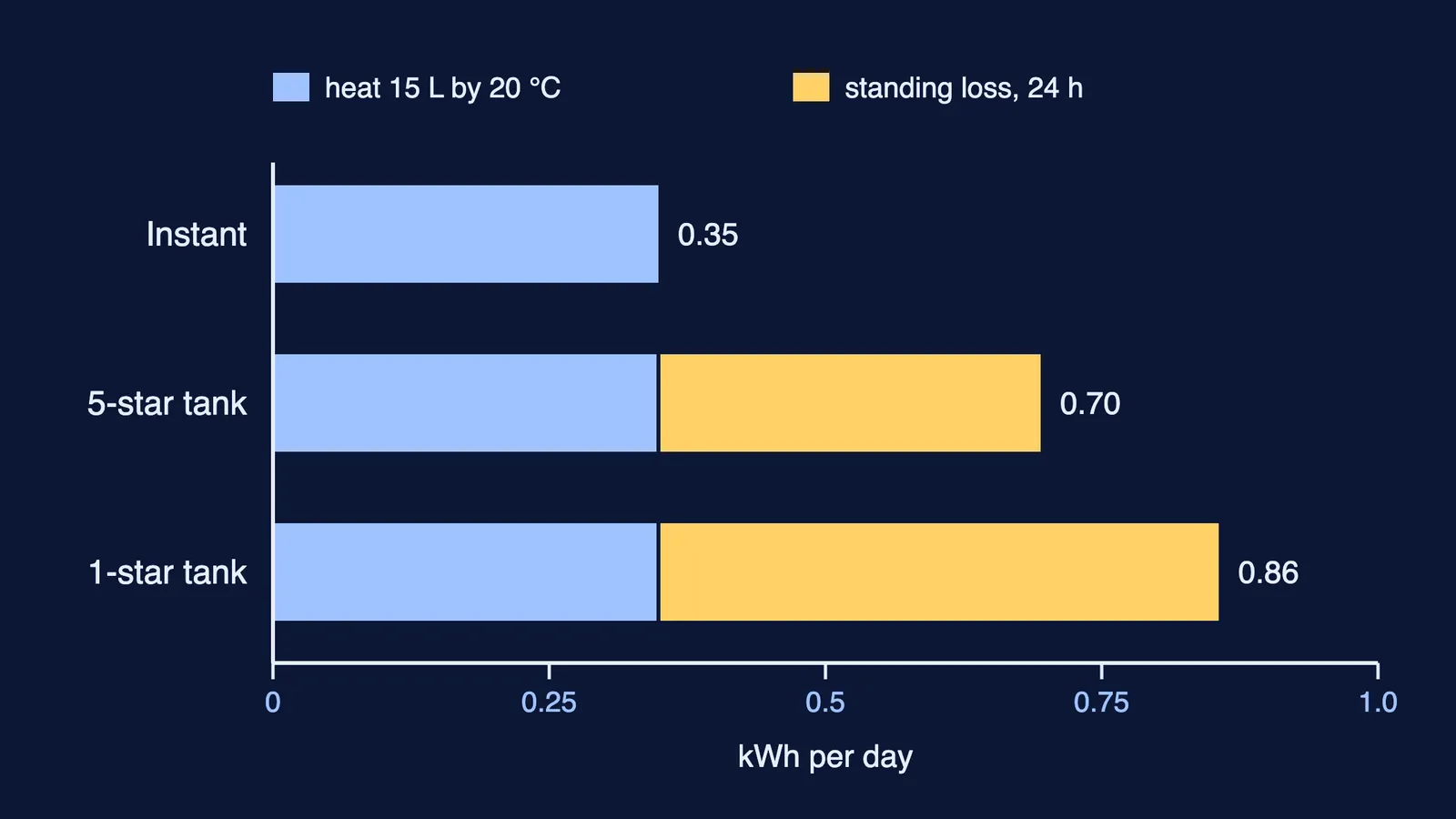
Energy in units: 15 × 0.001162 × 20 ≈ 0.35 kWh. One unit on your bill is one kWh, the number your meter counts.
Time with a 2 kW element: 0.35 ÷ 2 = 0.17 hours, or about 10 minutes.
Suppose instead you have a 3 kW instant geyser. Rearranging the same formula, it can raise water by 20 K at 3,000 ÷ (4,182 × 20) ≈ 0.036 kg per second, about 2.2 litres a minute, so it fills the bucket in roughly 7 minutes. The energy is still 0.35 kWh. Our post on how a smart electricity meter measures kWh shows how the meter counts it.
What is standing loss on a storage geyser?
Storage geysers are star-rated by their standing loss in kWh per 24 hours, measured in a standard test (the table's heading reads "kWh/24 hour/45°C"). The current table was added by Ministry of Power notification S.O. 5970(E) of 23 December 2025, issued in consultation with BEE, and applies from 1 July 2026 to 31 December 2027 (Gazette notification S.O. 5970(E), on BEE's star label site).
Under that table, a 15-litre geyser earns 5 stars at a standing loss of 0.346 kWh per day or less, and 1 star at up to 0.507 kWh per day. For a 25-litre geyser the limits are 0.423 kWh (5 stars) and 0.618 kWh (1 star) per day, from the same notification.
Put that next to the bucket: a 15-litre 5-star tank left on for 24 hours can lose about as much energy as heating the whole bath. Over 30 days, that is up to 10.4 kWh (5 stars) or 15.2 kWh (1 star), on top of the water you use. The same "paying for nothing" logic shows up in our post on whether a phone charger uses power when idle.
Is an instant geyser always cheaper to run?
Not always. The comparison assumes the tank stays on all day. Three things change it.
How you switch it. Switch a tank on, use the water, switch it off, and it loses only the heat left inside as it cools, not a full day of standing loss.
The thermostat. Heat leaks faster when the tank is much hotter than the room, so a lower setting means a smaller leak. BEE's figures come from one standard test condition: a guide, not your exact number.
How much hot water you need. An instant geyser's flow is limited by its power, as the 2.2 litres a minute shows. For long showers or several baths in a row, a tank may be the practical choice.
A five-minute check for your own home
Find the BEE star label on your storage geyser and note its capacity and, if listed, its standing loss; otherwise use the limit for its star rating in the BEE table.
Estimate your daily hot water in litres and the temperature rise, then use Q = 0.001162 × litres × ΔT for kWh, with c from Engineering ToolBox.
Add the standing loss for every 24 hours the geyser is left on.
Multiply the total by the rate per unit printed on your electricity bill.
Try a week of switching the tank off after use and compare meter readings.
If the specific-heat step is the part that keeps going wrong in your homework, Fermi's AI tutor works out what you already know and builds a plan for the session, then teaches through problems like this one on a board. For more water-heating maths with sunlight instead of a coil, read how a rooftop solar water heater works.


