On this page
Most of us leave the phone charger in the socket, switched on, long after the phone has gone. It is still connected to the mains, so how much does it use doing nothing? You can answer that with one formula from your Class 10 Electricity chapter.
Does a phone charger use electricity when nothing is plugged in?
Yes. A phone charger is a switched-mode power supply: it rectifies the 230 V AC from the wall, then switches it on and off very fast through a small transformer to make low-voltage DC. Our explainer on how a phone charger converts AC to DC walks through each stage.
With no phone attached, that circuit does not fully switch off. An application note on no-load power from Monolithic Power Systems looks at flyback converters, a common switched-mode design. It explains that at no load the current is so small that conduction loss is almost negligible, and the major losses are switching loss and the control circuit itself. It also notes that the resistors that discharge a safety capacitor across the mains dissipate power the whole time.
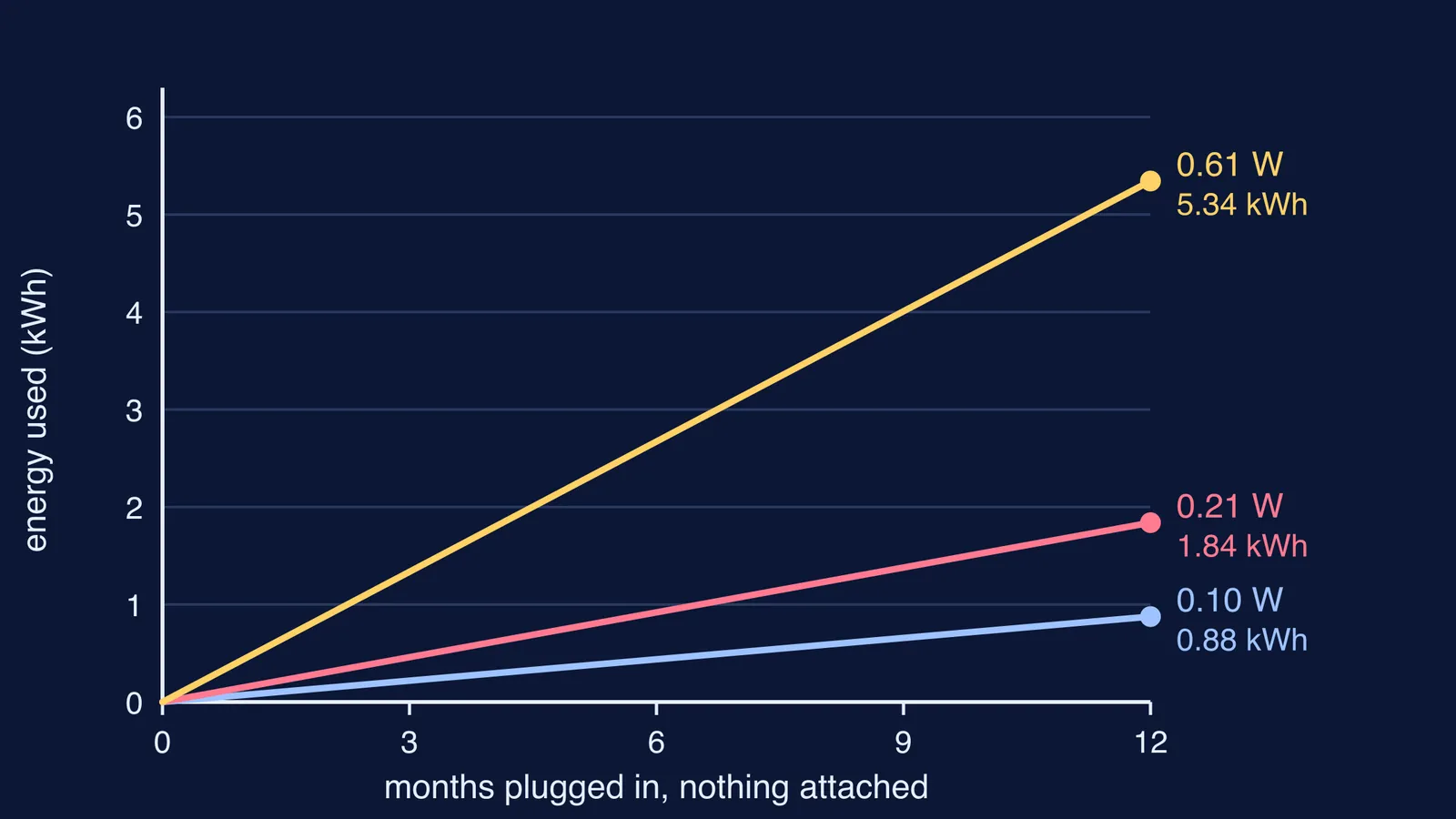
Europe sets a ceiling on this. The EU ecodesign regulation for external power supplies, (EU) 2019/1782, defines the no-load condition as the input connected to the mains with nothing connected to the output. Since 1 April 2020, an ordinary AC-DC power supply rated up to 49 W may draw no more than 0.10 W at no load, and one rated above 49 W, such as many laptop adapters, no more than 0.21 W. A supply with several outputs that work at the same time may draw up to 0.30 W. These are EU limits, not Indian ones, but they are a fair benchmark for a modern, well-made charger. An old or unbranded one may draw more.
How many units does one idle charger use in a year?
NCERT's Class 10 science textbook defines the commercial unit of electric energy as the kilowatt hour, "commonly known as 'unit'", with 1 kWh = 3.6 × 10⁶ J (NCERT Class 10 Science, Chapter 11). The method is the one in its refrigerator example: energy = power × time, then convert to kWh.
Take the EU ceiling of 0.10 W and the worst case, a charger left in all year with nothing attached.
Hours in a year: 24 × 365 = 8,760 h.
Energy: 0.10 W × 8,760 h = 876 Wh.
Convert: 876 Wh ÷ 1,000 = 0.876 kWh, or 0.876 units.
One idle charger at the EU limit uses under one unit a year. For more practice, our guide to calculating an electricity bill in kWh has further worked examples.
What does it cost for a whole household?
Price it with a real tariff. The Chhattisgarh State Electricity Regulatory Commission's tariff schedule for FY 2025-26 charges domestic consumers ₹5.60 per kWh in the 201 to 400 unit slab and ₹8.30 above 600 units. The schedule says energy charges are telescopic, so extra units are billed at the rate of the highest slab you reach that month. That is why the slab structure of an electricity bill matters even for small loads.
Now a household of four, each with a phone charger left in, plus one laptop adapter, all at their EU no-load limits:
Phone chargers: 4 × 0.10 W = 0.40 W
Laptop adapter: 0.21 W
Total: 0.61 W
Energy in a year: 0.61 W × 8,760 h = 5,343.6 Wh ≈ 5.34 kWh
Cost at ₹5.60 per unit: 5.34 × 5.60 ≈ ₹30 a year
Cost at ₹8.30 per unit: 5.34 × 8.30 ≈ ₹44 a year
One charger on its own costs about ₹4.90 a year at ₹5.60 per unit (0.876 × 5.60).
To put that in scale, NCERT's Example 11.13 has a 400 W refrigerator running 8 hours a day using 96 kWh in 30 days. The whole household's idle chargers use about 5.3 kWh in a full year, less than two days of that fridge.
So should you unplug your charger?
For the bill alone, it barely matters if your chargers are modern and stay within limits like the EU's 0.10 W and 0.21 W no-load caps. A few checks are still worth doing:
Feel the charger with nothing attached. A brick that is warm on its own is turning electricity into heat even with no phone, so unplug it when not in use.
Replace any charger with a cracked case, loose pins or a frayed cable, whatever it costs to run.
Use the same method on other gadgets left on standby: find the power, multiply by the hours, divide by 1,000.
If the unit conversions trip you up, the Fermi Problem Library has worked problems with a step-by-step solver that explains the reasoning rather than printing an answer. If power versus energy itself feels shaky, start with the lesson in the Fermi Concept Library.
Next time someone at home says the charger is eating electricity, you can show them the numbers in three lines.