

On this page
Most of us plug our smartphones into the wall every single day without wondering what happens inside that little white brick. Your wall socket delivers a powerful 230 V alternating current (AC), but the delicate lithium-ion battery inside your phone demands roughly 5 V direct current (DC) to charge. If you connected them directly without a middleman, the phone would instantly fry.
The job of the charger is to safely step down that massive voltage and straighten out the fluctuating current. Modern chargers do this using a switched-mode power supply (SMPS), a clever circuit that replaces the heavy, buzzing iron blocks of the past with fast-switching semiconductor electronics.
Why does a phone need DC instead of AC?
Batteries store energy chemically, which requires forcing electrons into the battery in one continuous direction. Direct current (DC) flows like a steady river. Alternating current (AC) in India reverses its direction 100 times every second (because it runs at 50 Hz). If you fed AC directly to a battery, it would charge for a fraction of a second and immediately discharge, achieving nothing but generating dangerous amounts of heat.
To charge a battery safely, the charger must give it a flat, steady DC voltage.
How does a phone charger convert AC to DC?
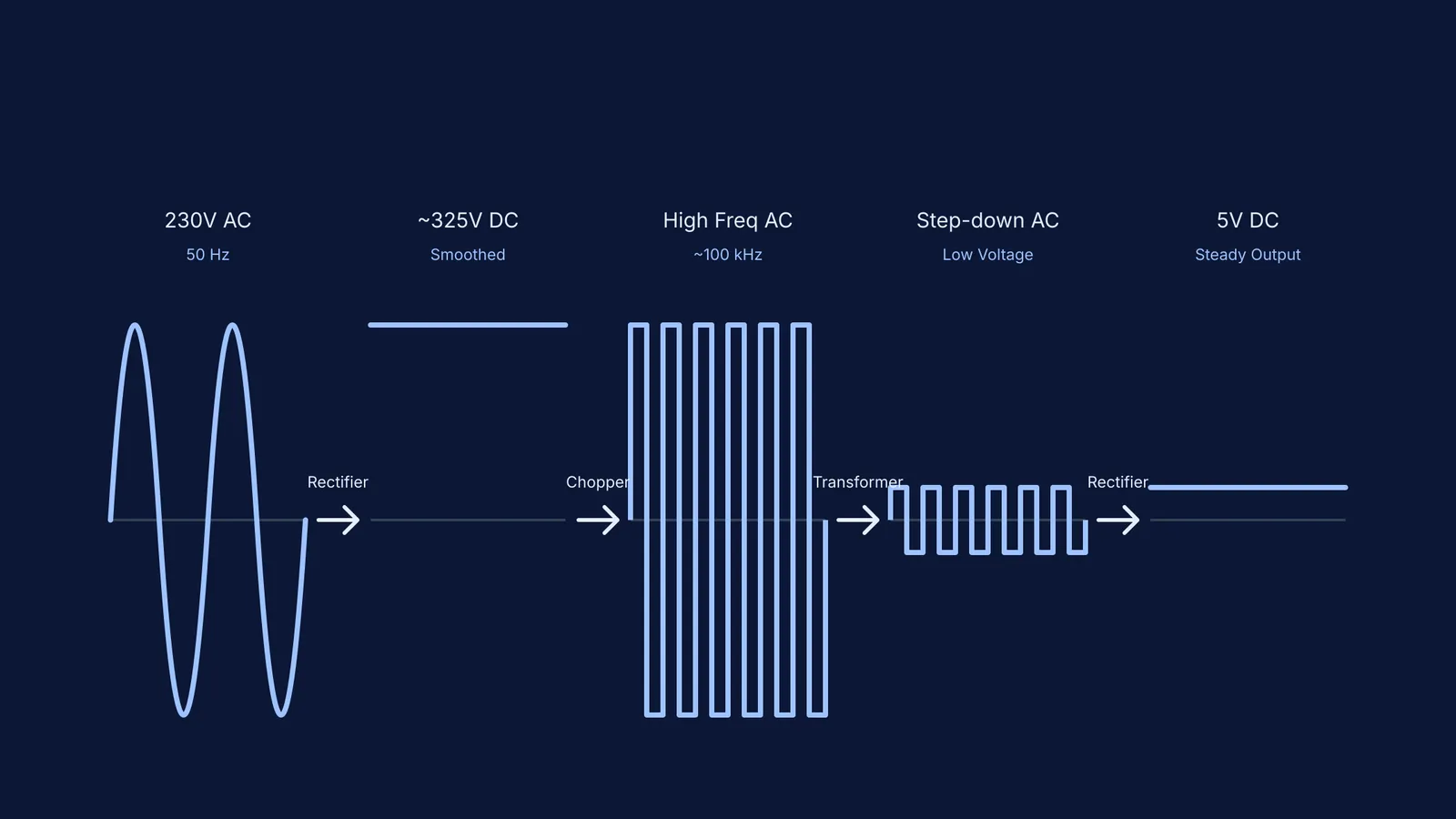
The magic happens inside a switched-mode power supply. It performs the conversion in four distinct stages:
First rectifier: Just like the half-wave and full-wave rectifiers you study in Class 12 physics, a bridge rectifier made of four diodes takes the 230 V AC and flips the negative halves upward. A capacitor then smooths it out into a high-voltage DC of about 325 V.
The chopper: A semiconductor switch, usually a MOSFET transistor, turns this high-voltage DC on and off incredibly fast. This chops the flat DC into a high-frequency AC square wave.
The transformer: This high-frequency AC is fed into a miniature transformer. As you learn in the transformers chapter, a changing magnetic field in the primary coil induces an electromotive force in the secondary coil to step the voltage down to a safe level, like 5 V or 9 V.
Second rectifier: Because the transformer outputs AC, another set of diodes and capacitors smooths this low-voltage AC back into the clean, steady 5 V DC your phone battery demands.
Why are modern chargers so small?
The secret to a pocket-sized charger is the chopper switch. The physical size of a transformer depends heavily on the frequency of the alternating current passing through it. A standard transformer running at the wall's low 50 Hz frequency requires a massive, heavy iron core to handle the magnetic flux without saturating.
By chopping the current at hundreds of kilohertz (kHz) or even into the megahertz (MHz) range, the transformer can be made tiny. According to engineering standards, this high-frequency switching allows switched-mode power supplies to reach 70% to 90% efficiency. The small amount of energy lost in the process is what makes the charger feel warm to the touch.
How can you master these circuits?
Understanding how electricity flows through rectifiers, transformers and diodes is crucial for board exams and engineering entrance tests. When you read a textbook, it can be hard to visualise how a capacitor smooths a rippling voltage or how a changing magnetic flux induces a current.
If you want to see these concepts in action, you can build these circuits yourself. The Fermi Simulation Lab has interactive simulations for the ideas that are easier to see than to read.
If you are confused by the difference between step-up and step-down transformers in your physics homework, Fermi's AI tutor asks questions to find the boundary of what the student knows, and builds a step-by-step plan to bridge the gap to the learning goal.
Component checklist for your next exam
When revising semiconductor electronics and alternating current for your exams, keep this functional checklist in mind. Understanding how these parts combine into a switched-mode power supply makes it easier to answer application-based questions:
Diode: A p-n junction that allows current to flow in only one direction. It is the core component of a rectifier, stripping away the negative half of the AC cycle.
Filter Capacitor: Stores charge when the voltage peaks and releases it when the voltage dips, smoothing out the bumpy output of a rectifier into a flatter DC.
Transistor (MOSFET): Acts as an incredibly fast, electrically controlled switch. In a charger, it chops the continuous DC into high-frequency pulses.
Step-down Transformer: Uses mutual induction between two coils to lower the voltage. It requires a changing magnetic flux to work, which is why the DC must be chopped into AC first.
Optocoupler: A combination of an LED and a photodiode that sends light signals across the circuit. It safely passes feedback from the low-voltage side to the high-voltage side to keep the 5 V output perfectly stable.


