On this page
On many Indian rooftops you will see a row of glass tubes tilted at the sky, with a steel drum above them. There is often no pump, yet the water is hot by evening. Three pieces of physics do the work: a black surface that soaks up sunlight, a vacuum that stops the heat leaking away, and hot water that rises on its own.
How does a solar water heater work on a rooftop?
The Haryana Renewable Energy Development Agency (HAREDA) puts it simply: a black absorbing surface inside the collector absorbs solar radiation and transfers the heat to water flowing through it, and the hot water is kept in an insulated tank. The same page says the water is easily heated to 60-80 °C, and that 100-300 litre systems suit homes.
The Delhi government's energy centre puts India's average solar incidence at 4-7 kWh per square metre per day.
Why is the absorber black?
Black absorbs most of the light that lands on it, but the dull black faces of Leslie's cube radiated the most heat, which shows the catch: a good absorber is also a good radiator. A hot black absorber would throw heat back out as infrared.
So collectors use a selective coating. The MNRE user's handbook on solar water heaters specifies an absorption coefficient of 0.94 or more and an emissivity of 0.12 or less. The coating takes in at least 94% of the sunlight but gives off no more than 12% of the infrared a perfect black body at the same temperature would.
Why do evacuated tubes have two layers of glass?
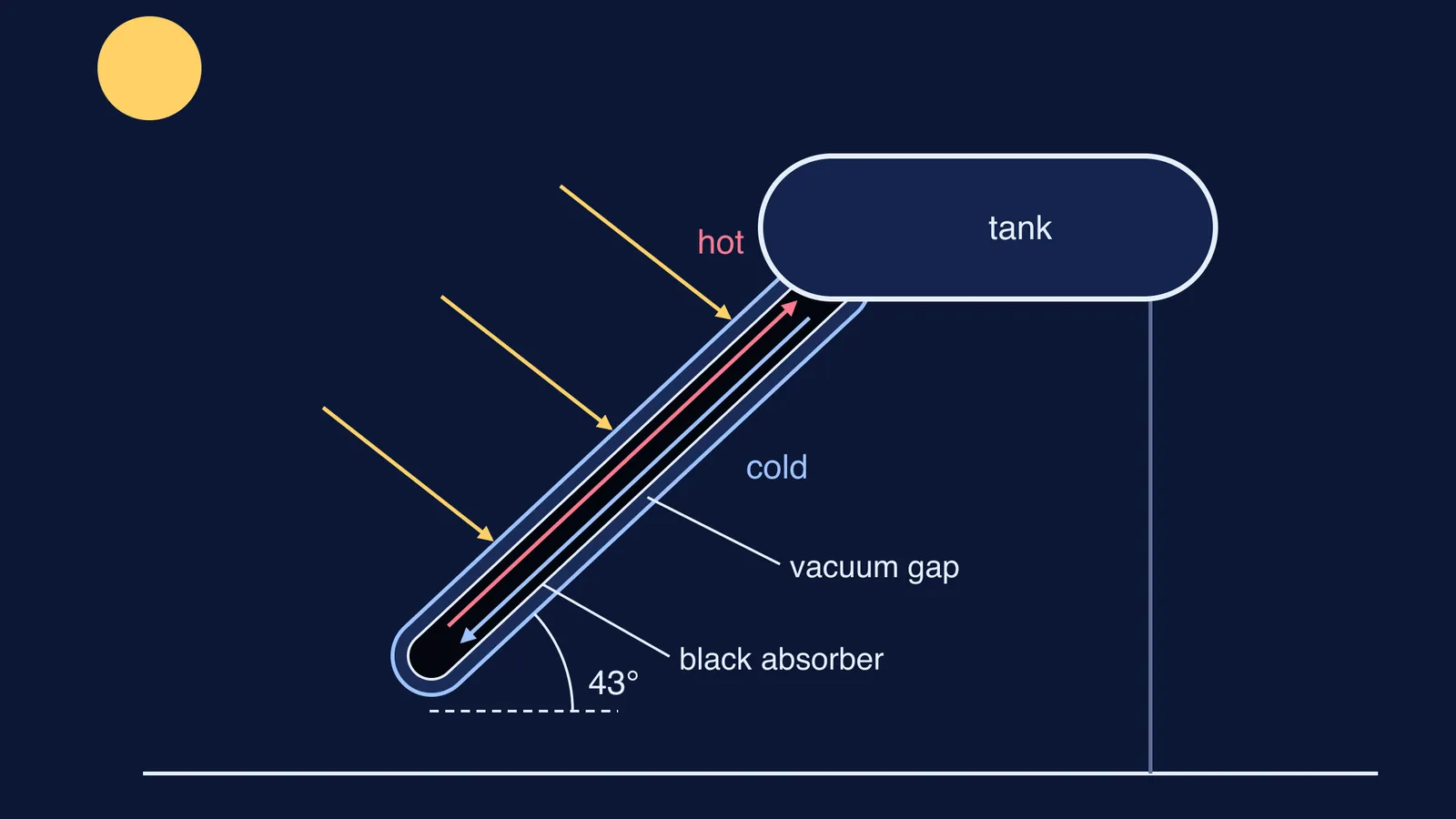
The same handbook explains that each tube is two glass tubes, one inside the other, fused at both ends, with the air between them pumped out so the vacuum works as insulation. The coating sits on the outer wall of the inner tube.
Conduction and convection need matter to carry heat, so a vacuum blocks both. Penn State's course notes say the gap is a vacuum, "so very little heat is lost from the fluid." Only radiation is left, and the coating keeps that small. It is the trick inside a thermos flask that keeps tea hot for hours.
How does hot water reach the tank without a pump?
Warm water is less dense than cold water, so it rises. The Pacific Northwest National Laboratory guide describes a thermosiphon system as a storage tank directly above the collector: water heated in the collector rises to the tank, while cool water sinks back into the collector.
That is why the tank sits higher than the collector. The MNRE handbook adds that for thermosiphon systems up to 500 litres, the cold-water supply must be at least 7 feet above terrace level.
You can see the same loop in our post on how convection currents form in a tank heated at one corner. The Fermi Simulation Lab has interactive simulations for ideas that are easier to see than to read.
How much heat does a 100-litre system give on a sunny day?
Table 8 of the MNRE handbook covers a 2 square metre collector on an average clear December day. For New Delhi it lists a 43° tilt, cold water at 10 °C, 6.64 kWh a day of sunlight at that tilt (which we read as per square metre) and about 102 litres at 60 °C. Let us check it with Class 11 physics.
Mass of 100 litres of water: about 100 kg.
Specific heat of water: 4,184 joules per kilogram per °C, says the USGS.
Heat to go from 10 °C to 60 °C: Q = mcΔT = 100 × 4,184 × 50 = 20.9 MJ.
In electricity units: 20.9 MJ ÷ 3.6 MJ per kWh = 5.8 kWh.
Sunlight on the collector: 2 m² × 6.64 kWh/m² = 13.3 kWh.
Share that ends up in the water: 5.8 ÷ 13.3 = about 44%.
That is in line with the handbook's efficiency table, which gives both collector types 0.46 when the fluid is 50 °C hotter than the outside air, and more at smaller differences. An electric geyser would need at least 5.8 units for the same job, and HAREDA estimates a 100-litre solar heater may save about 1,500 units of electricity a year.
How to work it out for your own home
The MNRE handbook lists solar radiation and output for many Indian cities.
Estimate your cold tap water's temperature on a winter morning.
Pick the temperature you want, usually 60 °C.
Work out Q = mcΔT for the tank, then divide by 3.6 million to get kWh.
Divide by about 0.45, the efficiency found above, to get the sunlight the collector must catch.
Divide by your city's daily sunlight per square metre to get the collector area.
If mcΔT or the joule-to-kWh step feels shaky, the Fermi Concept Library has a lesson for every concept in physics, so you can fill the gap before your next numerical.