

On this page
The meter by your front door decides your electricity bill, and more of them now report their own readings. By 30 June 2026, India had installed 7.24 crore smart meters, counting those on transformers and feeders as well as homes, with 20.33 crore sanctioned under the Revamped Distribution Sector Scheme, according to a written reply in Parliament reported by T&D India.
What does a kilowatt-hour actually measure?
Your bill charges you for energy, which is power multiplied by time. A watt is one joule per second, as the SI units table published by NIST defines it. One kilowatt-hour is the energy a 1,000-watt appliance uses in one hour, and the 'unit' on an Indian electricity bill is one kilowatt-hour, as this guide to reading an electricity bill explains. Since one hour is 3,600 seconds (NIST), one kWh is 1,000 × 3,600 = 3.6 million joules.
So a 100-watt fan running for 10 hours uses one unit. The units on your bill are this month's reading minus last month's.
How does an electricity meter measure energy?
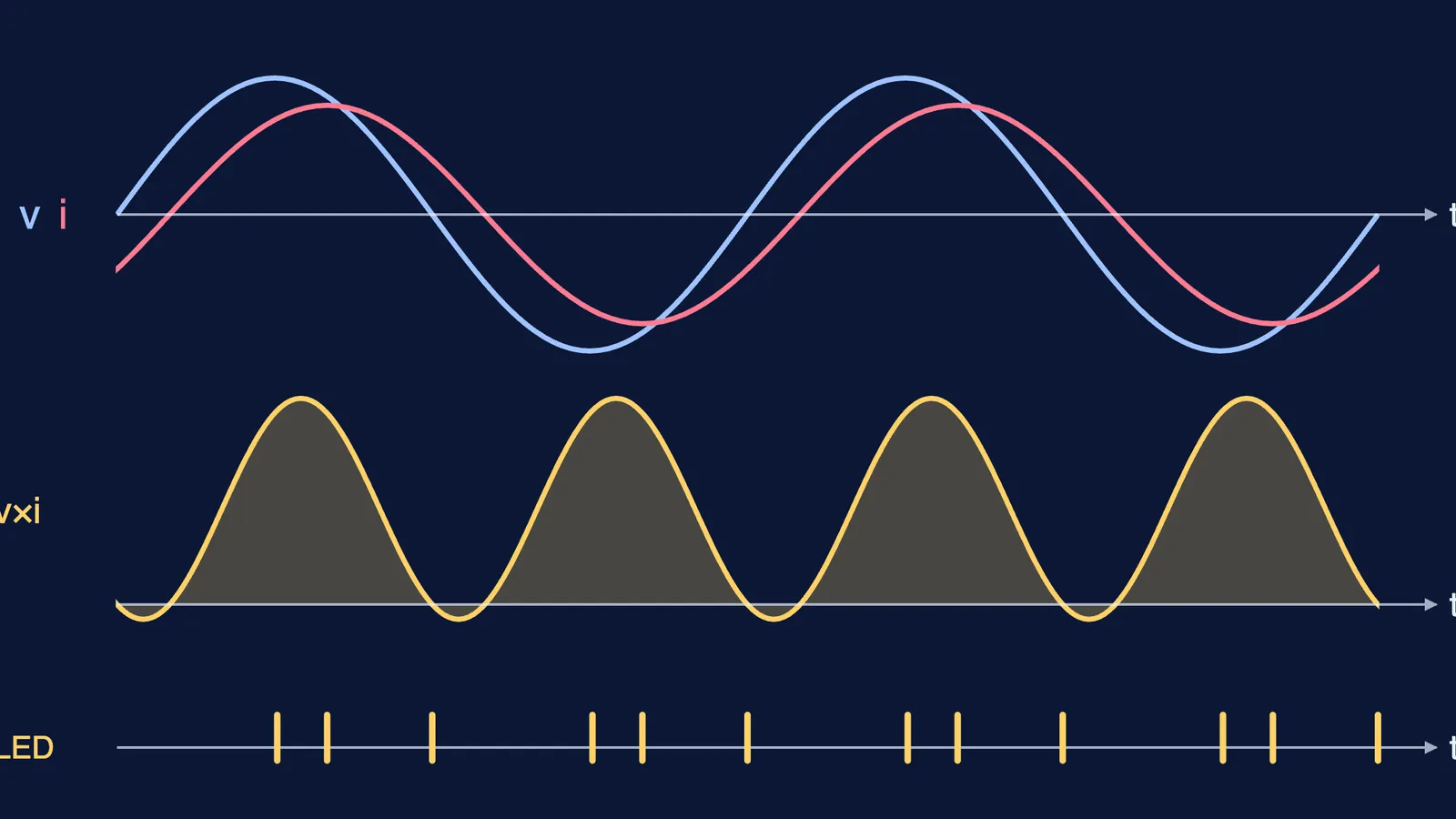
A modern electronic meter senses two things: the supply voltage and the current flowing into your home, often as a tiny voltage across a very small resistor called a shunt. A metering chip does the arithmetic. The datasheet for one such chip, Microchip's MCP3905, shows the design: two analogue-to-digital converters turn voltage and current into numbers, a multiplier combines them, and the chip sends out pulses at a frequency 'proportional to the average active real power'. Count the pulses and you have counted energy.
Why multiply moment by moment? With alternating current, voltage and current do not always rise and fall together. In a fan or motor the current lags the voltage, so for a short stretch of each cycle their product is negative. Multiplying at every instant, then averaging, gives the real power you use. Our explainer on power factor and phase angle works through the maths.
If a lagging current is hard to picture, the Fermi Simulation Lab has interactive simulations for ideas that are easier to see than to read.
How can you read your meter's blinking light?
Look on the front of your meter for a number followed by 'imp/kWh', impulses per kilowatt-hour; the MySensors energy-monitoring guide notes it is usually printed there. It is how many blinks make one unit. Look only: never open the meter box or touch the wiring.
A worked example, assuming your meter says 3200 imp/kWh (use yours):
Switch off everything you can, then switch on one appliance, say a kettle.
Count the blinks for 30 seconds. Say you count 40.
Energy used: 40 ÷ 3,200 = 0.0125 kWh.
Time taken: 30 seconds is 30 ÷ 3,600 = 0.00833 hours.
Power: 0.0125 ÷ 0.00833 = 1.5 kW. Compare that with the wattage printed on the kettle.
The shortcut: power in watts = blinks × 3,600,000 ÷ (imp/kWh × seconds counted).
Now turn it into money. A kettle running 6 minutes a day uses 1.5 kW × 0.1 h = 0.15 units a day, or 4.5 units in a 30-day month. Multiply by your tariff, remembering that many states charge in slabs, as our piece on electricity bill slab rates as a piecewise function shows. Then try your home with everything 'off' to find the standby load; our post on whether a phone charger uses power when idle does that maths for one charger.
How does a smart meter work, and what does prepaid add?
A smart meter measures energy the same way. It adds a communication link, a record of when you used energy and, if your discom offers it, a prepaid account.
Remote reading. Under India's amended consumer rules, smart meters must be read remotely at least once a day and the data shared with consumers, the Ministry of Power announced in June 2023.
Time-of-day prices. The same rules set the tariff in eight solar hours a day, chosen by your state regulator, at 10 to 20 percent below normal, and at peak hours 10 to 20 percent above. For consumers with smart meters, the rules make this effective immediately after installation.
Prepaid mode. You pay first and your use is drawn against the balance.
In a 2023 CEEW survey of nearly 2,700 urban households in six states, about 30 per cent of prepaid users recharged more than once a month. Nearly 12 per cent of those surveyed said paying had become harder, for reasons including fear of disconnection, and CEEW recommended timely alerts and several ways to pay.
What should you ask when a smart meter arrives?
Where can we see our daily readings: an app, a website or SMS?
What are the solar and peak hours in our tariff, and from when do they apply?
If we are prepaid, how will we be warned before the balance runs out, and how do we recharge?
Then note the meter's kWh reading at the same time on two days. The difference is your daily use; it should match the app.
The meter is school physics in a box: P = VI, energy equals power times time, and the phase between alternating voltage and current. To work through those ideas from where you are, Fermi's AI tutor works out what you already know and builds a plan for the session. Then go and count some blinks.


