

On this page
Plugging in an electric kettle to boil water seems like simple physics: electrical power in a resistive coil becomes thermal energy. Yet a stopwatch shows that boiling always takes longer than ideal formulas predict. Real-world thermal losses reshape the heating curve.
How long does a 1.5 kW kettle take to boil water?
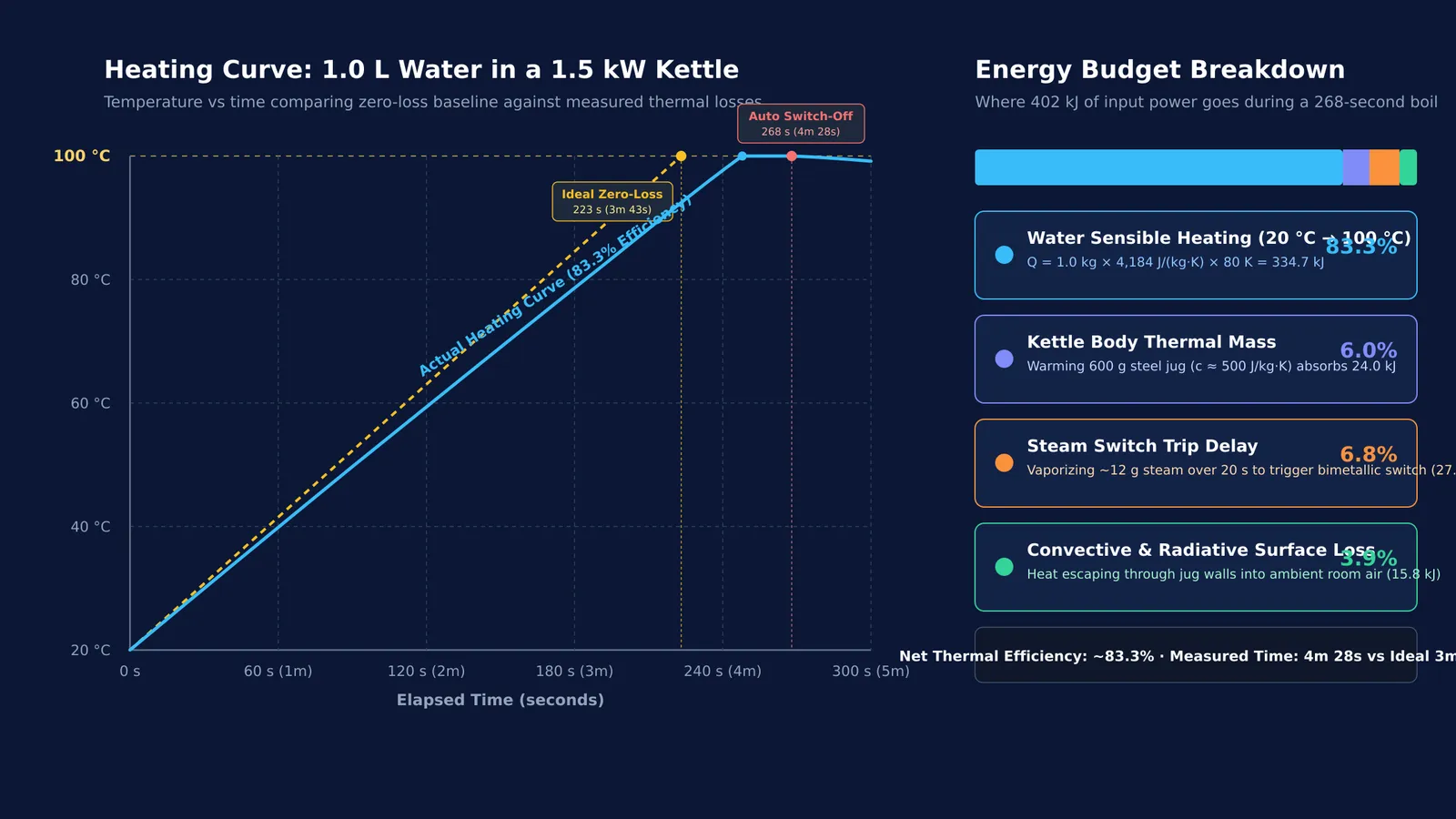
Consider 1.0 litre of water, with a mass of 1.0 kg. The specific heat capacity of liquid water at room temperature is approximately 4,184 J/(kg·K), tabulated near 4,182 J/(kg·K) at 20 °C in the NIST Chemistry WebBook. To heat water from 20 °C (293 K) to its boiling point of 100 °C (373 K), the temperature rise ΔT is 80 K.
The required heat energy Q is:
Q = m × c × ΔT = 1.0 kg × 4,184 J/(kg·K) × 80 K = 334,720 J (334.7 kJ)
A 1.5 kW heating element delivers 1,500 J per second via the heating effect of electric current. With zero heat loss, the ideal boiling time is:
t = Q / P = 334,720 J / 1,500 W = 223.1 seconds (3 minutes 43 seconds)
In Indian households where tap water starts near 25 °C, ΔT is 75 K, requiring 313,800 J and yielding an ideal time of 209.2 seconds (3 minutes 29 seconds).
Where does the missing heat go during boiling?
In real kitchen tests, a 1.5 kW kettle takes roughly 250 to 275 seconds before switching off. In an Ecodesign evaluation published in Sustainability, Antoine Durand and colleagues modelled domestic kettle efficiencies at 81.4% for standard 1.7-litre concealed-element models and 83.8% for 1.0-litre immersed-element models, with best available technology reaching 89.0% Durand et al., 2022.
The remaining 11% to 19% of energy escapes through three physical channels:
Heating the kettle body: A 600 g stainless steel jug has a specific heat capacity of roughly 500 J/(kg·K). Warming the vessel by 80 K absorbs 24.0 kJ of energy, an effect familiar from the principles of calorimetry and heat capacity.
Surface convection and radiation: As the kettle heats, thermal energy escapes through its walls into the cooler room air, dissipating roughly 12 kJ to 16 kJ over four minutes.
Latent heat of escaping steam: Kettles shut off via a bimetallic strip heated by steam channeled into the handle. Generating sufficient steam requires 15 to 20 seconds of vigorous boiling. Vaporizing roughly 12 grams of water at a latent heat of 2,260 kJ/kg consumes over 27 kJ.
How does water volume change kettle efficiency?
A kettle's thermal efficiency is not a fixed constant; it scales with water volume.
Because heating the vessel requires energy regardless of fill level, boiling a smaller volume devotes a larger fraction of total electricity to the kettle body. Durand and colleagues noted that a compact 1-litre kettle with an immersed element achieves 83.8% efficiency, whereas a larger 1.7-litre kettle with a concealed element reaches 81.4% efficiency due to greater vessel mass and indirect heating Durand et al., 2022.
However, boiling larger volumes always consumes more total kilowatt-hours. A study in Applied Energy led by D. M. Murray found that 67% of boiling events involve overfilling, with users boiling on average twice as much water as they pour out, citing widespread overfilling that costs consumers £66 million every year in the UK alone Murray et al., 2016. Furthermore, life-cycle research in Science of The Total Environment by Alejandro Gallego-Schmid and colleagues established that the use phase accounts for over 80% of a kettle's environmental impact across most categories, and heating only the water needed cuts that impact by 33% Gallego-Schmid et al., 2018. As temperature-time heating graphs show, heating surplus water wastes power across every degree.
How can you simulate kettle boiling time and power losses?
Simulation transforms abstract formulas into intuitive engineering. When numerical questions involve non-ideal thermal systems, the Fermi Problem Library provides worked problems with a step-by-step solver that explains the reasoning rather than printing an answer.
You can simulate a kettle's heating trajectory with this four-step plan using thermal data from the NIST Chemistry WebBook:
Set the ideal baseline: Compute the minimum energy Q = m × c × ΔT for your target water mass, dividing by power P to find the zero-loss time t_ideal.
Add vessel heat capacity: Combine water and vessel thermal capacities to obtain C_total = (m_water × c_water) + (m_vessel × c_vessel), setting the initial heating rate dT/dt = P / C_total.
Step through cooling losses: In 1-second steps, subtract convective loss q_loss = k × (T - T_room) from power P, updating temperature by dT = (P - q_loss) / C_total until water reaches 100 °C.
Evaluate power and volume sensitivity: Run comparative trials altering element power (1.0 kW vs 1.5 kW vs 2.2 kW) and volume (0.5 L vs 1.5 L) to track boiling times and net efficiencies.
In the Fermi Simulation Lab, interactive simulations let you test ideas that are easier to see than to read, exploring how power rating, water volume, and cooling losses shape the heating curve. For underlying principles, the Fermi Concept Library maps every concept across physics, chemistry, biology, mathematics, and computing.


