On this page
You close the fridge, remember the curd, and pull again. The door fights back. Nothing is broken: you are pulling against the air in your own kitchen.
Why is the fridge door hard to open right after closing?
While the door is open, cold air spills out and warm kitchen air takes its place. Shut the door and that warm air is sealed inside a box built to chill it.
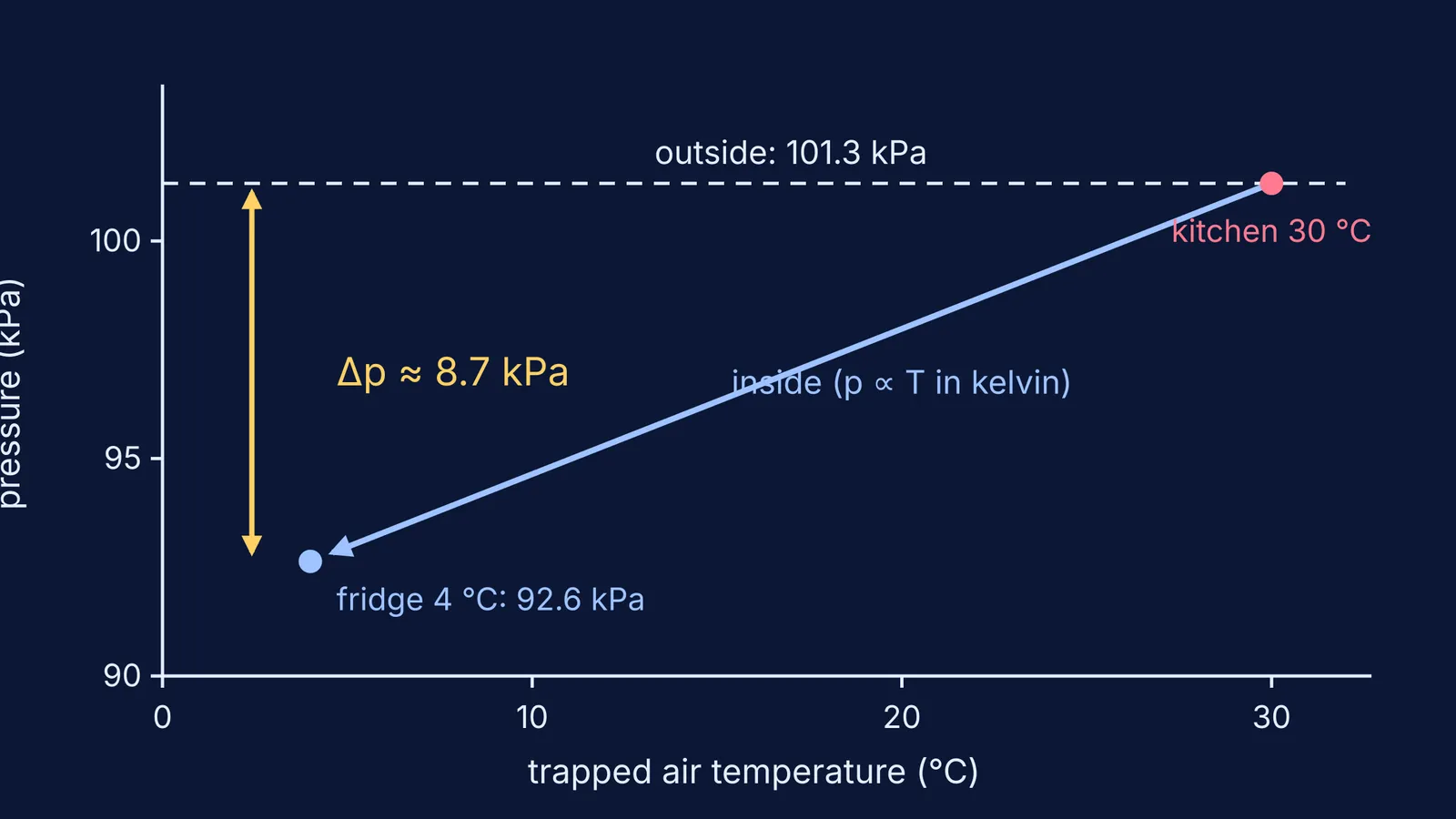
Gay-Lussac's law (also called Amontons's law) states that "the pressure of a given amount of gas is directly proportional to its temperature on the kelvin scale when the volume is held constant" (OpenStax Chemistry 2e). A closed fridge is close to a fixed volume, so as the trapped air cools, its pressure falls below the pressure outside.
Cambridge engineering professor Vikram Deshpande, answering this question for The Naked Scientists, adds a second cause: closing the door quickly or slamming it forces air out and lowers the mass of air inside. Both effects leave less push on the inside of the door than on the outside.
How much extra force is on the door?
The temperatures and door size below are our assumptions for an Indian kitchen in summer; swap in your own.
Outside pressure: one standard atmosphere is exactly 101,325 Pa (NIST).
Kitchen air: 30 °C, which is 303.15 K.
Fridge: 4 °C (277.15 K), the upper limit the US FDA recommends for a refrigerator (FDA).
Door: 0.55 m wide and 1.2 m tall, an area of 0.66 m². Measure yours with a tape.
Step 1: the worst case. Suppose every bit of air inside was warm kitchen air, and none leaks in while it cools to 4 °C. Gay-Lussac's law gives p₂ = p₁ × T₂/T₁ = 101,325 × 277.15/303.15 ≈ 92,640 Pa. The pressure difference is about 8,690 Pa.
Step 2: the force. Force = pressure difference × area = 8,690 × 0.66 ≈ 5,700 N, the weight of roughly 580 kg. You never feel that much, because only part of the air gets swapped and the seal leaks while it cools.
Step 3: a realistic case. A 1% drop in pressure needs the trapped air to cool by only about 3 °C on average, because 1% of 303 K is 3 K. That 1% is about 1,013 Pa, and on 0.66 m² it adds up to about 670 N, roughly the weight of a 68 kg person. So even a small pressure gap produces a pull your arm notices.
Why does the door get easier to open after a while?
The rubber gasket is not airtight. Deshpande explains that the low pressure is released "due to small leaks in the fridge seals" and that this takes several minutes (The Naked Scientists). As air seeps in, the gap between inside and outside pressure shrinks and the pull gets weaker until the door opens normally. AEG's advice is to wait approximately one minute before opening the door again if it has just been closed (AEG).
If you can't wait, a few habits help:
Close the door gently. Slamming pushes extra air out, the cause Deshpande describes.
Pull from the handle edge and let the seal peel. A small gap at one edge lets air rush in, so the pressures equalise before the whole door has to move.
Don't run the fridge colder than you need. Samsung's support guide suggests raising the temperature setting to reduce the vacuum pressure, setting it to suit the food load, and cleaning the door seal.
Why is the freezer door even harder to open?
Deshpande notes that because the freezer is colder than the fridge, the pressure difference between inside and outside is larger (The Naked Scientists). Run the same worst case with the freezer temperature of −18 °C (255.15 K) recommended by the FDA: p₂ = 101,325 × 255.15/303.15 ≈ 85,280 Pa. That is a gap of about 16,000 Pa, almost double the fridge's 8,690 Pa.
How can you practise this kind of problem?
This is a classic gas-law numerical in disguise: fixed volume, two temperatures, find the new pressure, then multiply by area to get force. Try it on your own fridge:
Measure the door's width and height and multiply to get its area in m².
Note your kitchen temperature and the fridge setting, and convert both to kelvin by adding 273.15.
Find the worst-case inside pressure with p₂ = p₁ × T₂/T₁.
Multiply the pressure difference by the area, then divide by 9.8 to see the equivalent mass in kg.
The same idea explains why hot water loosens a tight jar lid, how a constant-volume gas thermometer reads temperature, and why tyre pressure rises on long drives.
If you want more problems like this one, the Fermi Problem Library has worked problems with a step-by-step solver that explains the reasoning rather than printing an answer. If the kelvin step is the shaky part, the Fermi Concept Library has a lesson for every concept in physics, chemistry, biology, mathematics and computing, gas laws included.