

On this page
We have all been there: staring down a stubbornly tight lid on a jar of jam or pasta sauce. You try gripping harder, using a towel, or tapping the edge with a knife. But often, the most reliable trick is to run the lid under hot tap water for a few seconds, after which it twists off with surprisingly little effort.
Why does this simple trick work so well? The answer lies in two fundamental principles of physics: thermal expansion and thermal conductivity.
How do different materials respond to heat?
Every material expands when it gets hot and shrinks when it cools, because its molecules vibrate more violently and push further apart as they gain thermal energy. However, materials do not all expand at the same rate. The amount a material grows per degree of temperature increase is called its coefficient of thermal expansion (α).
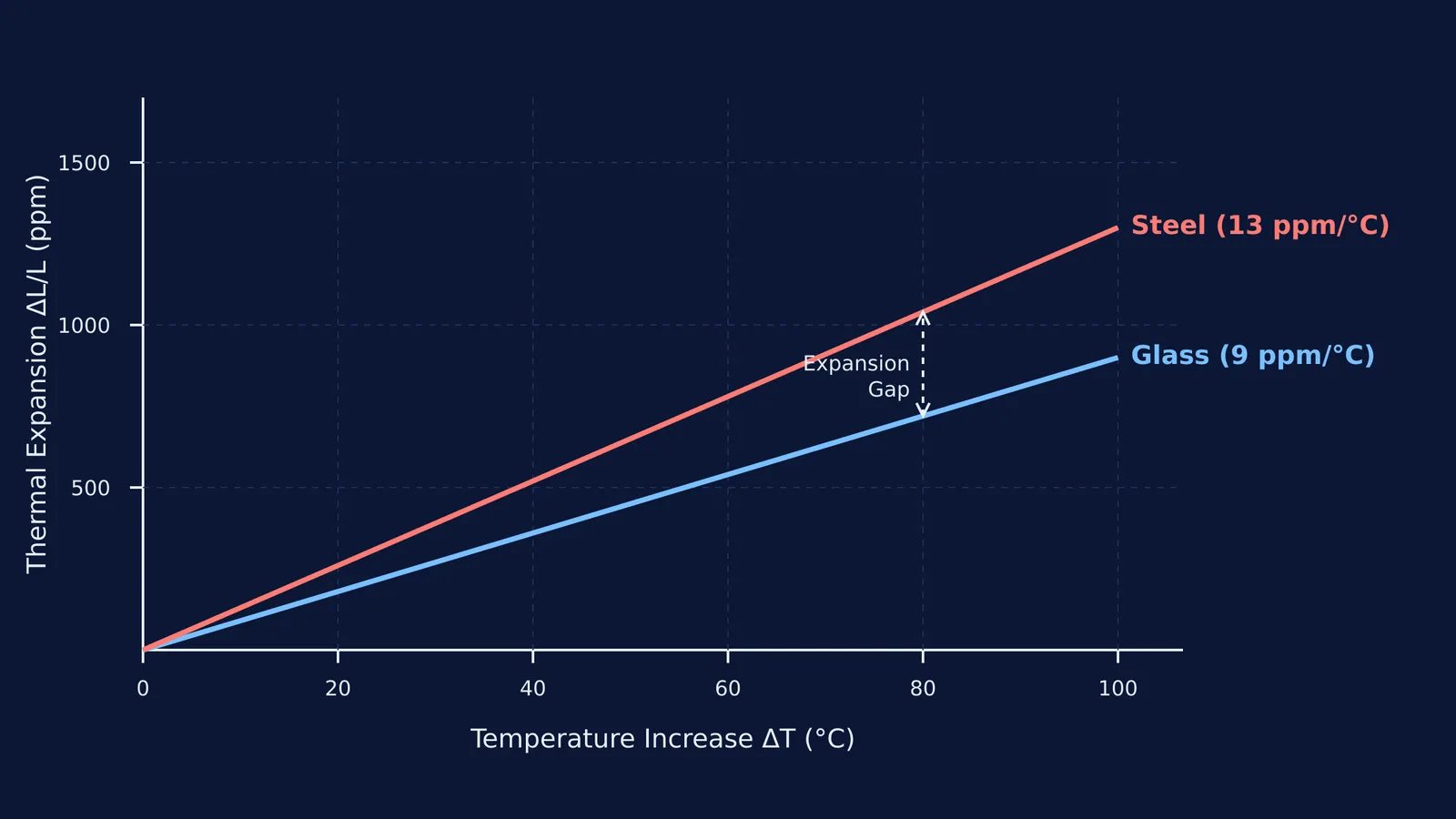
The glass jar and its metal lid are made of very different materials with distinct properties. According to HyperPhysics from Georgia State University, ordinary glass has a linear expansion coefficient of about 9 × 10⁻⁶ / °C (HyperPhysics). Steel, which is the most common material for jar lids, has a coefficient of roughly 13 × 10⁻⁶ / °C.
This means that for every degree the temperature rises, steel expands roughly 1.4 times (or 40%) more than ordinary glass. When both the jar and the lid are heated, the metal lid's circumference grows slightly larger than the glass rim it is screwed onto. This uneven expansion pulls the metal threads away from the glass, breaking the tight physical grip and reducing friction so you can easily twist the lid off.
If you find it hard to picture how atoms vibrate and push apart when heated, exploring thermodynamics in the Fermi Simulation Lab offers interactive models for ideas that are easier to see than to read. You can also use the Fermi Problem Library to work through step-by-step mathematical examples, such as thermal expansion problems, which explain how to calculate linear, area and volume changes.
Why does the water have to be hot?
Could you achieve the same loosening effect by just leaving the jar out on a hot summer day? Not quite, and the reason is thermal conductivity—the speed at which a given material transfers heat through its structure.
Metals are excellent thermal conductors because of how freely their electrons can move. Carbon steel has a thermal conductivity of 50.2 W/m·K, meaning it absorbs and spreads heat rapidly. Glass, on the other hand, is a thermal insulator, with a conductivity of just 0.8 W/m·K (HyperPhysics).
When you run hot tap water over the jar, the steel lid heats up almost instantly and expands to its new, larger size. The glass rim beneath it heats up much more slowly because it insulates against the rapid temperature change. In those crucial first few seconds, the lid reaches its maximum expanded state while the glass has barely changed size at all. This temporary structural difference creates the perfect window to open the jar. This specific timing mechanism relies on the exact same physics that makes a pendulum clock lose time in summer due to its rod expanding, or creates thermal stress in clamped rods when an object is heated but prevented from growing.
What is a physicist's checklist for stuck jars?
If thermal expansion alone does not work immediately, the jar might be fighting you with other forces. Here is a step-by-step physical plan to tackle a stuck lid:
Target the heat: Run the hot water *only* on the metal lid, rotating the jar slowly. If you heat the glass jar equally, it will eventually expand too, closing the microscopic gap you just created.
Break the vacuum: Many jars are vacuum-sealed at the factory to preserve freshness. The hot water often slightly softens the rubber gasket inside the lid, which helps air enter. If it is still stuck, use the back of a spoon to gently pry under the edge of the metal lid until you hear a small pop, equalizing the internal and external air pressure.
Dissolve the glue: If the jar contains something sticky like honey or jam, dried sugar crystals in the threads act like cement. Submerge the lid in hot water for a full minute to dissolve the sugars so they act as a slippery lubricant rather than a rigid glue.
Increase your friction: Thermal expansion reduces the friction between the lid and the glass, but you still need friction between your hand and the lid to apply torque. Dry the lid completely after the hot water bath, or use a rubber grip pad to maximize your turning force.


