On this page
Grass, grasshopper, frog, snake, hawk. Most food chains in your textbook stop around there, and the reason is not that nature runs out of animals. It runs out of energy, and a little arithmetic shows why.
Why do food chains have only 4 or 5 trophic levels?
A trophic level is an organism's feeding position in a food chain: producers are the first level, herbivores the second and carnivores the third, as NCERT's Class 12 Biology chapter on Ecosystem defines it.
The same chapter gives the reason chains stay short. In NCERT's words, the number of trophic levels in the grazing food chain "is restricted as the transfer of energy follows 10 per cent law", meaning only 10 per cent of the energy passes from one level to the next (NCERT, Ecosystem).
Where does the other 90 per cent go? At every level, organisms use much of their energy to stay alive, and it leaves as heat; NCERT's energy-flow figure shows heat leaving every level. Organisms that die become detritus, an energy source for decomposers. Our explainer on why energy flows one way but nutrients cycle covers that part.
You can see the result in real data. NCERT's pyramid of numbers for a grassland shows 5,842,000 producers supporting only 3 tertiary consumers, and its pyramid of biomass drops from 809 kg per square metre of plant dry weight to 1.5 kg at the top (NCERT, Ecosystem).
How much energy reaches the fifth trophic level?
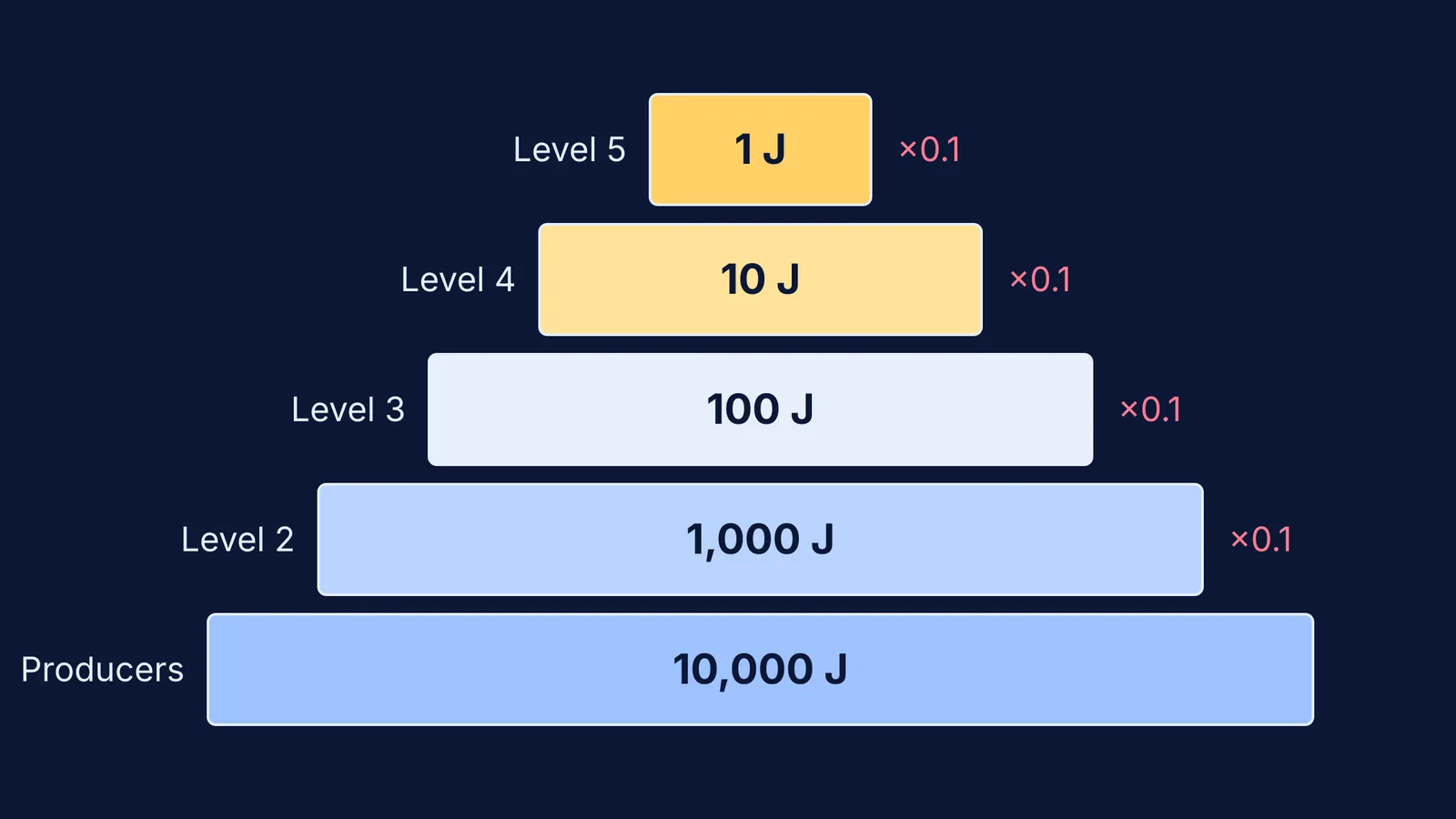
Apply NCERT's 10 per cent law to a field whose producers store 10,000 J, multiplying by 0.1 at every step:
Level 1, producers (grass): 10,000 J
Level 2, herbivores (grasshoppers): 10,000 × 0.1 = 1,000 J
Level 3, first carnivores (frogs): 1,000 × 0.1 = 100 J
Level 4, second carnivores (snakes): 100 × 0.1 = 10 J
Level 5, top carnivores (hawks): 10 × 0.1 = 1 J
The fifth level gets 0.01 per cent of the producers' energy; a sixth would get 0.1 J. The top runs dry after four or five steps.
Now go further back. NCERT says plants capture only 2 to 10 per cent of the photosynthetically active radiation (PAR), and PAR is less than 50 per cent of incoming sunlight (NCERT, Ecosystem). Even at the best case of 10 per cent, storing 10,000 J in plants needs 100,000 J of PAR, which means more than 200,000 J of sunlight. NCERT's own ideal pyramid of energy assumes 1 per cent and starts from 1,000,000 J of sunlight. Our post on what percentage of sunlight plants use goes into that first step.
Is the 10 percent law always exactly 10 per cent?
No. It is a rule of thumb. A 2021 review in Trends in Ecology & Evolution by Tyler Eddy and colleagues notes that a transfer efficiency of about 10 per cent is generally used as a characteristic value for marine ecosystems, but that ecosystem-scale transfer efficiency is highly variable and one of the most uncertain parameters in studying them (Eddy et al., 2021).
The review also notes that small changes compound across levels. With the same 10,000 J:
At 5 per cent per step, level 5 gets 10,000 × 0.05 × 0.05 × 0.05 × 0.05 = 0.0625 J.
At 10 per cent per step, level 5 gets 1 J.
At 20 per cent per step, level 5 gets 16 J.
Doubling the efficiency gives the top predator 16 times more energy, but it still gets a tiny share. The idea of tracking energy level by level goes back to Raymond Lindeman's 1942 paper in Ecology, "The Trophic-Dynamic Aspect of Ecology"; our profile of Raymond Lindeman and the energy budget of a lake tells that story.
How do you solve 10 percent law questions in exams?
Board and NEET-style questions on NCERT's 10 per cent law often test one of three moves:
Going up the chain. Multiply by 0.1 once per transfer. If producers have 20,000 J, level 3 gets 20,000 × 0.01 = 200 J.
Going down the chain. Divide by 0.1, which is the same as multiplying by 10. If a level 4 carnivore receives 50 J, the producers fixed 50 × 1,000 = 50,000 J.
Counting transfers, not levels. Producer to level 4 is three transfers, not four. This is an easy slip to make.
Also check whether the question starts from sunlight, PAR or energy stored in plants.
If you keep getting a factor of ten wrong, work problems where each step is written out. The Fermi Problem Library has worked problems with a step-by-step solver that explains the reasoning rather than printing an answer. If the gap is in the idea itself, such as trophic levels or energy flow, the Fermi Concept Library gives each concept its own lesson and its place in the map.