On this page
Revising Ecosystem for NEET-UG or your Class 12 boards? One line in section 12.4 carries a surprisingly small number. NCERT's Class 12 Biology textbook says that of the incident solar radiation, less than 50 per cent is photosynthetically active radiation (PAR), and that "plants capture only 2-10 per cent of the PAR and this small amount of energy sustains the entire living world."
The number is easier to remember, and to use in a numerical, once you can say where the rest goes.
What is PAR, and why is it less than half of sunlight?
PAR is the part of sunlight that plants can use for photosynthesis, taken in practice as wavelengths from 400 to 700 nm. A 2010 review in the Annual Review of Plant Biology by Zhu, Long and Ort puts this band at 48.7% of total incident solar energy. Most of the rest is near-infrared light, which, the same review notes, the leaves of healthy crops mostly transmit rather than absorb.
Where does the rest of the sunlight go?
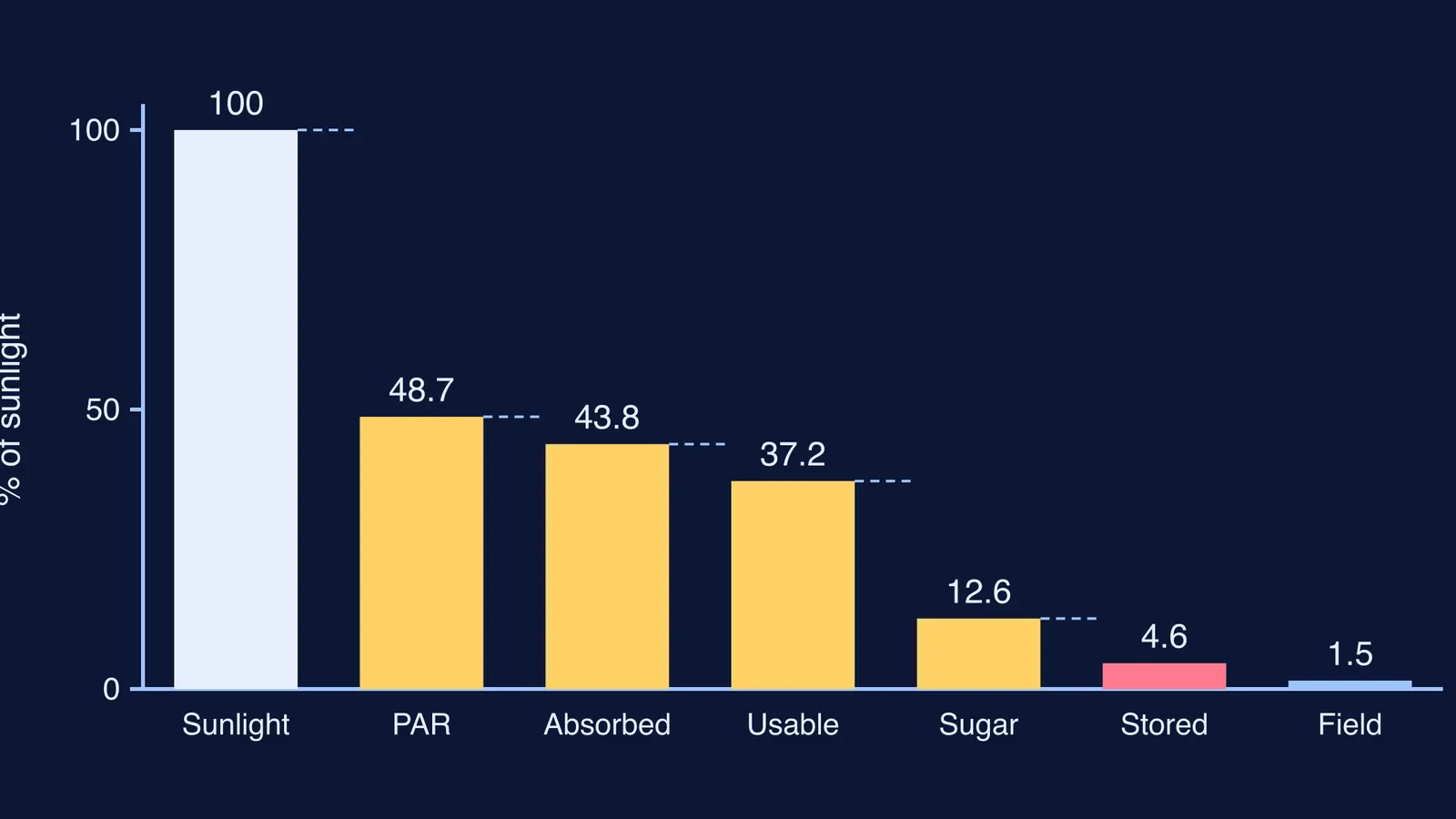
The Zhu, Long and Ort review traces the losses step by step for a leaf under ideal conditions at 30 °C. Here is what is left at each stage, as a share of all the sunlight hitting the leaf:
Outside PAR: 51.3% is lost, leaving 48.7%.
Reflected and transmitted: leaves absorb about 90% of PAR, partly because chlorophyll absorbs weakly in the green band, leaving 43.8%. Our post on why leaves look green explains that part.
Photochemical inefficiency: a blue (400 nm) photon carries 75% more energy than a red (700 nm) one, but the reaction centres run on the energy of a red photon, so the extra is lost as heat. That leaves 37.2%.
Thermodynamics and building sugar: only 63% of a red photon's energy can do work, and turning CO2 into carbohydrate costs more again. Before photorespiration, a C3 leaf is down to 12.6%.
Photorespiration and respiration: in C3 plants, Rubisco also reacts with oxygen, roughly halving the efficiency, and the plant burns some sugar to keep itself running. The final ceiling is 4.6% for C3 plants and 6% for C4 plants, which avoid most photorespiration at the cost of extra ATP (see why C4 plants need more ATP).
Measured against PAR alone, the ceilings are 9.4% for C3 and 12.3% for C4, so the top of NCERT's range is roughly the theoretical best for a C3 crop. The review says the highest efficiencies observed in crops are, with few exceptions, about one-third of the theoretical value, and a modern soybean crop it analysed converted roughly 1.5% of full-spectrum sunlight into biomass.
How much sugar does one square metre of crop make in a day?
India's average solar incidence is 4-7 kWh per square metre per day, according to the Delhi government's Energy Efficiency and Renewable Energy Management Centre. Take a sunny day of 5 kWh on 1 m² of crop.
Total sunlight: 5 kWh × 3.6 MJ per kWh = 18 MJ.
PAR: 18 × 0.487 ≈ 8.8 MJ.
NCERT's range: 2-10% of 8.8 MJ is about 0.18 to 0.88 MJ captured.
Theoretical C3 ceiling: 4.6% of 18 MJ ≈ 0.83 MJ.
A field crop like the review's soybean: 1.5% of 18 MJ ≈ 0.27 MJ.
Now turn energy into sugar. Zhu, Long and Ort note that one-sixth of a mole of glucose (a one-carbon carbohydrate unit, 30 g) holds 477 kJ. So 270 kJ ÷ 477 kJ × 30 g ≈ 17 g of carbohydrate for the whole square metre that day, as a rough estimate. At the theoretical ceiling it is about 52 g, and NCERT's range works out to roughly 11 to 55 g.
At the C3 ceiling, the 18 MJ splits like this:
9.2 MJ is outside PAR
0.9 MJ is reflected or passes through the leaf
1.2 MJ becomes heat from photochemical inefficiency
4.4 MJ goes to the thermodynamic limit and the cost of building sugar
1.4 MJ goes to photorespiration and respiration
0.8 MJ is stored
These add back to 18 MJ, give or take rounding: nothing disappears, which is the first law of thermodynamics at work.
How do exam questions test this?
PAR or total sunlight? In NCERT's energy flow section, "less than 50%" is the share of sunlight that is PAR; 2-10% is the share of PAR captured. Mixing them up is an easy slip.
GPP and NPP: NCERT defines net primary productivity as GPP minus respiration losses (R). The plant's own respiration in step 5 is that R, which is why NPP is always less than GPP.
What happens next: stored energy passes up the food chain with large losses at each step; our worked energy-flow numericals carry the budget one level further.
If the unit conversions are where you slip, the Fermi Problem Library has worked problems with a step-by-step solver that explains the reasoning rather than printing an answer. And if PAR, GPP or photorespiration still feel shaky, each has its own lesson in the Fermi Concept Library.