On this page
Every student learns from the NCERT Class 11 Biology chapter on photosynthesis that the Calvin cycle needs 18 ATP to make one glucose. Then the C4 pathway raises a harder question: why do C4 plants need more? Below we count every ATP and show why maize or sorghum pays the extra in a hot field.
How much ATP does a C3 plant use per glucose?
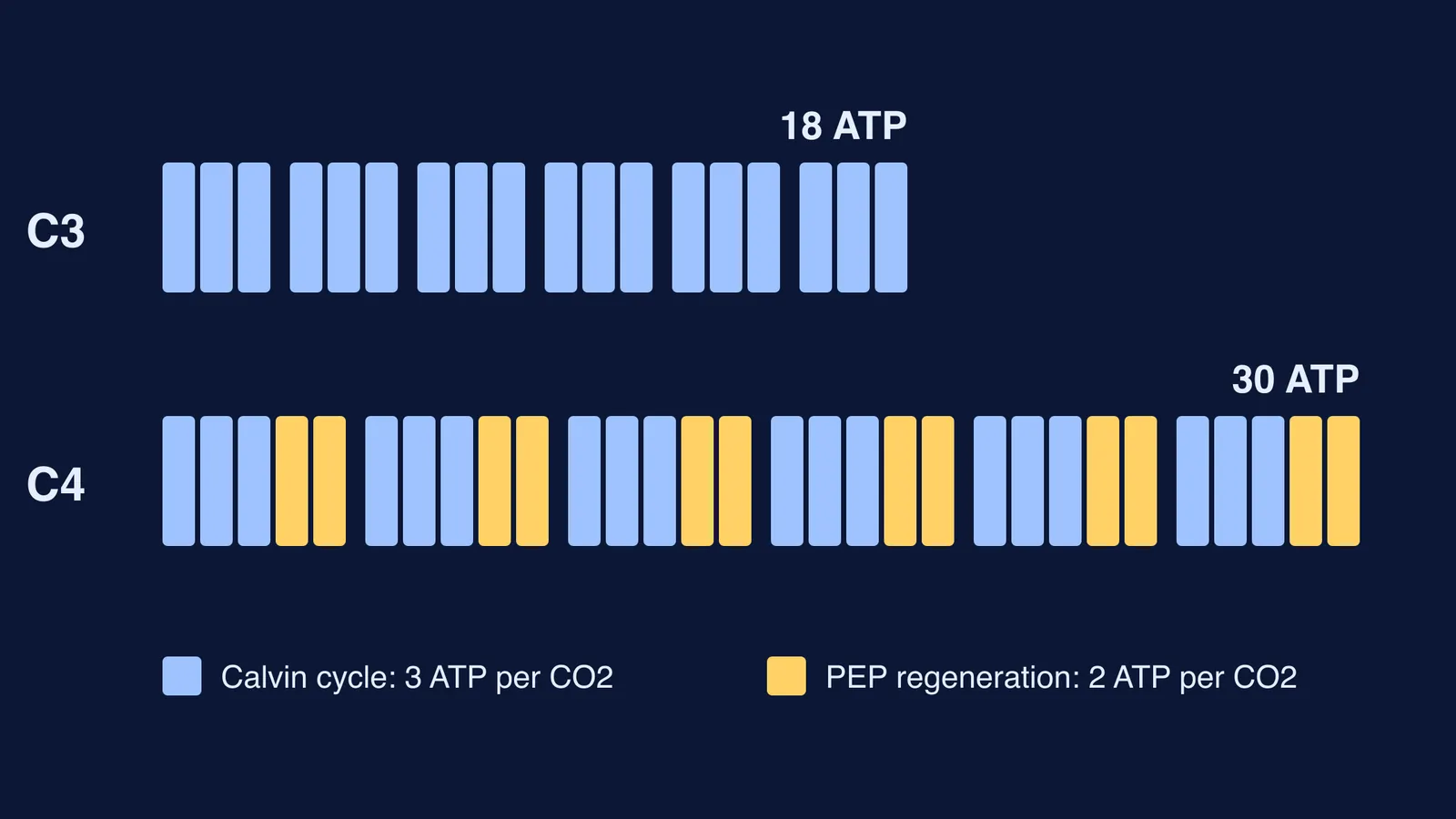
The Calvin cycle needs 3 ATP and 2 NADPH for every CO2 molecule it fixes, according to the NCERT Class 11 Biology chapter on photosynthesis in higher plants. Two ATP go into the reduction stage and one into regenerating RuBP. Six turns make one glucose, so NCERT's balance sheet reads 18 ATP and 12 NADPH in, one glucose out. Our post on the Calvin cycle in numbers walks through each stage.
Where does the extra ATP go in the C4 cycle?
NCERT's chapter also describes the Hatch and Slack pathway. In the mesophyll cells, the enzyme PEP carboxylase fixes CO2 onto PEP (phosphoenolpyruvate, a 3-carbon molecule) to make the 4-carbon oxaloacetic acid. That C4 acid, or the malic or aspartic acid made from it, moves into the bundle sheath cells, where it is broken down to release CO2 for the ordinary Calvin cycle. The leftover 3-carbon molecule returns to the mesophyll and is turned back into PEP.
That last step is where the extra cost sits. The enzyme pyruvate, phosphate dikinase (PPDK) runs the reaction ATP + pyruvate + phosphate gives AMP + PEP + diphosphate. Notice the AMP: the ATP loses two phosphates, not one, so rebuilding it costs two.
A C4 plant spends 2 ATP to regenerate each molecule of PEP, as Yin and Struik's 2018 energy-budget model in New Phytologist counts it. In the NADP-ME type of C4 plant, that brings the total to 5 ATP per CO2 fixed instead of 3, while the NADPH need stays at 2. Treat this as a minimum: the model notes that some CO2 leaks back out of the bundle sheath, which raises the real cost. For the anatomy behind the shuttle, see our post on Kranz anatomy and the bundle sheath.
Here is the textbook count for one glucose:
C3 plant: 6 CO2 x 3 ATP = 18 ATP, plus 6 x 2 = 12 NADPH.
C4 plant, Calvin cycle part: the same 18 ATP and 12 NADPH.
C4 plant, pump part: 6 PEP regenerated x 2 ATP = 12 ATP.
C4 total: 18 + 12 = 30 ATP and 12 NADPH.
Comparison: 30 / 18 is about 1.7, so roughly two-thirds more ATP.
Why is the extra ATP worth it in hot climates?
The answer is RuBisCO. NCERT explains that its active site binds both CO2 and O2; in C3 plants some O2 binds, starting photorespiration, which releases CO2 and makes no sugar, ATP or NADPH. C4 plants raise the CO2 concentration around RuBisCO in the bundle sheath, so it works as a carboxylase and photorespiration is minimised. Our photorespiration explainer covers the oxygenase reaction itself.
Heat makes that waste worse. Ehleringer and Björkman (1977, Plant Physiology) measured how much CO2 leaves fix per unit of light absorbed. At 30 °C, C3 plants fixed 0.0524 mol CO2 per einstein in normal air but 0.0733 in 2% oxygen, so oxygen cut their yield by about 29%. C4 plants fixed 0.0534 in normal air and 0.0538 in low oxygen, almost no difference. The C3 yield depended strongly on leaf temperature; the C4 yield did not change with temperature over the range measured.
In cool leaves, the cheaper C3 route wins; as leaves warm, photorespiration grows until it costs more than the C4 pump. Osborne and Beerling (2005) call the point where cost matches benefit the crossover temperature, and describe the C4 system as a trade-off that helps light-use efficiency at high temperatures and lowers it at low temperatures.
Zhu, Long and Ort (2008) estimated the maximum efficiency of turning sunlight into biomass at 4.6% for C3 photosynthesis at 30 °C and 380 ppm CO2, but 6% for C4.
How do you write this answer in an exam?
A four-line frame for a short answer:
State the cost: C4 plants need 5 ATP per CO2 (30 per glucose, as Yin and Struik count it) against 3 ATP per CO2 (18 per glucose, NCERT) in C3 plants.
Name the step: the extra 2 ATP regenerate PEP from pyruvate in the mesophyll cells.
Name the benefit: concentrating CO2 in bundle sheath cells keeps RuBisCO working as a carboxylase, so photorespiration is negligible.
Link it to climate: photorespiration rises with temperature, so in hot, bright places the saved carbon is worth more than the extra ATP.
If the C3 and C4 steps still blur together, the Fermi Concept Library gives each concept its own lesson and its place in the map. For more sums, the Fermi Problem Library has a step-by-step solver that explains the reasoning rather than printing an answer.