

On this page
In standard C3 plants such as wheat and rice, photosynthetic enzymes operate inside mesophyll cells exposed to intercellular air spaces. At temperatures above 25 °C, RuBisCO frequently binds oxygen rather than carbon dioxide, triggering why RuBisCO wastes energy in C3 plants through photorespiration and wasting over 25% of fixed chemical energy. To prevent this loss, warm-climate grasses evolved a structural adaptation called Kranz anatomy. Derived from the German word for "wreath", Kranz anatomy was first documented in 1884 by Gottlieb Haberlandt and reviewed by Lundgren et al. (2014).
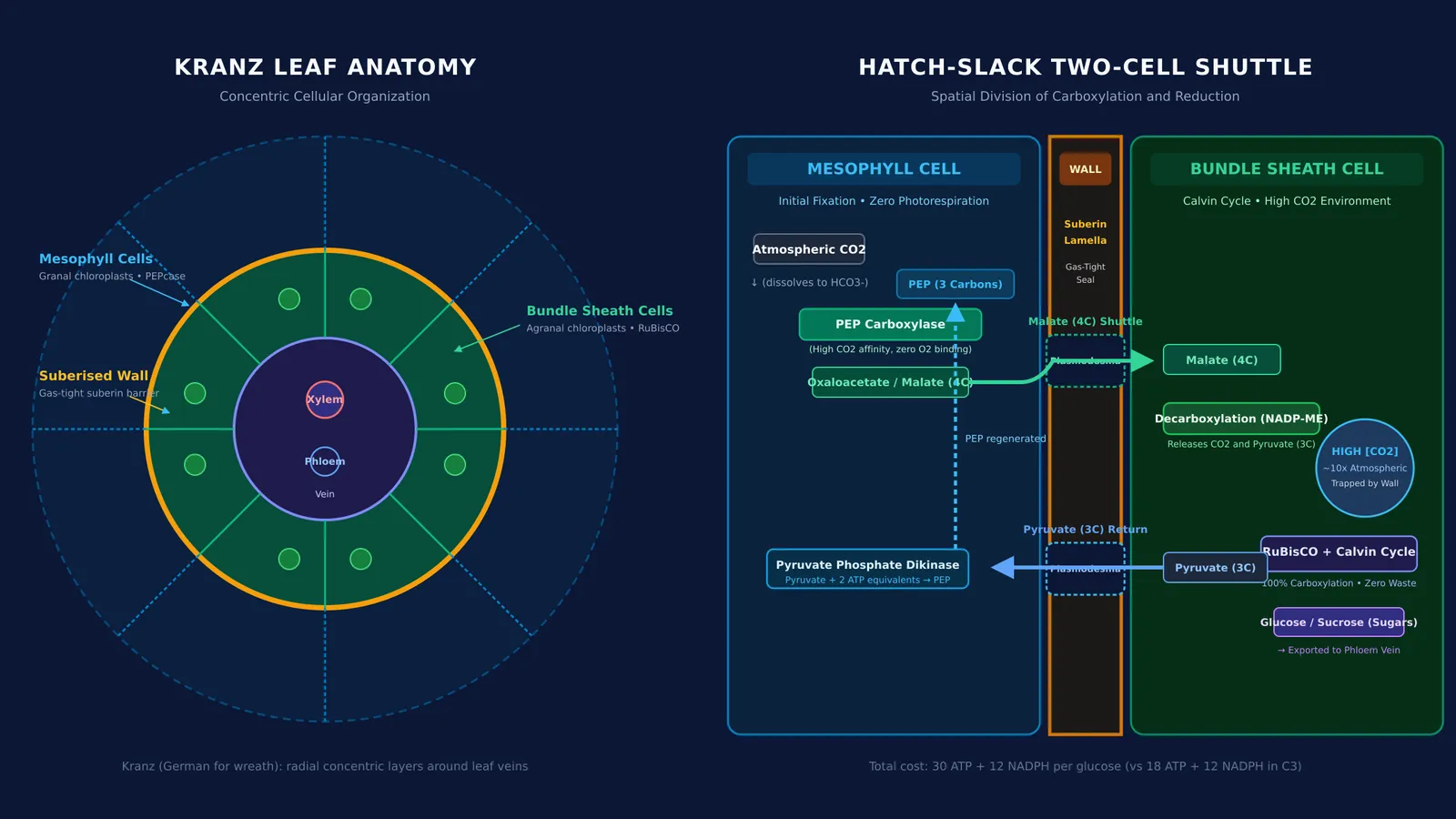
Instead of scattering chloroplasts loosely across spongy tissue, C4 leaves organise photosynthetic cells into two concentric rings around each vascular bundle. Large bundle sheath cells form the inner ring encircling the vascular bundle, while mesophyll cells form the outer ring. According to Rowan F. Sage (2016), C4 photosynthesis evolved independently across 61 lineages and encompasses 8,145 species in 19 families. Although C4 species comprise only about 3% of terrestrial vascular plants, their structural efficiency generates roughly 23% of global terrestrial primary productivity.
Why do bundle sheath cells have thick walls and no intercellular spaces?
Under a microscope, bundle sheath cells in maize and sugarcane stand out by their size and dense packing. In plant anatomy and secondary biology curricula, three diagnostic features characterise bundle sheath cells:
Thick cell walls that are suberised and impervious to gas exchange.
No intercellular spaces between adjacent cells.
A large number of chloroplasts rich in starch granules.
These adaptations act as a gas-tight seal. Thick walls prevent concentrated carbon dioxide from leaking back into the mesophyll. Genetic evidence from Danila et al. (2021) showed that disrupting suberin lamellae in Setaria viridis bundle sheath walls produced a more than two-fold increase in gas conductance, causing carbon dioxide leakage that lowered photosynthetic rates. The lack of intercellular spaces forces all metabolites to pass through regulated cytoplasmic junctions called plasmodesmata.
How do mesophyll and bundle sheath cells divide photosynthetic labour?
Kranz anatomy works because it divides photosynthesis into two physical compartments, a mechanism discovered in sugarcane by M. D. Hatch and C. R. Slack (1966). You can read more about Marshall Hatch and Roger Slack's discovery of the C4 pathway to see how isotope tracing proved that four-carbon acids form first. In C4 leaves, the two cell types play distinct biochemical roles:
Mesophyll cells capture carbon: Atmospheric carbon dioxide dissolves as bicarbonate in mesophyll cytoplasm. Phosphoenolpyruvate carboxylase (PEPcase) fixes it onto phosphoenolpyruvate (PEP, 3 carbons) to form oxaloacetate (OAA, 4 carbons). Crucially, PEPcase has zero affinity for oxygen, avoiding photorespiration entirely. Mesophyll cells lack RuBisCO.
Bundle sheath cells produce sugars: The 4-carbon acid moves through plasmodesmata into bundle sheath cells and undergoes decarboxylation, releasing carbon dioxide around RuBisCO. The resulting 3-carbon pyruvate returns to the mesophyll to regenerate PEP.
Because the bundle sheath is physically sealed and constantly fed by the mesophyll pump, internal carbon dioxide concentrations reach saturated levels directly around RuBisCO. At these elevated concentrations, RuBisCO operates exclusively as a carboxylase, driving the Calvin cycle forward while its wasteful oxygenase function is entirely suppressed. When exploring these interconnected cellular loops alongside core photosynthesis mechanisms for NEET, keeping track of cellular compartments is often where students get confused. The Fermi Concept Library includes every concept in physics, chemistry, biology, mathematics and computing, each with its own lesson and its place in the map.
How should you solve NEET questions on the Hatch-Slack pathway?
Competitive examinations frequently test the contrast between mesophyll and bundle sheath cells, as well as the energetic stoichiometry of C4 photosynthesis reviewed by Marshall D. Hatch (1987)80009-5). To avoid common trap answers, verify each question using this three-step diagnostic framework:
Check enzyme compartmentalisation: Mesophyll cells contain PEPcase but lack RuBisCO. Bundle sheath cells contain RuBisCO but lack PEPcase. RuBisCO never fixes initial carbon in C4 mesophyll.
Check chloroplast dimorphism: Mesophyll chloroplasts have grana stacks and Photosystem II to generate ATP and NADPH. Bundle sheath chloroplasts in maize are agranal and lack Photosystem II, preventing oxygen generation near RuBisCO.
Count the ATP cost: Fixing 1 carbon dioxide in the Calvin cycle consumes 3 ATP and 2 NADPH. Regenerating PEP in the mesophyll consumes 2 additional ATP equivalents via pyruvate phosphate dikinase. Synthesizing 1 glucose molecule (6 carbon atoms) in C4 plants requires 30 ATP and 12 NADPH, compared to 18 ATP and 12 NADPH in C3 plants.
Consider a typical examination problem: "How many additional ATP molecules does a sugarcane plant consume compared to a wheat plant to synthesize 5 moles of hexose sugar?" Wheat uses C3 photosynthesis (18 ATP per mole of glucose, totaling 90 ATP). Sugarcane uses C4 photosynthesis (30 ATP per mole, totaling 150 ATP). The extra energy required is 150 − 90 = 60 moles of ATP. If you want to practice multi-step questions without getting stuck on wrong-method mistakes, the Fermi Problem Library has worked problems with a step-by-step solver that explains the reasoning rather than printing an answer.


