On this page
You put toor dal and water in the cooker, close the lid, and a few minutes later grey froth is spitting out of the vent and crusting on the lid. That froth is not dirt or a faulty cooker. It is chemistry: molecules that leak out of the pulse coat each steam bubble so it refuses to burst.
Why does dal foam while cooking?
Bubbles in boiling plain water burst at the surface. In dal they pile up, because of what dissolves out of the pulse.
The first ingredient is protein. Researchers studying chickpea cooking water (aquafaba, the liquid used as an egg-free meringue) note that enough chickpea protein has to dissolve into the broth for it to foam. These proteins need to be partly unfolded, so their water-avoiding parts point into the air bubble and their water-loving parts stay in the liquid. They form a thin, elastic skin around each bubble.
The second ingredient is saponins. A saponin is a molecule with one water-loving sugar part and one fat-loving part, which is why saponins have foaming and emulsifying properties, much like soap. Pulses differ a lot here. An Indian study of four pigeon pea (arhar or toor) varieties measured saponin contents of 2,164 to 3,494 mg per 100 g in the raw seeds.
Starch and other carbohydrates make the water thicker, so the liquid may drain out of the bubble walls more slowly. The same aquafaba study suggests that complex polysaccharides could raise the viscosity of the liquid and help stabilise it. Proteins and saponins make the skin; thick liquid helps keep it from thinning and popping.
Why can foam block the pressure cooker vent?
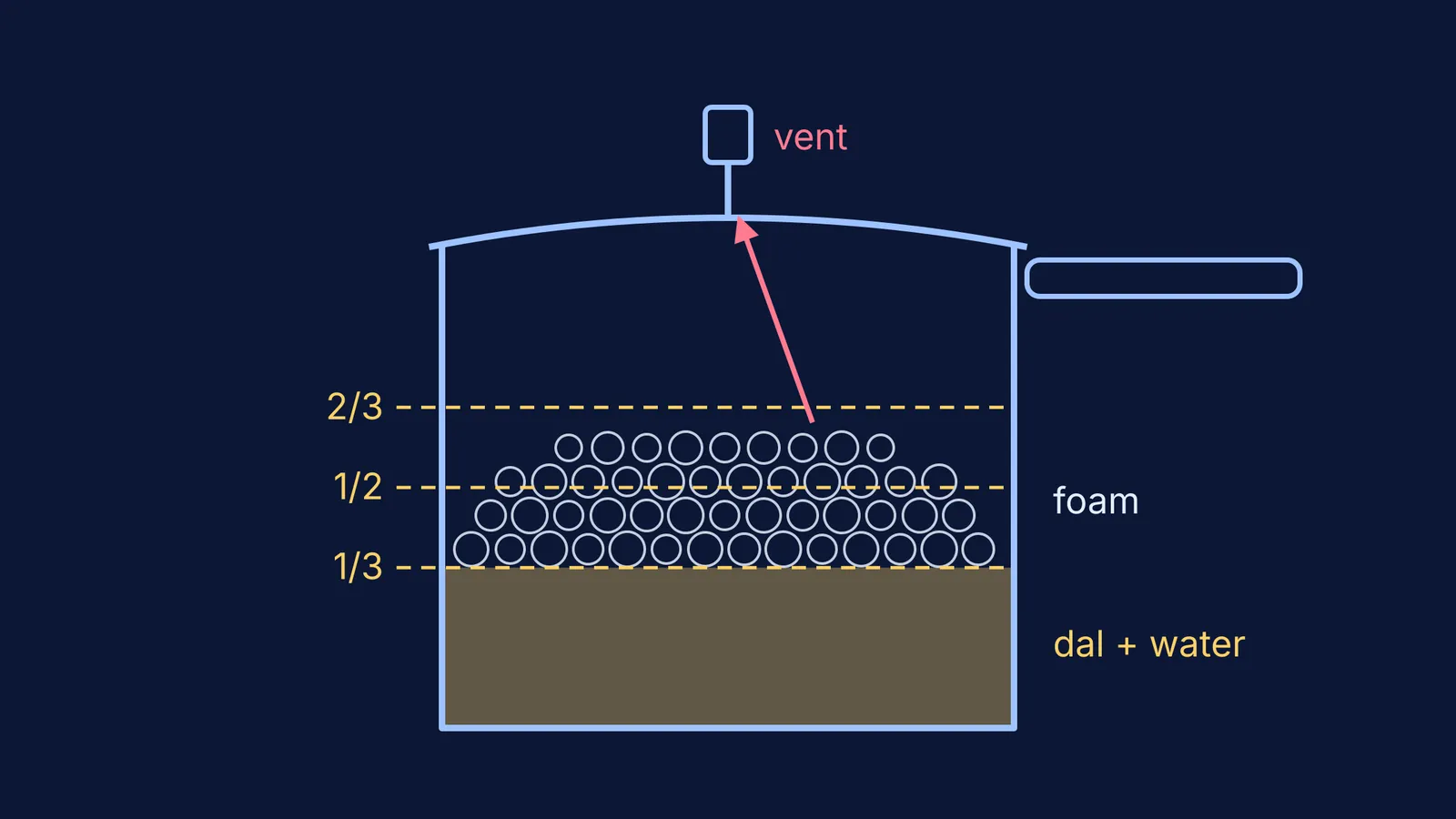
A cooker works by trapping steam until pressure builds, then letting the excess out through a narrow vent tube under the weight (here is why that weight whistles). Steam passes through easily. Froth carrying bits of dal skin does not.
The Hawkins Hevibase instruction manual is direct about this. It says foods such as lentils, beans and rice, which expand or froth, should fill no more than half the cooker body, and that dals which froth excessively and sprout out of the cooker, "especially tuvar dal and moong dal", should fill no more than one-third. It warns that overfilling may cause a risk of clogging the vent tube and developing excess pressure, the situation the cooker's safety valve is there for. Hawkins calls this froth escaping from the cooker "sprouting".
Does a drop of oil really stop dal foaming?
It helps, and there is physics to explain why. A review by Nikolai Denkov in Langmuir, on oil-based antifoams used in industry and consumer products, explains that the fastest ones break foam by forming "oil bridges" between the two surfaces of a bubble wall, which then rupture the film. In a typical foam-stability test, these fast antifoams destroy the foam completely in less than a minute. It did not test cooking oil in dal.
The same Hawkins manual turns this into a kitchen rule: to reduce dal sprouting, add 1 teaspoon (5 ml) of vegetable oil per cup of dal, along with salt and turmeric, and soak the dal for 15 minutes before cooking.
Does rinsing or soaking dal help?
Rinsing mainly removes dust and loose powder from the surface of the grains. Treat it as a small help, not the main fix.
Soaking can do more, depending on the pulse and how long you soak. In the pigeon pea study, seeds soaked for 12 hours and then dehulled had 22 to 27% less saponin than the unprocessed raw seeds; a short 15-minute soak was not tested. For lentils, a review found total soyasaponins stayed almost constant after soaking and cooking. For the science of soaking itself, see why soaking dal reduces cooking time.
A foam-free dal checklist (with a worked example)
The Hawkins manual gives a cooker's stated volume as the volume of its body, and lists one-third of a 3 litre Hevibase as 4 cups (1 litre).
Worked example: in a 3 litre cooker, one-third is 1 litre. One cup of dal (240 ml) plus three cups of water (720 ml) is 960 ml, just under the limit. A fourth cup of water would take you over it.
Rinse the dal two or three times until the water runs clearer.
Soak it for at least 15 minutes if you have time.
Keep dal and water together at or below one-third of the cooker.
Add about 1 teaspoon of oil per cup of dal, plus salt and turmeric.
Check the vent tube is clear before closing the lid.
When the cooker reaches full pressure, turn the heat down to medium or low.
If froth still escapes, turn the heat down further. Do not lift the weight; next time, cook less dal at once.
Surfactants and surface tension sit behind all of this. To go further into them, the Fermi Concept Library has a lesson for every concept in physics, chemistry, biology, mathematics and computing.