

On this page
A pressure cooker saves time by cooking food at higher temperatures, but trapping high-pressure steam carries inherent risks. If the primary vent becomes blocked, the pressure inside can rise to dangerous levels. The safety valve acts as a clever, fail-safe backup to prevent the metal pot from bursting under extreme stress.
What does the safety valve on a pressure cooker do?
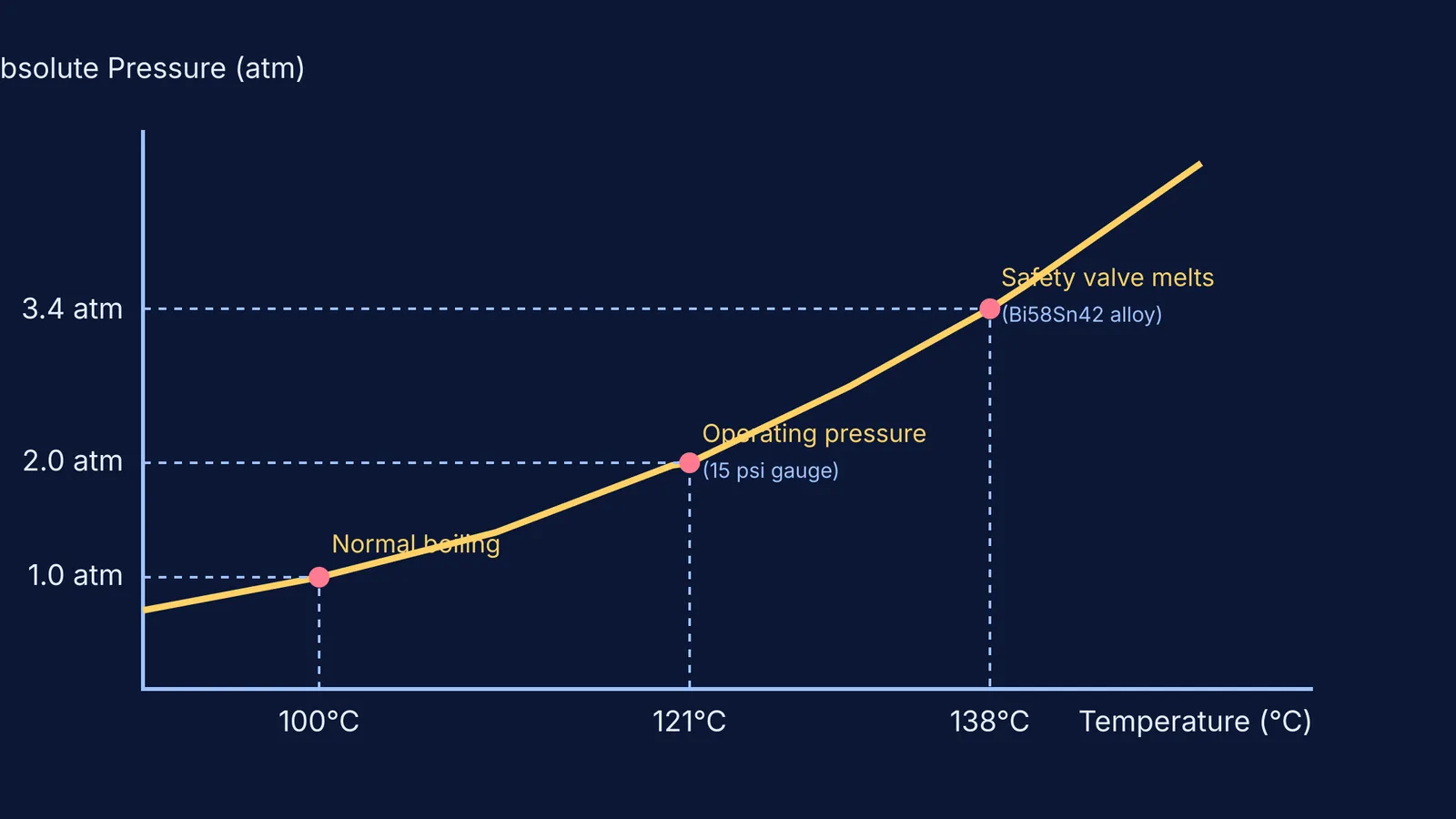
Under normal conditions, a pressure cooker is regulated by its primary weight or "jiggler". For most stovetop models, the main weight sits loosely over the central vent pipe. As water boils, steam builds up inside the rigid walls of the pot, increasing the internal pressure. Once the pressure reaches 15 psi above atmospheric pressure, the force of the steam is strong enough to lift the weight, allowing a burst of steam to escape with a familiar whistle. This specific pressure raises the boiling point of water from 100 °C to about 121 °C. Cooking at this higher temperature forces heat into food much faster, significantly cutting down cooking times for tough ingredients like pulses and meats.
However, if starchy foods like dal or rice froth up and clog the main vent pipe from the inside, the regular whistling stops and the steam has nowhere to go. Because the pot is completely sealed and still sitting on a hot stove, the temperature and pressure of the trapped steam will continue to climb.
The safety valve, usually located on the lid under the handle bar, is the vital emergency exit. It is designed to blow open and release the steam long before the pressure can stress the metal structure of the cooker to its breaking point.
How does the fusible alloy work?
Rather than relying on moving mechanical parts or springs that could also get stuck with food residue, the safety valve uses a highly reliable thermal trigger. Its core is a solid plug made of a "fusible alloy"—typically a specific mix of 58% bismuth and 42% tin, known in metallurgy as Bi58Sn42.
This specific combination of metals is a eutectic alloy. In most metal mixtures, melting happens gradually over a range of temperatures, creating a mushy state before turning completely liquid. A eutectic alloy, however, behaves more like a pure element: it transitions directly from a solid to a liquid at a single, sharp melting point. For Bi58Sn42, this point is exactly 138 °C.
As the temperature inside a clogged cooker rises past the normal 121 °C, the vapor pressure of the water does not just increase steadily—it increases exponentially. By the time the steam reaches 138 °C, the pressure inside has surged to roughly 3.4 atmospheres absolute (about 35 psi above atmospheric pressure). At this precise thermal threshold, the metal plug instantly melts into a liquid. The trapped high-pressure steam easily blows the molten alloy out of the valve housing, rapidly depressurising the pot. The valve is deliberately positioned to deflect this escaping burst of steam safely downwards toward the stovetop, rather than upwards into the kitchen.
Thermodynamics in the kitchen
For students studying physics or chemistry, the pressure cooker is a perfect everyday demonstration of saturation curves and vapor pressure. You cannot raise the pressure of a liquid in a sealed vessel without also raising its boiling temperature. The history of harnessing this relationship dates back centuries, famously starting with Denis Papin and the pressure cooker of the 1600s.
When you study thermodynamics for exams, you have to track how gases behave as they heat up and expand. If you find these concepts hard to picture, you can run experiments in the Fermi Simulation Lab. Watching gas molecules speed up as heat is added makes the exponential rise in pressure much easier to grasp, and helps immensely when converting PV, PT and VT graphs of ideal gas processes.
What should you do if the safety valve blows?
If your safety valve melts during cooking, it means the mechanism did exactly what it was supposed to do and kept your kitchen safe.
Never try to plug the hole with a screw or use a cheap third-party valve. The precise 138 °C melting point of the Bi58Sn42 alloy is a carefully calibrated safety limit. Replacing it with an unknown metal could allow the cooker to reach explosive pressures the next time a blockage occurs. Always ensure the main vent pipe is completely clear before you start cooking, and let the safety valve remain your silent, solid-state guardian.


