

On this page
Cooking dal requires two critical elements to penetrate the seed: heat and water. Starch granules need both to gelatinise and soften, and proteins need both to denature. But heat and water do not travel through solid objects at the same speed, and this difference dictates how your food cooks.
Why does an unsoaked dal cook unevenly?
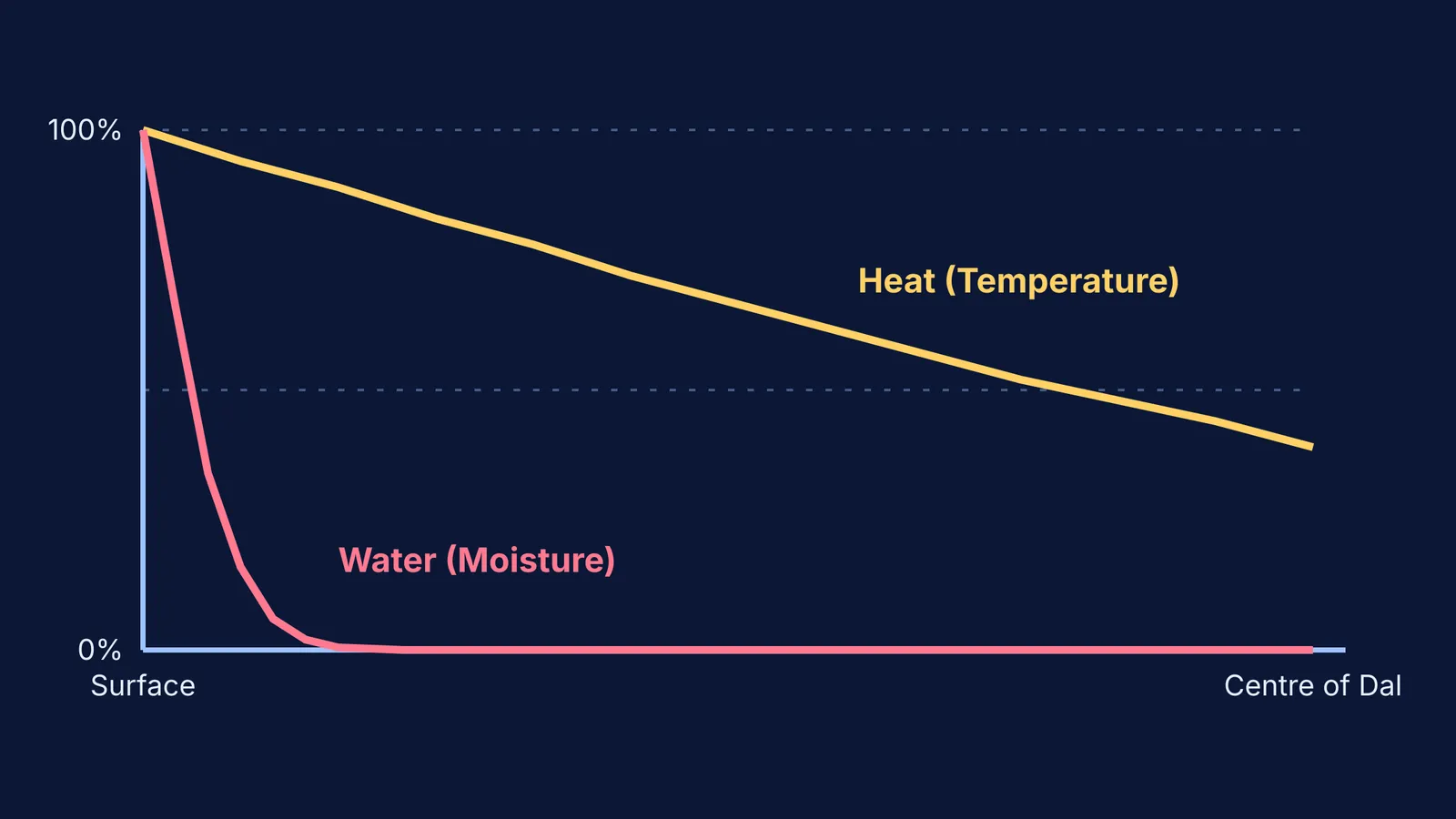
When you drop unsoaked, dry dal into a pot of boiling water, heat transfers through the solid structure very quickly. The outside of the seed reaches boiling temperature almost instantly, and this high thermal energy races towards the centre. The thermal diffusivity of a dry legume is high enough that the entire seed becomes hot in a matter of minutes.
Water, on the other hand, relies on mass transfer. Water molecules must physically squeeze their way into the dense, dry structure of the seed coat and the cotyledon inside. This is a much slower process, heavily restricted by the tightly packed microscopic structure of the dry plant tissue.
If you boil unsoaked dal, the heat reaches the core long before the water does. The outside layers get enough water and heat to gelatinise and turn to mush, but the centre remains a hard, dry core. It has reached boiling temperature, but without the moisture needed to cook, the starch cannot break down. This is similar to the heat transfer principles you can observe when determining why vegetables cut into small pieces cook faster.
What does soaking actually do to the seed?
Soaking decouples these two processes, allowing the water to do its work without the rush of boiling temperatures. When you leave dal in water at room temperature, it undergoes a biological and physical process called imbibition. According to the National Council of Educational Research and Training (NCERT), imbibition is a special type of diffusion where water is absorbed by solids (colloids), causing them to enormously increase in volume.
Because this happens before any heat is applied, the water has hours to slowly distribute itself uniformly all the way to the centre of the seed. The slow diffusion of water through organic membranes is a powerful force, similar to the slow osmosis that explains why pickles do not spoil for months. The swelling also softens the seed coat, making it easier for even more water to enter.
How much time does soaking really save?
When you finally put soaked dal on the stove, the water is already waiting inside the seed. The heat only has one job: raising the temperature to cook the starch and protein.
This uniform hydration makes a significant difference to efficiency. A 2026 study published in *Food Science and Preservation* found that optimising the soaking time reduced the actual cooking time on the stove by up to 40 ± 3%. The same study showed that this shorter cooking duration decreased energy consumption by 18–22%. The researchers noted that because the moisture is uniformly distributed, the dal splits less and retains its shape, unlike unsoaked dal which often sheds its outer layers before the inside is done. This controlled starch release is also why rice water gets thick and starchy at a predictable rate when pre-soaked.
A practical experiment to try at home
You can observe this race between heat and water in your own kitchen. It is an excellent way to see mass transfer and thermal transfer happening in real time. Try this simple experiment the next time you cook:
Take a handful of dry chana dal and boil it immediately in a small pan.
Take another handful that has soaked in water for two hours and boil it in a separate pan.
Every 5 minutes, take one grain from each pan, carefully cut it in half with a knife, and look at the centre.
In the unsoaked dal, you will see a clear white, powdery core that shrinks very slowly. The outside will likely begin to dissolve before the centre is fully cooked. In the soaked dal, the core will turn soft and translucent much faster, because the water is already there when the heat arrives. If you want to explore how different physical variables like temperature and density change these outcomes before testing them in the kitchen, you can visualise these physical processes in the Fermi Simulation Lab.


