On this page
Wave Optics is Chapter 10 of the NCERT Class 12 Physics textbook, Part II (Reprint 2026-27). In the CBSE Physics syllabus for 2026-27, it shares Unit VI, Optics, and its 18 of 70 theory marks with Ray Optics. For answer-writing, see our Wave Optics Class 12 board exam guide.
Polarisation and Malus' law (NCERT Section 10.7) are in the chapter but not in the CBSE 2026-27 syllabus, so they are left out.
What is a wavefront, and what does Huygens principle say?
Wave optics: the study of light that keeps its wavelength in the picture. Don't confuse with: geometrical (ray) optics, which treats the wavelength as tending to zero.
Corpuscular model: the particle picture of light (Descartes, then Newton); it wrongly predicted light moves faster in a denser medium. Foucault (1850) found light slower in water, as the wave model said.
Wavefront: a surface on which every point vibrates in the same phase, a surface of constant phase. Example: the circular rings that spread when a stone drops into a still pond.
Spherical wavefront: the wavefront around a point source sending light equally in all directions.
Plane wavefront: a small patch of a spherical wavefront far from its source, flat enough to treat as a plane. Example: light from a distant star.
Ray: a line at right angles to the wavefront, showing the direction energy travels. Don't confuse with: the wavefront itself, which is a surface, not a direction.
Huygens principle: every point on a wavefront acts as a source of secondary wavelets that spread at the wave's speed.
Secondary wavelets: those spheres, radius vt after time t.
Huygens construction: the forward common tangent (envelope) of the wavelets gives the new wavefront.
Backwave: the backward envelope, which does not exist; fuller wave theory justifies dropping it.
How do wavefronts explain reflection and refraction?
Refraction of a plane wave: the wavefront turns because the part already in the second medium moves at a different speed, giving sin i / sin r = v1 / v2.
Refractive index: n = c / v, the speed of light in vacuum divided by its speed in the medium.
Snell's law: n1 sin i = n2 sin r, which follows from the same construction.
Frequency on refraction: frequency stays the same; speed and wavelength both drop in a denser medium, so v1 / λ1 = v2 / λ2. Don't confuse with: wavelength, which does change.
Critical angle: going into a rarer medium, the incidence angle at which the refracted wave grazes the surface, sin ic = n2 / n1; beyond it comes total internal reflection.
Law of reflection (wavefront proof): incident and reflected wavefronts form congruent triangles with the mirror, so the angle of incidence equals the angle of reflection.
Equal travel time: light takes the same time from object point to image point along every ray. Example: a convex lens's central ray has a shorter path but more slow glass.
What are coherent sources, and why do they matter?
Superposition principle: where waves overlap, the net displacement is the vector sum of their displacements.
Coherent sources: two sources whose phase difference stays constant in time. Example: two needles dipping together in water, or Young's two slits lit by one source.
Incoherent sources: sources whose phase difference changes rapidly, so intensities simply add. Example: two sodium lamps, whose light changes phase abruptly in times of the order of 10^-10 seconds (NCERT Section 10.5).
Path difference and phase difference: a path difference of λ equals a phase difference of 2π.
Constructive interference: path difference nλ, waves arrive in phase, intensity 4I0 (I0: one source alone).
Destructive interference: path difference (n + 1/2)λ, waves arrive out of phase, intensity zero.
Resultant intensity: I = 4I0 cos²(φ/2) for phase difference φ. Don't confuse with: 2I0, the average for incoherent sources.
Sustained interference: a steady pattern from coherent sources; maxima and minima stay put.
What happens in Young's double-slit experiment?
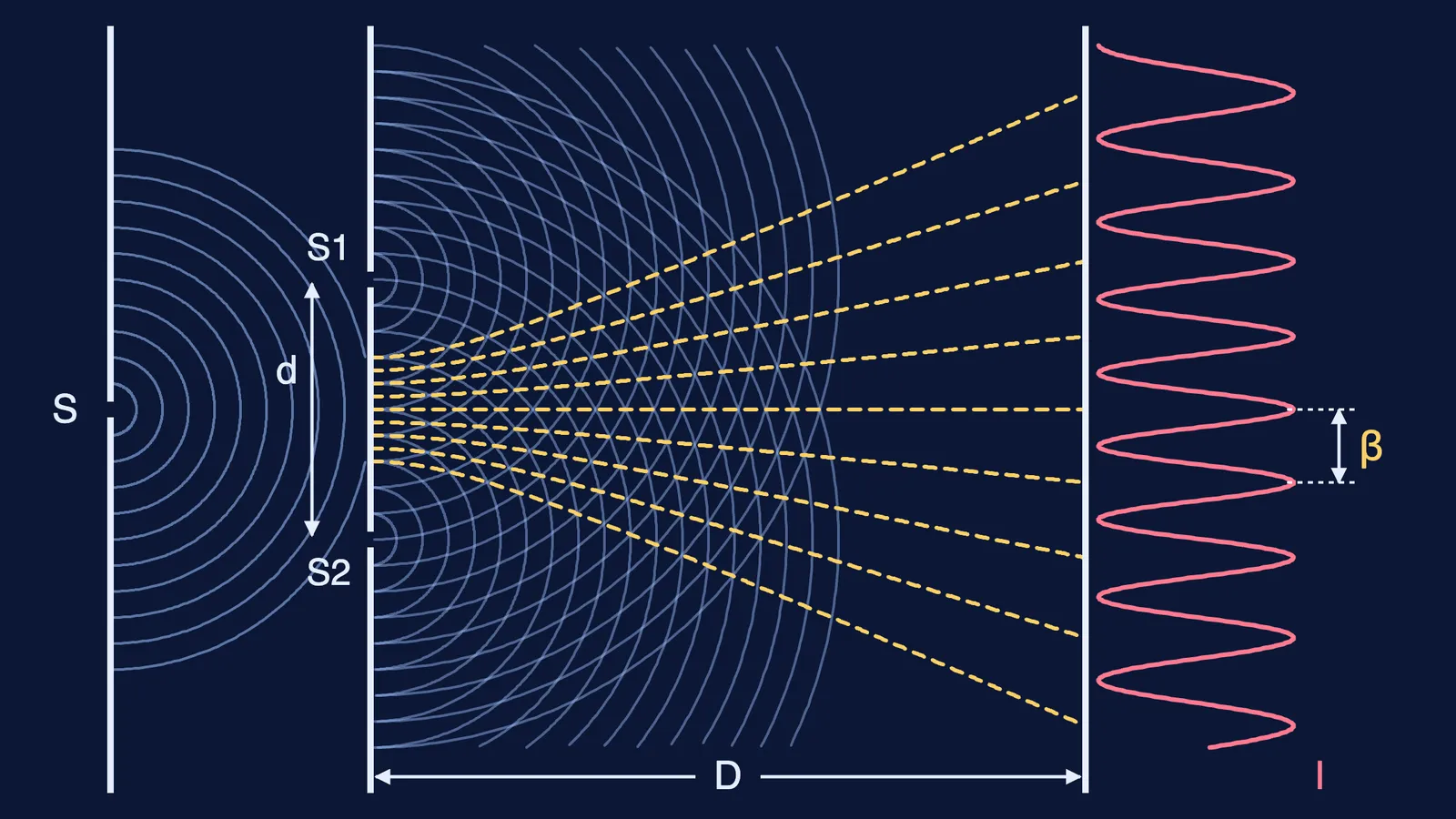
Young's double-slit experiment (YDSE): one pinhole S lights two close pinholes S1 and S2, which act as coherent sources and make bright and dark fringes on a screen.
Bright and dark fringe positions: from the centre, bright at x = nλD/d, dark at x = (n + 1/2)λD/d.
Fringe width (β): the distance between two neighbouring bright (or dark) fringes, β = λD/d; fringes are equally spaced. Don't confuse with: d, the slit separation, and D, the slit-to-screen distance.
Central bright fringe: the bright band on the perpendicular bisector of S1S2, where the path difference is zero.
Energy redistribution: energy missing from dark fringes appears in bright ones.
What is single-slit diffraction?
Diffraction: light spreading round edges and into the region of geometrical shadow; all waves do it. Example: the colours on a CD.
Single-slit pattern: a broad central bright band with weaker bands on each side.
Central maximum: the brightest band, at θ = 0.
Minima of a single slit: zero intensity at θ ≈ nλ/a (n = ±1, ±2, ...), where a is the slit width. Don't confuse with: YDSE, where dark fringes depend on d, not a.
Width of central maximum: the band between the first minima at ±λ/a, so it widens as the slit narrows or the wavelength grows. Example: fringes look wider through a red filter than a blue one.
Interference vs diffraction: no sharp physical line; a few sources is usually called interference, many sources diffraction. A double-slit pattern is interference fringes inside each slit's diffraction pattern.
How to learn these terms
Learn the pairs together: wavefront vs ray, coherent vs incoherent, d vs a.
Redraw the diagram above from memory: S, S1, S2, d, D, β, and dashed lines where path difference is a whole number of wavelengths.
Write the four conditions as one grid: YDSE bright nλ, YDSE dark (n + 1/2)λ, single-slit dark nλ/a, single-slit central maximum at θ = 0.
Then test the terms on Wave Optics practice questions with solutions.
If interference still feels abstract, the Fermi Simulation Lab has interactive simulations for the ideas that are easier to see than to read.