On this page
Water Resources is Chapter 4 of NCERT's Class 12 book India: People and Economy (NCERT, Reprint 2026-27). The CBSE 2026-27 Geography curriculum keeps all its topics. Unit III (Chapters 3 to 6) carries 10 marks together, with no separate figure for this chapter, and the curriculum lists no map items for it.
How much water does India have?
Figures as printed in the NCERT chapter, which gives no reference year:
India: about 2.45 per cent of world area, 4 per cent of world water, over 17 per cent of world population.
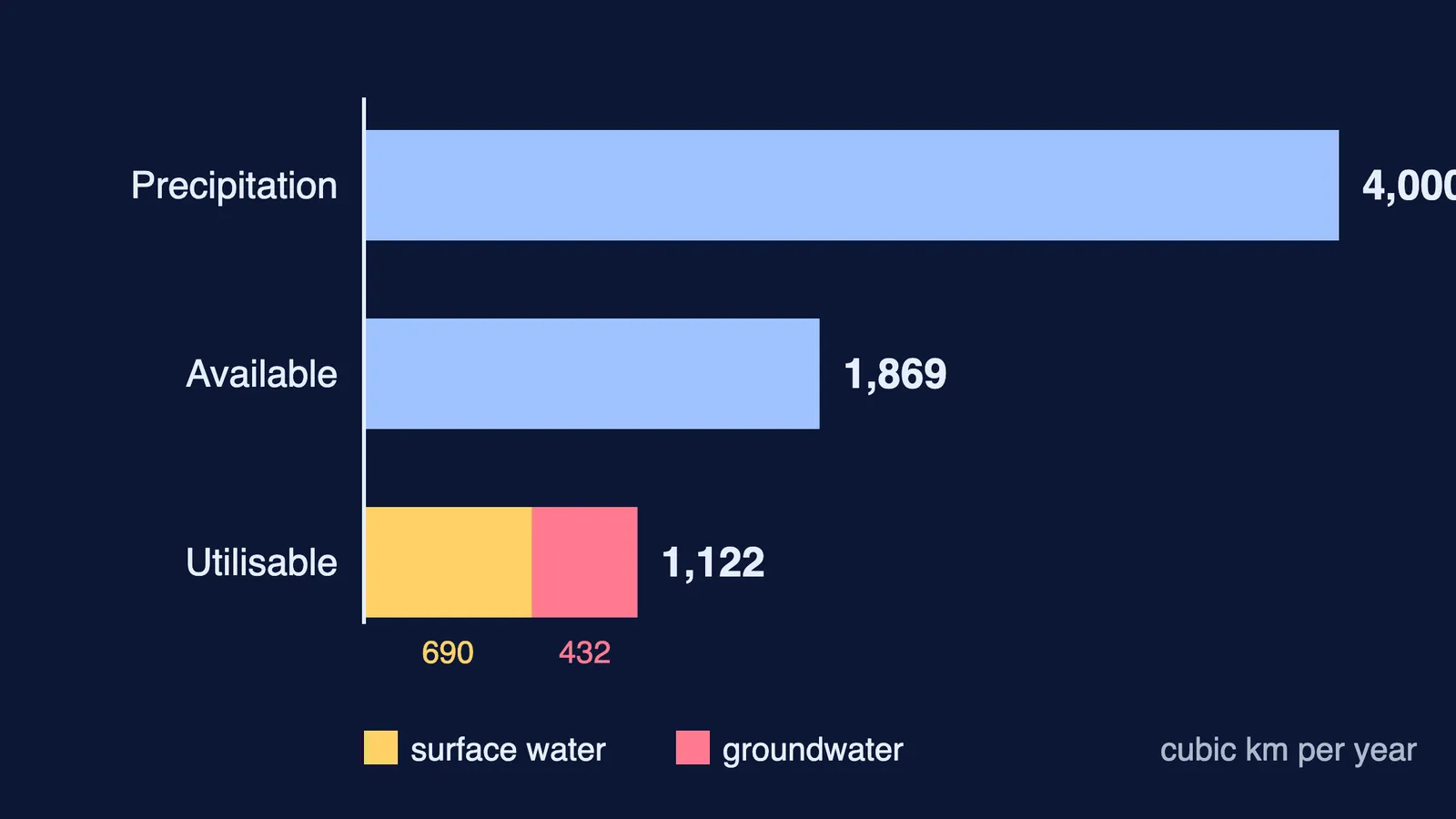
Precipitation: about 4,000 cubic km a year.
Surface water plus replenishable groundwater: 1,869 cubic km.
Only about 60 per cent of that can be used, so utilisable water is 1,122 cubic km.
Usable surface water: about 690 cubic km (NCERT says 32 per cent), limited by terrain and hydrology.
Replenishable groundwater is about 432 cubic km. 690 plus 432 gives 1,122.
The chapter is not consistent. Its next section gives 1,869 cubic km as the yearly flow of all rivers, groundwater excluded, and 690 is about 37 per cent of 1,869, not 32. In the exam, quote the printed figures.
Why is water so unevenly spread across India?
River flow depends on the size of the basin and the rain that falls on it. NCERT notes that the Ganga, Brahmaputra and Barak basins cover only about a third of the country but hold 60 per cent of its surface water. The Godavari, Krishna and Kaveri are heavily tapped; the Ganga and Brahmaputra are not.
Groundwater use is very high in Punjab, Haryana, Rajasthan and Tamil Nadu, moderate in Gujarat, Uttar Pradesh and Maharashtra, and low in Chhattisgarh, Odisha and Kerala. Kerala, Odisha and West Bengal also have large lagoons. Their brackish water still supports fishing and some paddy and coconut irrigation.
Who uses India's water, and what is going wrong?
Farming dominates (NCERT, Chapter 4):
Agriculture: 89 per cent of surface water use and 92 per cent of groundwater use.
Industry: 2 per cent of surface water use and 5 per cent of groundwater use.
Domestic: 9 per cent of surface water use.
Irrigation answers uneven rain, dry winters and summers, thirsty crops like rice and sugarcane, and high yielding varieties that need steady moisture. In Punjab, Haryana and western Uttar Pradesh, over 85 per cent of net sown area is irrigated. Wells and tubewells water 76.1 per cent of Punjab's net irrigated area and 51.3 per cent of Haryana's, lowering water tables.
Over-pumping has raised fluoride in Rajasthan and Maharashtra, and arsenic in parts of Bihar and West Bengal. In the plains, farm, household and factory waste drains into rivers, worst in summer when flow is low. Data from the Central Pollution Control Board's 507 monitoring stations show organic and bacterial contamination as the main problem. NCERT names the Yamuna between Delhi and Etawah as the most polluted stretch.
How do rainwater harvesting and watershed management work?
Rainwater harvesting means catching rain and storing it, or sending it underground to recharge aquifers. It raises water tables, dilutes fluoride and nitrates, and checks erosion, flooding and seawater intrusion. Rajasthan's traditional kund or tanka is a covered underground tank, and Tamil Nadu requires harvesting structures in every new building.
Watershed management conserves surface and groundwater together through percolation tanks and recharge wells; in the wider sense it covers all natural and human resources of a watershed. Success depends on community participation. Examples:
Haryali: central project run by Gram Panchayats.
Arvary Pani Sansad (Alwar, Rajasthan) and Neeru-Meeru (Andhra Pradesh): johads, check dams and percolation tanks built by villagers.
Atal Jal: 8,220 water-stressed Gram Panchayats in 80 districts of seven states (NCERT cites the Ministry of Jal Shakti's 2022-23 annual report).
Ralegan Siddhi, Ahmadnagar: fixed a leaking percolation tank, banned open grazing and sugarcane, and chose low-water crops.
Recycling helps: reclaimed water for industrial cooling, washing water for gardens. Revise PMKSY (2015-16), the National Water Policy 2012 and Jal Kranti Abhiyan (2015-16).
How should you practise this chapter for the board exam?
The 2026-27 sample paper has 1-mark MCQs, 3-mark answers of 80 to 100 words and 5-mark answers of 120 to 150 words. Its one water question, an MCQ on rising demand, is keyed to rainwater harvesting and reuse in the marking scheme. Try these questions we wrote:
(1 mark) Which sector has the largest share of groundwater use?
(3 marks) Why can only about 690 cubic km of India's surface water be put to use?
(3 marks) Give three ways over-irrigation harms Punjab's groundwater and soil.
(5 marks) A village in a dry district has falling wells. Plan a watershed programme using two NCERT examples.
(5 marks) Explain why river pollution peaks in summer and suggest three remedies.
For question 4: definition, structures, then community rules such as crop choice and grazing bans.
Related: our guides to land resources and agriculture and world population distribution and growth.
If you are not sure where to start, Fermi's AI tutor can work out what you already know and build a plan for the session.