On this page
Units and measurement is the first physics unit in both JEE Main and NEET-UG, and the official syllabus text is the same in both. What changes is how the questions reach you: the format, the time per question and how many steps a question chains together. Here is a line-by-line comparison, one worked example in each style and a plan that serves both exams.
Is the Units and Measurement syllabus different for JEE Main and NEET?
No. The topic list is the same; only the unit's name differs.
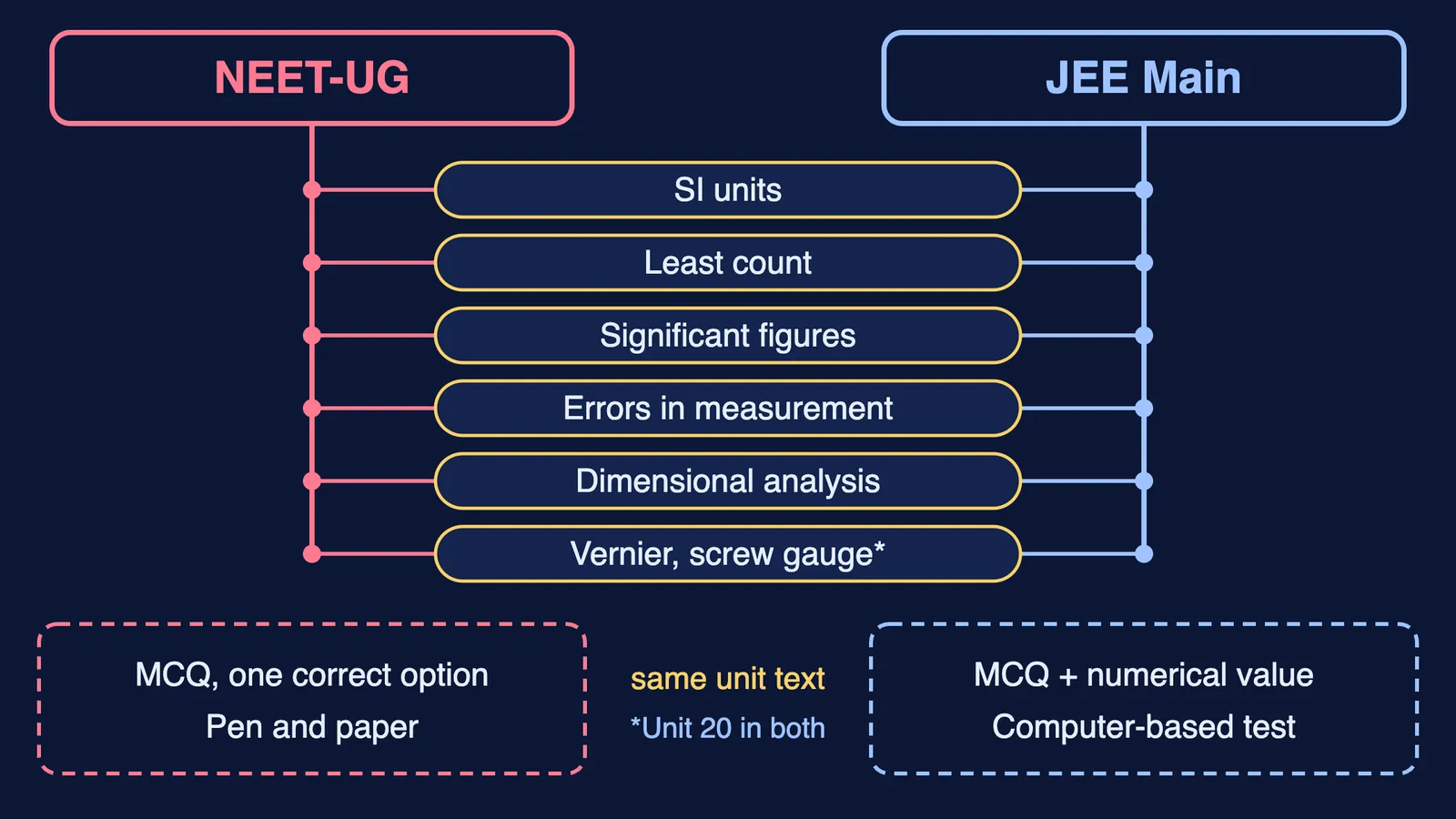
In NTA's Syllabus for JEE (Main) - 2027, Physics Unit 1 is called "Units and Measurements". In the NMC's syllabus for NEET (UG)-2026, Physics Unit 1 is called "Physics and Measurement". Read the two unit texts side by side and they list the same items in the same order:
Units of measurements, system of units, SI units
Fundamental and derived units
Least count
Significant figures
Errors in measurements
"Dimensions of Physics quantities, dimensional analysis and its applications"
Only commas and capitals differ. No sub-topic appears in one exam and not the other.
The instruments sit elsewhere in both papers. Unit 20, Experimental Skills, in each syllabus begins with the vernier calipers, used to measure "the internal and external diameter and depth of a vessel", and the screw gauge, used for the "thickness/ diameter of thin sheet/wire". That wording is nearly word for word the same.
The matching textbook, NCERT Class 11 Physics Chapter 1, Units and Measurement (Reprint 2026-27), has no section on least count, and treats errors mainly through the rules in Section 1.3.3. Practise both beyond the textbook, whichever exam you sit.
How is the question format different in each exam?
The JEE (Main) 2027 information bulletin gives Paper 1 three subjects, each with Section A (20 multiple-choice questions) and Section B (5 questions whose answer is a numerical value). For Section B, you enter an integer on an on-screen keypad, and the answer "should be rounded off to the nearest integer". Both sections carry +4 for a correct answer and -1 for an incorrect one. The paper is a computer-based test, and Paper 1 lasts 3 hours for its 75 questions.
The NEET (UG)-2026 information bulletin, the latest listed on the NTA NEET site when we checked, sets 180 compulsory questions in 180 minutes, with 45 in Physics. Every question is a multiple-choice question "with four options and single correct answer/best option", marked +4 if correct, -1 if incorrect and 0 if unanswered. The exam is in pen-and-paper mode.
So in JEE Main's numerical section you must carry a calculation to the end, while in NEET speed on short questions matters.
How does the style of questions differ?
These are tendencies, not rules, that you will likely notice in official past papers:
NEET questions on this unit tend to test one idea at a time: a dimensional formula, a significant-figures rule or one error rule, often close to a statement in NCERT.
JEE Main questions tend to chain steps: read an instrument, correct a zero error, then carry the reading into an error or dimension calculation.
Both use dimensional analysis to check or build formulae, and both reward knowing which rule applies to which operation.
What does the same idea look like in each exam?
Both examples below test one idea: in a power law, the percentage error is multiplied by the power. Both questions are original.
NEET-style. The side of a cube is measured as 2.50 cm with a vernier caliper of least count 0.01 cm. What is the maximum percentage error in its volume? (A) 0.4% (B) 0.8% (C) 1.2% (D) 1.6%
Answer: (C). The error in the side is 0.01/2.50 × 100 = 0.4%. Volume goes as side cubed, so its error is 3 × 0.4 = 1.2%. Trap: (A) forgets the power.
JEE Main-style (numerical value). Young's modulus of a wire is found from Y = 4MgL/(πd²ΔL). The screw gauge has a pitch of 0.5 mm and 100 circular divisions. With the studs closed, the reference line reads 96 on the circular scale. On the wire, the linear scale shows 0 mm and the circular scale 96 divisions. The extension is ΔL = 0.50 mm, measured to ±0.01 mm. Treat M, g and L as exact, and take the least count as the error in d. What is the maximum percentage error in Y, to the nearest integer?
Answer: 4.
Least count = 0.5/100 = 0.005 mm.
The zero error is negative: 4 divisions short, so -4 × 0.005 = -0.02 mm.
Observed reading = 96 × 0.005 = 0.480 mm. Corrected d = 0.480 - (-0.02) = 0.500 mm.
Error in d = 0.005/0.500 × 100 = 1%; error in ΔL = 0.01/0.50 × 100 = 2%.
Error in Y = 2(1) + 2 = 4%.
Trap: forgetting the square on d gives 3.
The NEET question takes one step and offers options. The JEE Main question chains a reading, a zero-error sign and an error rule, with no options.
How to prepare for both
Learn the six syllabus items once. The unit text is the same, so one set of notes serves both exams. Add least count and error rules from your practical work, since the NCERT chapter is thin on both.
Make a dimensional-formula sheet. Write 25 common quantities as powers of M, L and T, derived from their definitions, not memorised.
Drill the instruments. Read vernier and screw-gauge scales with positive and negative zero errors until the sign is automatic. Unit 20 puts them in both syllabi.
Train two speeds. Time single-idea NEET-style questions at about a minute each. Then practise JEE Main-style chains and type an integer answer without looking at options.
Log each miss by rule. Mark it as significant figures, error rule, zero-error sign or dimensions, then redo it two days later on a blank page.
Does one step keep going wrong, such as the zero-error sign? The Fermi Problem Library has worked problems with a step-by-step solver that explains the reasoning rather than printing an answer.
For a full plan for each exam, read our guides on how to prepare Physics and Measurement for NEET and how to prepare Units and Measurements for JEE Main.