On this page
Chapter 3 of the NCERT Class 11 Mathematics textbook (Reprint 2026-27) turns the right-triangle ratios of Class 10 into functions of any real number. The CBSE 2026-27 Mathematics syllabus covers the same chapter. For proofs and solved questions, read our Trigonometric Functions Class 11 chapter guide.
Not covered: general solutions of equations such as sin y = sin a, which the rationalised chapter leaves out. Below, n is any integer.
What are angles, degrees and radians?
Angle: the amount a ray turns about its starting point. The ray starts as the initial side, ends as the terminal side, and turns about the vertex.
Positive and negative angle: anticlockwise turning is positive, clockwise is negative. Example: −30° is a 30° clockwise turn.
Degree, minute, second: one degree is 1/360 of a revolution; 1° = 60′ and 1′ = 60″.
Radian: the angle at the centre made by an arc as long as the radius. Example: a full turn is 2π radians.
l = rθ: an arc of length l in a circle of radius r makes θ radians at the centre. Example: r = 10 cm, θ = π/3 gives l = 10π/3 cm, about 10.47 cm. Don't confuse with: putting θ in degrees.
Degree–radian relation: π radians = 180°, so 1 radian is about 57° 16′. Example: 150° = 150 × π/180 = 5π/6.
Notational convention: θ° means degrees; a plain β means radians. Example: sin π/4 is the sine of 45°.
How does the unit circle define trigonometric functions?
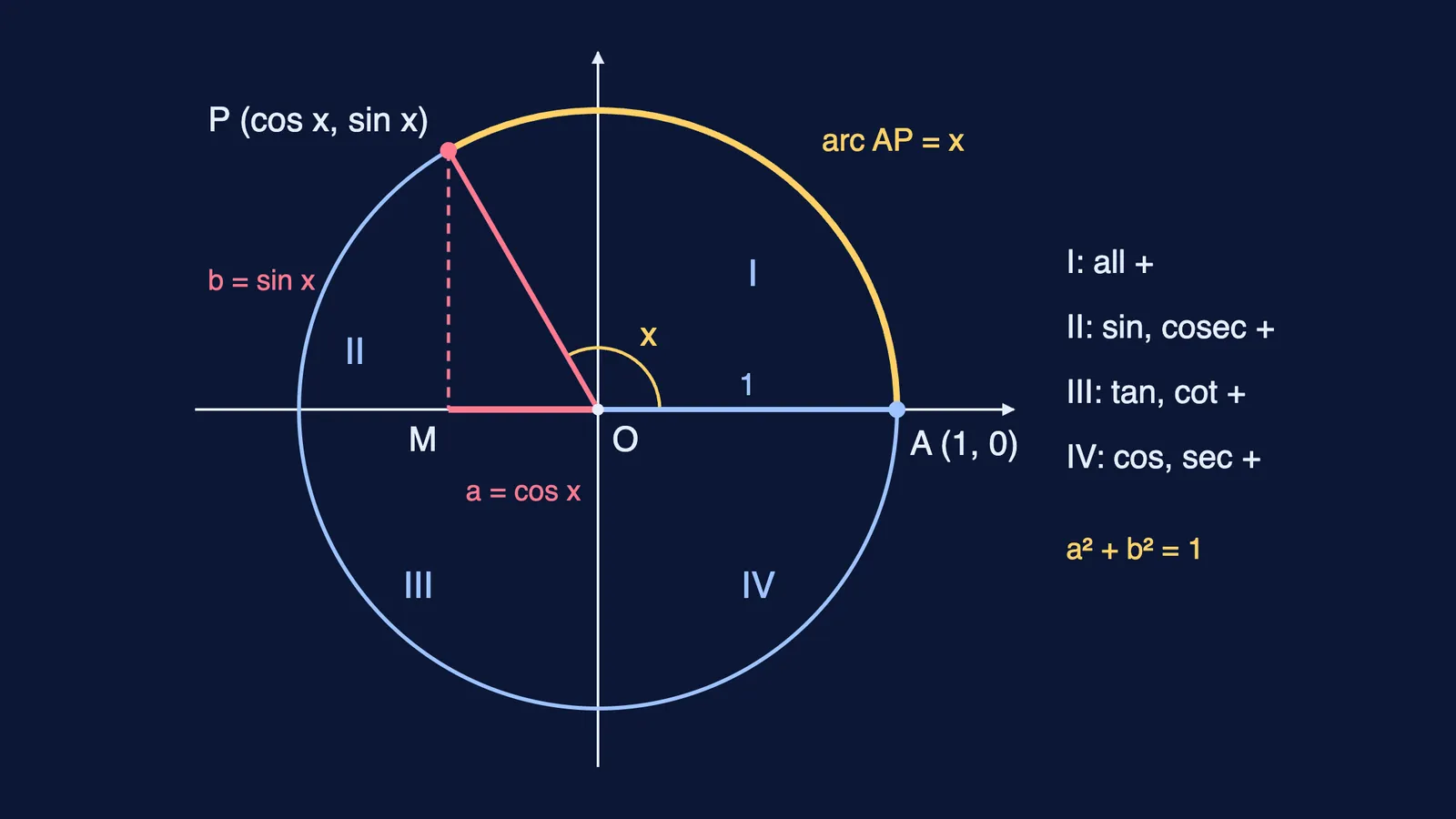
Unit circle: radius 1, centre at the origin.
cos x and sin x: mark off an arc of length x from A(1, 0) (anticlockwise if x > 0, clockwise if x < 0). If it ends at P(a, b), then cos x = a and sin x = b. The diagram above shows x = 2π/3, where P is (−1/2, √3/2).
Quadrantal angle: an integer multiple of π/2. Example: at π the point is (−1, 0), so cos π = −1 and sin π = 0.
Zeros: sin x = 0 only when x = nπ; cos x = 0 only when x = (2n + 1)π/2.
cosec x, sec x, tan x, cot x: 1/sin x, 1/cos x, sin x/cos x and cos x/sin x, each defined only where its denominator is not zero. Example: tan π/2 is not defined.
Fundamental identity: sin² x + cos² x = 1 for all real x. It gives 1 + tan² x = sec² x and 1 + cot² x = cosec² x. Don't confuse with: sin x + cos x = 1, which is usually false.
What are the signs, domains, ranges and graphs?
Quadrant signs: quadrants I to IV run anticlockwise. All six functions are positive in I; only sin and cosec in II; tan and cot in III; cos and sec in IV.
Domain: the inputs allowed. Example: sin and cos take all reals; tan and sec exclude (2n + 1)π/2; cot and cosec exclude nπ.
Range: the outputs produced. Example: sin x and cos x lie in [−1, 1]; tan and cot take all reals; sec and cosec give y ≤ −1 or y ≥ 1.
Repetition: sin, cos, sec and cosec repeat after 2π; tan and cot after π. Example: sin 765° = sin 45° = 1/√2.
Negative angles: sin(−x) = −sin x but cos(−x) = cos x.
Increasing and decreasing: how a value moves as x grows. Example: sin x rises from 0 to 1 in quadrant I, then falls to 0 in quadrant II.
∞ and −∞: shorthand for "grows without limit". Example: tan x becomes arbitrarily large as x nears π/2 from below; it never equals ∞.
Graph: the curve y = f(x); sine is a wave between −1 and 1.
Which identities does the chapter name?
Trigonometric identity: an equation true for every value where both sides are defined.
Sum and difference formulas: cos(x + y) = cos x cos y − sin x sin y and sin(x + y) = sin x cos y + cos x sin y, with matching x − y forms. Example: sin 75° = sin(45° + 30°) = (√6 + √2)/4.
Allied angle results: values at π/2 ± x, π ± x and 2π − x. Example: cos(π/2 + x) = −sin x. See allied angles and the ASTC rule.
Conditions on tan and cot formulas: tan(x + y) = (tan x + tan y)/(1 − tan x tan y) needs none of x, y, x + y to be an odd multiple of π/2; the cot forms need none of x, y and x ± y to be a multiple of π. Example: at x = y = π/4, x + y = π/2 and the denominator 1 − tan x tan y is 0.
Double angle identities: sin 2x = 2 sin x cos x; cos 2x = cos² x − sin² x = 2cos² x − 1 = 1 − 2 sin² x; plus tan 2x.
Triple angle identities: sin 3x = 3 sin x − 4 sin³ x and cos 3x = 4 cos³ x − 3 cos x, plus tan 3x. Example: x = π/6 gives sin 3x = 3/2 − 1/2 = 1.
Sum-to-product: a sum or difference of sines or cosines rewritten as a product. Example: cos 75° + cos 15° = 2 cos 45° cos 30° = √6/2.
Product-to-sum: the reverse, such as 2 sin x cos y = sin(x + y) + sin(x − y). Don't confuse with: sum-to-product.
All formulas, with worked examples, are in our Trigonometric Functions Class 11 formulas list.
How to learn these terms
Draw the unit circle from memory, mark P(cos x, sin x) and the quadrant signs.
Learn domain and range as a pair: tan has gaps where cos x = 0.
Put mixed-up pairs on one card: radian and degree, domain and range, sum-to-product and product-to-sum, 2 sin x and sin 2x.
Test each identity at x = π/6 on a calculator before trusting your memory of the signs.
If a term keeps slipping, the Fermi Concept Library gives each mathematics concept its own lesson and its place in the map.