On this page
Learn each of the three travellers through four questions: where he came from, why he wrote, what he noticed, and where the chapter says he got it wrong.
What does CBSE ask from Through the Eyes of Travellers in 2026-27?
In the CBSE History curriculum for 2026-27, Through the Eyes of Travellers: Perceptions of Society (c. tenth to seventeenth centuries) is Theme 5 of Themes in Indian History Part II.
Part II's 25 marks are shared across Themes 5 to 8, with no separate figure for this chapter. Each part has 7 one-mark MCQs, 2 three-mark short answers, 1 eight-mark long answer and 1 four-mark source-based question, per the same document.
The 2026-27 sample paper uses this chapter for two MCQs and a source-based question on Ibn Battuta and slavery, split 1, 1 and 2 marks. Short answers take 60 to 80 words and long answers 300 to 350.
What did Al-Biruni, Ibn Battuta and Bernier each write?
From the current NCERT chapter (Reprint 2026-27):
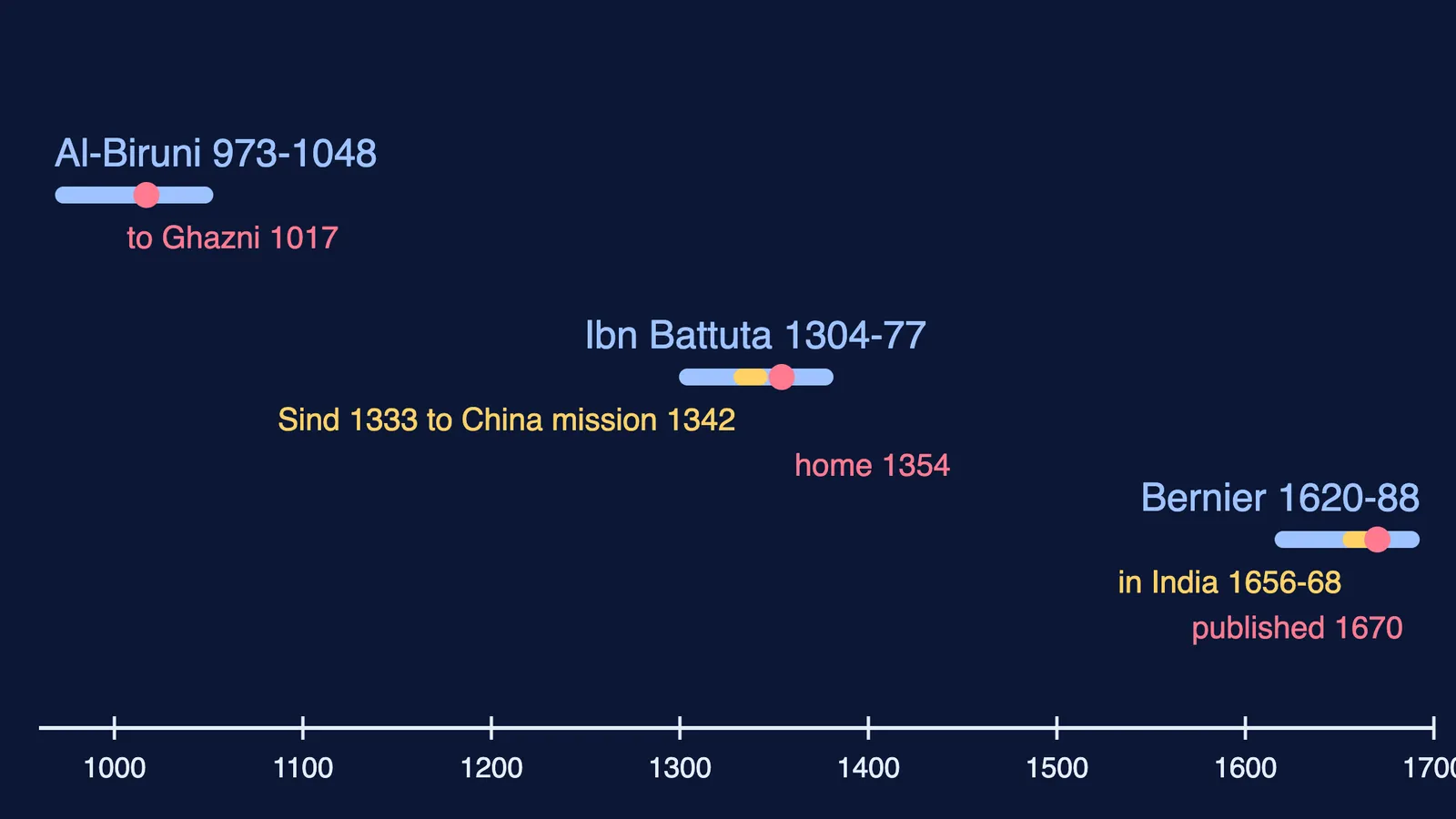
Al-Biruni (973-1048), Kitab-ul-Hind. Born in Khwarizm in present-day Uzbekistan, he was taken to Ghazni by Sultan Mahmud in 1017; he learnt Sanskrit from Brahmana scholars. His Arabic book has 80 chapters; most open with a question, describe the Sanskrit view and end with a comparison. He named three barriers to understanding: language, religious difference and local insularity.
Ibn Battuta (1304-77), Rihla. From Tangier in Morocco, he reached Sind in 1333, served Muhammad bin Tughlaq as qazi of Delhi, and was sent to China as envoy in 1342. He dictated his travels back home to delight and astonish. He likened the coconut and paan to things his readers knew, praised Delhi and Daulatabad as huge cities, and marvelled at a postal system that brought spies' reports from Sind in five days, against fifty for an ordinary journey.
François Bernier (1620-88), Travels in the Mughal Empire. A French doctor in India from 1656 to 1668, physician to Dara Shukoh. He measured India against Europe at every turn, usually to India's cost, to persuade European policy-makers. His books appeared in France in 1670-71.
Where does NCERT say the travellers got India wrong?
Learn the correction the NCERT chapter pairs with each claim:
Al-Biruni on caste. He relied on Brahmanical normative texts, so his varna order is more rigid than real life; antyaja groups, outside the system, were often made to supply cheap labour to peasants and zamindars, so economic networks included them.
Bernier on land. He thought the emperor owned all land, so landholders, unable to pass it to heirs, would not invest in it. No Mughal document claims sole state ownership; Abu'l Fazl treats revenue as the ruler's due for protection, and the chapter calls it a tax on the crop. Montesquieu and Marx later built on his view.
Bernier on society. He saw a tiny rich elite above masses of poor, with no middle group. Rural society actually ran from big zamindars through big and small peasants to landless labourers.
Bernier on towns. He called Mughal cities camp towns that rose and fell with the court. Yet about 15 per cent of people lived in towns in the seventeenth century, on average more than in Western Europe, and there were manufacturing and trading towns, ports and pilgrimage centres.
Bernier on women. European writers often made women's treatment the marker of East-West difference; Bernier chose sati to describe in detail. The chapter adds that women's labour was crucial in farming and crafts, and merchant women sometimes took trade disputes to court.
How do you answer a source-based question from this chapter?
A method for the three sub-parts:
Identify the traveller, then ask what he is trying to do: explain (Al-Biruni), astonish (Ibn Battuta) or warn (Bernier).
For the 2-mark part, answer from the passage, then add one point from the chapter, ideally a correction from the list above.
Worked example: a passage shows artisans in royal workshops working all day with no hope of bettering their lot. That is Bernier on the karkhanas, showing activity without progress. Your extra point: he himself admitted that gold and silver flowed into India for its manufactures.
Practice questions for Theme 5
(1 mark) Which traveller served as qazi of Delhi under Muhammad bin Tughlaq? (a) Al-Biruni (b) Ibn Battuta (c) Bernier (d) Abdur Razzaq.
(3 marks) State the three barriers Al-Biruni felt stood in the way of understanding the subcontinent.
(3 marks) Why did Bernier stress the absence of private property in land?
(8 marks) How did each traveller's purpose in writing shape what he noticed about society? Give one example from each of the three.
(4 marks) A passage describes a fruit whose shell looks like a face and whose fibre is used to stitch ships. Identify the traveller and explain how he made the unfamiliar familiar to his readers.
Answer key for Q1: (b).
Revise it alongside Theme 7, Vijayanagara, and Theme 8, peasants, zamindars and the state. If you are not sure where to begin, Fermi's AI tutor works out what you already know and builds a plan for the session.