On this page
This glossary covers NCERT Class 11 Physics Chapter 10, Thermal Properties of Matter, and Chapter 11, Thermodynamics, both marked Reprint 2026-27, matched to the CBSE 2026-27 Physics syllabus. For PV cycles and practice, see our Thermodynamics Class 11 physics guide.
What is the difference between heat and temperature?
Temperature: a measure of how hot or cold a body is. SI unit: kelvin (K).
Heat: energy that flows between bodies only because their temperatures differ. SI unit: joule (J). Example: hot tea on a table cools down. Don't confuse with: temperature, which is not energy.
Absolute (Kelvin) scale: same step size as Celsius, with zero at absolute zero, so T = tC + 273.15, per NCERT Chapter 10.
Triple point of water: the one temperature and pressure where ice, water and vapour coexist, fixed at 273.16 K, per NCERT.
Coefficient of linear expansion (αl): fractional change in length per kelvin, Δl/l = αl ΔT. SI unit: K⁻¹.
Coefficient of volume expansion (αv): fractional change in volume per kelvin; for solids αv = 3αl. SI unit: K⁻¹.
Anomalous expansion of water: water contracts when warmed from 0 °C to 4 °C, so it is densest at 4 °C. Example: ponds freeze from the top.
Thermal stress: stress in a heated rod whose ends cannot move. SI unit: N m⁻². Example: NCERT finds 2.4 × 10⁷ N m⁻² in a steel rail warmed by 10 °C.
How do specific heat and latent heat differ?
Specific heat capacity (s): heat per kilogram per kelvin, s = ΔQ/(mΔT). SI unit: J kg⁻¹ K⁻¹. Don't confuse with: heat capacity (J K⁻¹), the heat for a whole body, which grows with its mass.
Molar specific heat capacity (Cp, Cv): heat per mole per kelvin at constant pressure or constant volume. SI unit: J mol⁻¹ K⁻¹. For an ideal gas, Cp − Cv = R.
Calorimetry: measuring heat; in an insulated calorimeter, heat lost by the hot body equals heat gained by the cold one.
Melting and boiling points: temperatures at which solid and liquid, or liquid and vapour, coexist; both change with pressure. Example: a pressure cooker raises the boiling point.
Latent heat (L): heat per kilogram to change state with no temperature change, Q = mL (fusion for melting, vaporisation for boiling). SI unit: J kg⁻¹. Don't confuse with: specific heat, which changes temperature.
Sublimation: solid turning straight to vapour. Example: dry ice and iodine.
Regelation: ice melting under pressure and refreezing when it is released. Example: a loaded wire cuts through an ice slab that stays in one piece.
How does heat travel?
Conduction: heat passed between neighbouring parts of a body by molecular collisions, with no flow of matter.
Thermal conductivity (K): how readily a material conducts; for a bar of length L and area A with ends at TC and TD, H = KA(TC − TD)/L in the steady state. SI unit: W m⁻¹ K⁻¹.
Convection: heat carried by moving fluid. Natural convection runs on buoyancy (sea breeze); forced convection uses a pump (the heart moving blood).
Thermal radiation: electromagnetic energy a body emits because of its temperature; it needs no medium.
Blackbody and Wien's law: a blackbody absorbs and emits perfectly; the wavelength of its peak emission falls as it gets hotter, λm T ≈ 2.9 × 10⁻³ m K, per NCERT. Example: iron glows red, then yellow, then white.
Stefan-Boltzmann law and emissivity (e): radiated power H = AeσT⁴, σ = 5.67 × 10⁻⁸ W m⁻² K⁻⁴ (NCERT); e has no unit and is 1 for a perfect radiator.
What do the laws of thermodynamics say?
Zeroth law: if A and B are each in thermal equilibrium with C, they are in equilibrium with each other; this leads to the idea of temperature.
Internal energy (U): the total kinetic and potential energy of the molecules, excluding motion of the system as a whole. SI unit: J.
Work (W): energy transferred without needing a temperature difference, such as pushing a piston. Don't confuse with: heat.
First law: ΔQ = ΔU + ΔW, with ΔQ heat supplied to the system and ΔW work done by it.
State variable and equation of state: P, V, T and U depend only on the present state, not the path; heat and work do not. An equation of state links them, like PV = μRT.
Extensive vs intensive: halve the system; U, V and mass halve, while P, T and density do not.
Second law: no process can have, as its only result, taking heat from a reservoir and turning all of it into work (Kelvin-Planck), or moving heat from a colder body to a hotter one (Clausius). Don't confuse with: the first law, which only balances energy.
Which thermodynamic processes should you know?
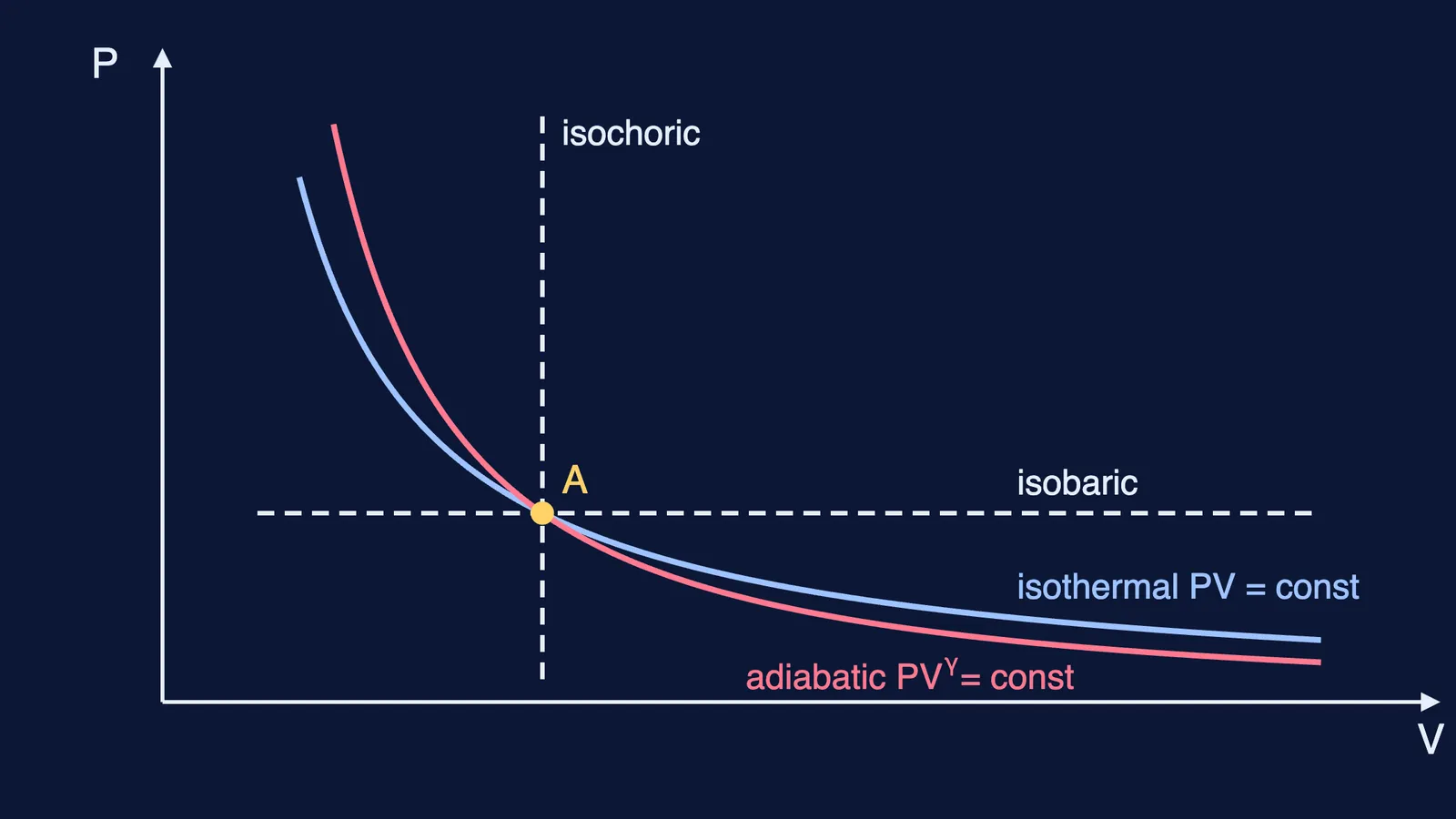
Isothermal: T fixed; for an ideal gas PV = constant and ΔU = 0, so heat in equals work out.
Adiabatic: no heat flow; for an ideal gas PV^γ = constant, γ = Cp/Cv. Don't confuse with: isothermal. The adiabat is steeper (diagram above).
Isobaric and isochoric: P fixed (W = PΔV) versus V fixed (no work, so heat goes into ΔU).
Cyclic: the system returns to its start, so ΔU = 0.
Quasi-static and reversible: a quasi-static change is infinitely slow, keeping equilibrium throughout; a reversible one is quasi-static with no friction and can be undone leaving no trace. Real processes, like free expansion, are irreversible.
Left out here because the CBSE 2026-27 theory syllabus does not name them: Newton's law of cooling (NCERT 10.10; a cooling-curve practical is listed) and the Carnot engine (NCERT 11.11).
How to learn these terms
Learn the pairs together: heat vs temperature, specific vs latent heat, isothermal vs adiabatic.
Draw all four processes through one point on a PV graph and say what stays fixed on each line.
Tie each heat-transfer mode to one everyday case: a spoon in tea, a sea breeze, sunlight.
For worked numbers on expansion and calorimetry, use our Thermal Properties of Matter Class 11 guide.
If a concept will not settle, the Fermi Concept Library gives every physics concept its own lesson and its place in the map.