On this page
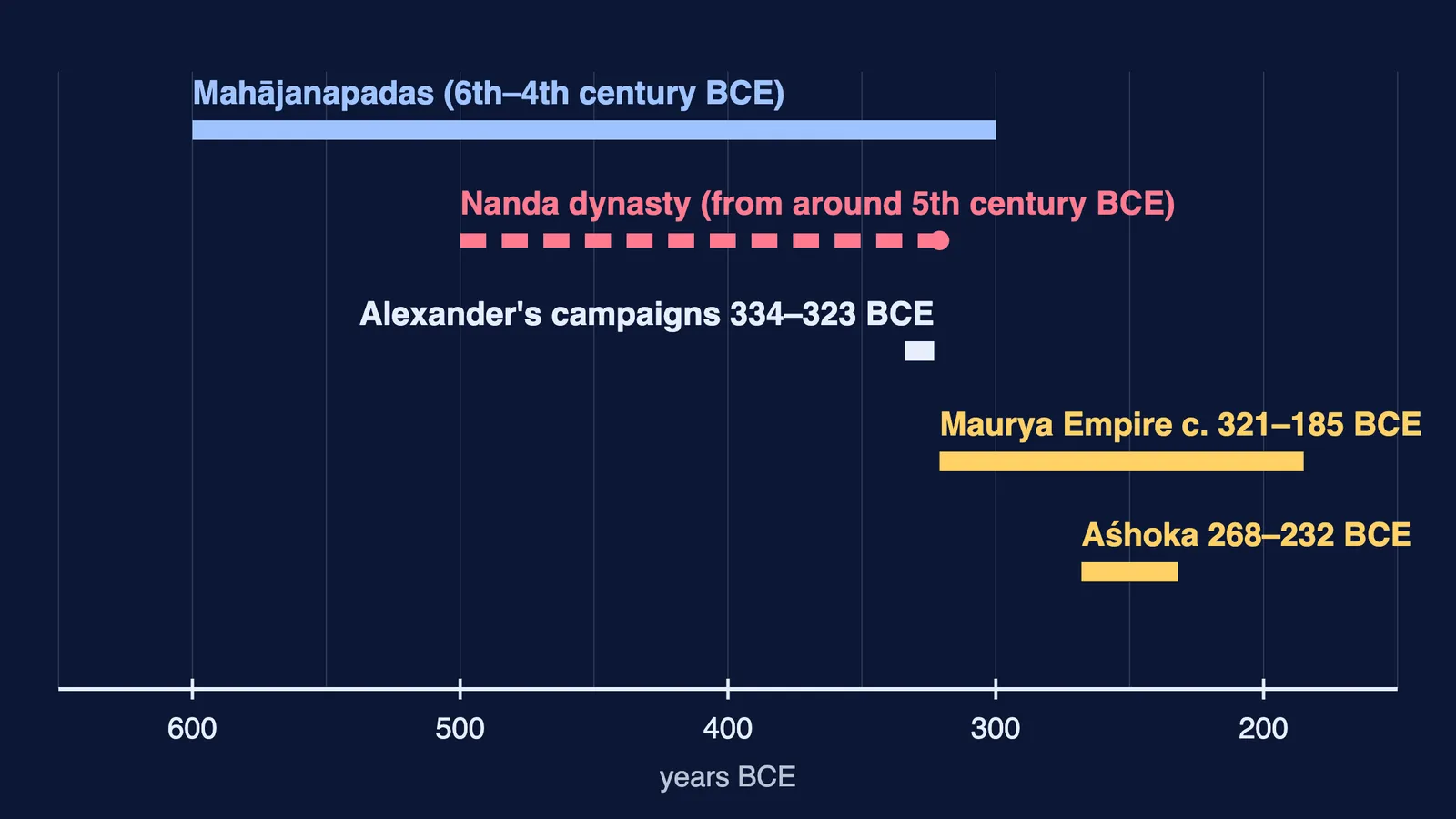
Chapter 5 of the new NCERT Class 7 book Exploring Society: India and Beyond, Part 1 (code gees1, First Edition April 2025) runs from the mahājanapadas to the Maurya Empire, roughly the 6th to the 2nd century BCE. CBSE publishes no separate 2026-27 curriculum for Classes 6 to 8; these classes follow the NCERT book, and the chapter is assessed by the school.
What is an empire, according to the chapter?
The book traces the word to the Latin imperium, "supreme power" (NCERT, Chapter 5). An empire is a group of smaller kingdoms or territories under one powerful ruler or group of rulers, often brought together after war. The smaller rulers kept their thrones but became tributaries, paying the emperor tribute such as gold, grain, livestock or elephants. The Sanskrit title rājādhirāja, "king of kings", carried the same idea.
The chapter lists six features: an empire keeps an army, runs an administration that collects taxes, makes laws and issues coins, controls resources such as mines and forests, supports art and learning, and builds roads and other networks.
Why did Magadha rise to power?
Magadha, in present-day south Bihar, was one of the sixteen mahājanapadas. The book says it prepared the ground for India's first empire, and credits early kings such as Ajātaśhatru with its strength (NCERT, Chapter 5). Its advantages were the fertile Ganga plains, iron ploughs that raised harvests, sharper iron weapons, surplus grain that let more people take up arts and crafts, and rivers for transport. Trade then raised its income.
Mahāpadma Nanda rose in Magadha around the 5th century BCE, founded the Nanda dynasty, unified many smaller kingdoms and began issuing coins. Various accounts, the book says, describe the last Nanda ruler, Dhana Nanda, as very rich but highly unpopular.
What happened when Alexander reached India?
The book dates Alexander's campaign against the Persian Empire to 334–331 BCE (NCERT, Chapter 5). In 327–325 BCE he brought the campaign to northwest India and defeated Porus, whom Greek accounts name as king of the Pauravas, then left him at the head of his kingdom as a satrap, or provincial governor. His army returned to Persia with heavy losses, and he died in Babylon at 32. The chapter sums up the campaign as having a limited political impact while opening the door to Indo-Greek cultural contacts.
How did the Mauryas build and run their empire?
Around 321 BCE Chandragupta Maurya founded the Maurya Empire, with Pāṭaliputra as its capital (NCERT, Chapter 5). Many accounts credit his mentor Kauṭilya, also called Chāṇakya; Buddhist texts describe him as a teacher at Takṣhaśhilā. Chandragupta defeated the Greek satraps in the northwest and hosted the Greek historian and diplomat Megasthenes, author of Indika.
Kauṭilya's Arthaśhāstra sets out the saptānga, seven parts of a kingdom: the king (swāmi), ministers and officials (amātya), territory and people (janapada), fortified towns (durga), treasury (koṣha), the forces of defence and law and order (daṇḍa), and allies (mitra).
Chandragupta's grandson Aśhoka ruled from 268 to 232 BCE. He expanded the empire; after a war in Kalinga, described in one of his edicts, he chose to give up violence and follow the Buddha's path. In his edicts, mostly in Prakrit and the Brahmi script, he called himself Devanampiya Piyadasi, "Beloved of the Gods" and "one who regards others with kindness". One edict tells city magistrates to act impartially and promises an officer on tour every five years to check their work. The book notes that not every claim need be taken literally.
For the older books, see our Class 6 guide to Ashoka and the Mauryan empire and kingdoms, kings and an early republic.
Why do empires break apart, according to the chapter?
The Maurya Empire lasted about half a century after Aśhoka's death (NCERT, Chapter 5).
Worked example: "Why did the Maurya Empire break up?" Pair each general cause in the chapter with a Mauryan fact:
Size: the larger an empire, the harder it is to hold; far-off regions often split first. The Mauryas ruled almost the whole subcontinent.
Tribute: heavier demands for long campaigns or in droughts breed resentment among local rulers.
Successors: after a powerful emperor, a ruler seen as weak may stop receiving tribute. Aśhoka's successors could not hold the empire together.
Result: many smaller kingdoms broke off, and around 185 BCE a new phase began.
Practice questions for The Rise of Empires Class 7
Our own questions; mark values are our suggestion only.
Explain how a tributary kingdom differs from a kingdom inside an emperor's own territory. (2 marks)
Arrange in order: Aśhoka's reign begins, Alexander enters northwest India, Chandragupta founds the Maurya Empire, Mahāpadma Nanda rises. (2 marks)
Write a three-link cause chain showing how Magadha's surplus grain connected to its trade and income. (3 marks)
Name the saptānga part that matches each: (a) a royal treasury, (b) a walled city, (c) a friendly neighbouring king. (3 marks)
Choose one general cause from the chapter and use it to explain why distant regions might leave an empire. (2 marks)
Not sure where to start with the timeline? Fermi's AI tutor works out what you already know and builds a plan for the session.