On this page
Chapter 5 of NCERT's *An Introduction to Indian Art, Part II* (chapter PDF, Reprint 2026-27) follows painting in the hill states of the western Himalayas from the seventeenth to the nineteenth century.
For a refresher on how art history is studied, see our Class 9 guide to Introduction to the History of Arts.
What does the Pahari chapter cover in Class 12 Fine Arts?
The CBSE 2026-27 Fine Arts curriculum sets one Class 12 theory paper of 30 marks and 2 hours, and states that the theory syllabus for Graphics, Sculpture and Applied Art (Commercial Art) is the same as for Painting. Unit 1, Miniature Paintings, carries 15 marks, shared by the Rajasthani, Pahari, Mughal and Deccan schools. The curriculum gives no separate figure for Pahari painting.
The curriculum does not name a textbook. This guide follows the NCERT chapter and maps it to Unit 1, which lists two Pahari works for appreciation:
*Krishna with Gopis*, painter Manku, sub-school Basohli
*Nand, Yashoda and Krishna with Kinsmen Going to Vrindavana*, painter Nainsukh, sub-school Kangra
Both painter credits are the curriculum's.
The curriculum writes "Manku" and "Nand"; the book uses "Manak or Manaku" and "Nanda". The book's exercise page prints "Basohali"; the rest of the chapter and the curriculum spell it Basohli.
How did Pahari painting move from Basohli to Kangra?
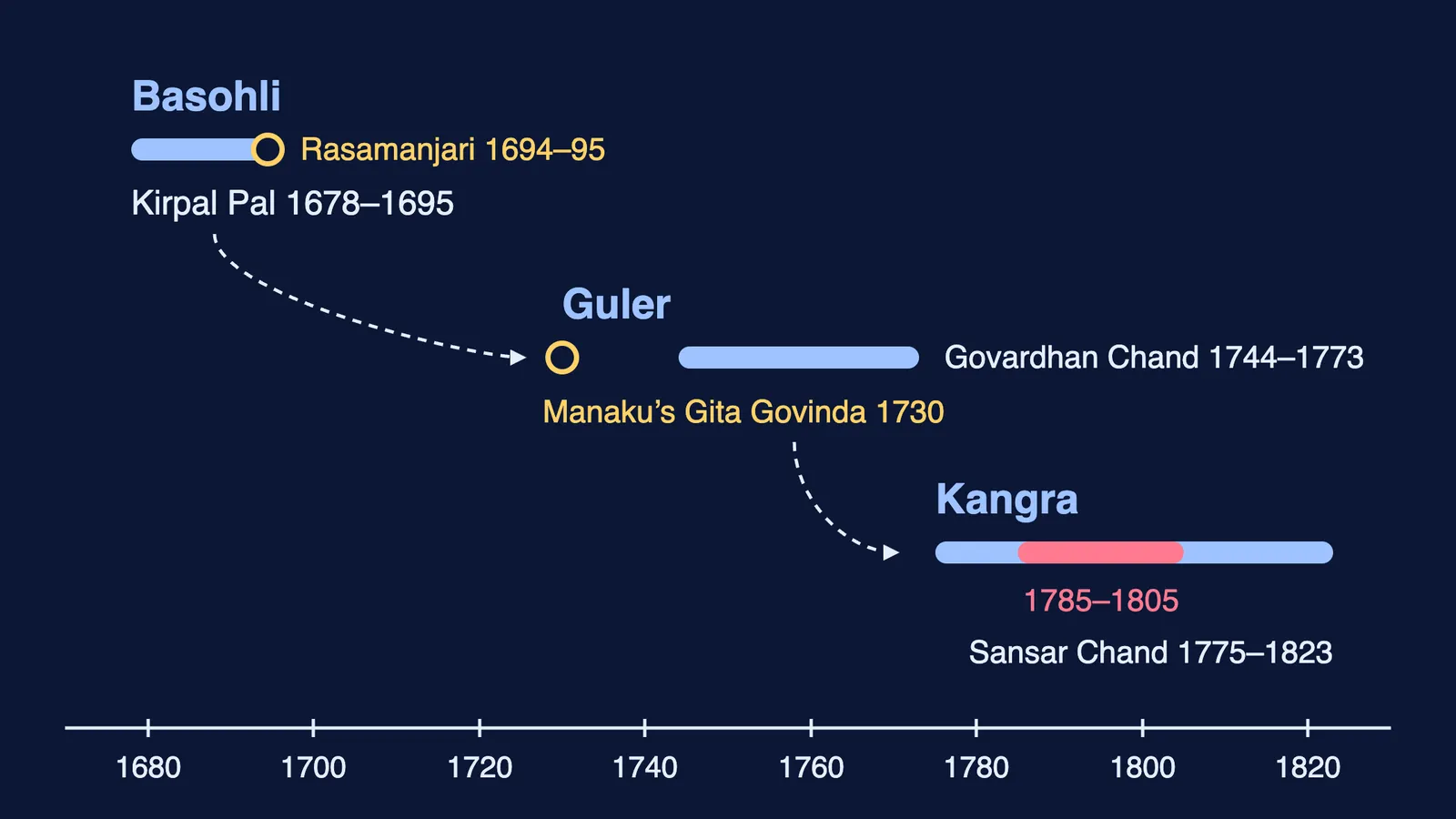
Basohli. The first and most dramatic hill style grew under Kirpal Pal, who ruled from 1678 to 1695. Look for strong primary colours, warm yellows across background and horizon, stylised trees, raised white paint for pearls and, most famously, tiny shiny pieces of beetle wings used to suggest emeralds. Bhanu Datta's *Rasamanjari* was the favourite theme; a carpenter-painter named Devida painted a series of it in 1694–95.
Guler. Around 1730–40, the artist Pandit Seu and his sons Manaku and Nainsukh moved painting towards what the book calls the pre-Kangra or Guler–Kangra style: calmer, more refined and more elegant than Basohli. Raja Govardhan Chand (1744–1773) was the Guler patron. Nainsukh went to Jasrota, where Raja Balwant Singh became his greatest patron, and recorded his patron's daily life in portrait after portrait. The scholar B. N. Goswamy, the book notes, argued that a family of artists, not a region, carried the style.
Kangra. Painting flowered under Raja Sansar Chand (1775–1823), with workshops at Tira Sujanpur, Alampur and Nadaun along the river Beas. The book lists the marks of the style as delicate line, brilliant colour and very fine decoration, plus a female face whose nose runs straight on from the forehead, seen from around the 1790s. The best work dates from 1785 to 1805; painting was badly disrupted around 1805, when the Gurkhas besieged Kangra fort.
What should you write about the two set paintings?
Krishna with Gopis (Manku, per the curriculum). The chapter does not discuss a painting with this title. It names Manaku's most outstanding work as a *Gita Govinda* set painted in 1730 at Guler that keeps some Basohli elements, above all the lavish beetle-wing casings. The curriculum places this work in the Basohli sub-school. As the book retells it, Jayadeva's poem follows Radha and Krishna falling in love, a separation and their reunion. In an answer, connect it to Basohli traits you can name.
Nand, Yashoda and Krishna with Kinsmen Going to Vrindavana (Nainsukh, per the curriculum). The book discusses this work as *Nanda, Yashoda and Krishna* without naming its painter. The scene comes from the *Bhagvata Purana*: in the story as the book retells it, the family finds Gokul troubled by demons, so Nanda leads them to Vrindavan on a bullock cart; a second cart carries Krishna, Balaram, Yashoda and Rohini and villagers follow with loads. Discuss three points the book highlights: observed gestures (tilted heads, tired downcast eyes, arms stretched to steady a pot), a naturalistic landscape, and a composition cut off at the edges like a photograph.
How do you tell Basohli from Kangra in an answer?
Colour: Basohli uses strong primaries and warm yellow grounds; Kangra is known for brilliant colour.
Ornament: Basohli has raised white pearls and beetle-wing emeralds; Kangra has very fine decorative detail.
Nature: Basohli stylises vegetation; Kangra observes landscape closely and paints it naturalistically.
Faces: Kangra's female profile has the nose in line with the forehead.
Mood: the book calls Basohli coarsely flamboyant and Kangra poetic and lyrical.
History students may like our Class 12 guide to Bhakti-Sufi traditions for background on devotional poetry.
Practice questions
Mark values are our suggestion.
Name the ruler under whom the Basohli style developed and give two of its features. (2 marks)
How did Basohli painters suggest pearls and emeralds in jewellery? (2 marks)
Explain the role of Pandit Seu's family in changing Pahari painting, according to B. N. Goswamy. (3 marks)
Appreciate *Nand, Yashoda and Krishna with Kinsmen Going to Vrindavana* with reference to its theme, figures and composition. (6 marks)
Compare the Basohli and Kangra styles under colour, nature, ornament and mood. (6 marks)
Not sure which of the four miniature schools to revise first? Fermi's AI tutor works out what you already know and builds a plan for the session.