On this page
This guide follows Chapter 3 of NCERT's An Introduction to Indian Art Part II (Reprint 2026-27). The CBSE Fine Arts curriculum 2026-27 names no textbook, so we map the chapter to its Unit 1, Miniature Paintings.
What is the Mughal school of miniature painting?
It is a style of small, finely worked painting that grew in north India from the sixteenth century and lasted until the mid-nineteenth, according to the NCERT chapter. The chapter's central idea is fusion: Indian themes and styles mixed with Persian ones first, then European ones.
Royal workshops (ateliers) brought together calligraphers, painters, gilders and binders, and most paintings were manuscript or album pages for the royal family. Against the flat, bold-lined earlier Indian styles, the book says Mughal work sought subtlety and near three-dimensional figures. Favourite subjects: court scenes, portraits, and accurately drawn plants and animals.
How did Mughal painting change from Babur to Bahadur Shah Zafar?
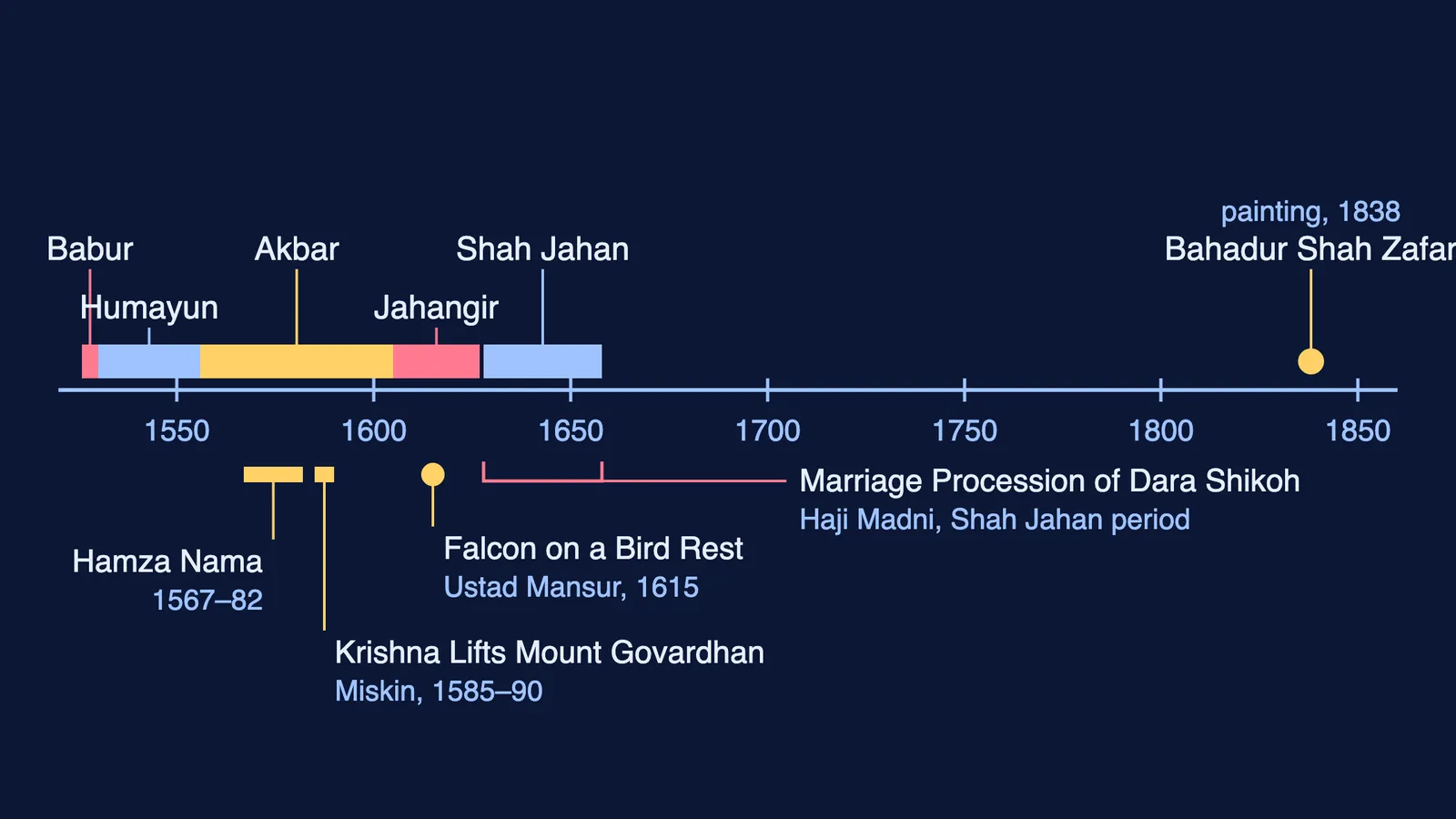
Learn it as a chain of patrons; dates are from the NCERT chapter.
Babur (came to India in 1526): began the habit of keeping memoirs in the Baburnama, and wrote about the Persian master Bihzad.
Humayun (succeeded in 1530): in exile he saw Shah Tahmasp's Safavid workshops, and with the Shah's help set up court in Kabul in 1545. On regaining power in India he invited two Persian painters, Abd us Samad and Mir Sayyid Ali, to run his studio, and he began the Hamza Nama that Akbar continued.
Akbar (1556-1605): his historian Abul Fazl records more than a hundred artists in the atelier. The Hamza Nama (1567-1582) ran to 14 volumes with 1400 illustrations; the Razm Nama, a Persian Mahabharata supervised by Daswant, was finished in 1589 with 169 paintings.
Jahangir (1605-1627): favoured fewer works by single masters, exact study of nature, album pages (muraqqas) with gilded margins, and growing European influence seen in spatial depth and naturalism.
Shah Jahan (1628-1658): preferred idealised, stylised images, jewel-like colour and fine line; the Padshahnama was a major project.
Aurangzeb and after: the book says he gave the atelier less attention, though it was not closed at once. Artists moved to provincial courts, a painting of Bahadur Shah Zafar is dated 1838, and the style finally merged into Provincial and Company painting.
Per the curriculum, Graphics, Sculpture and Applied Art-Commercial Art share this theory syllabus. For a quick refresher on the dynasty, see our Class 7 summary of Mughal rulers.
How was a Mughal miniature made?
The NCERT chapter gives an order you can draw as a flow chart:
Handmade paper was prepared and cut to the size of the manuscript, with space kept for the picture.
The page was ruled and the text written in.
The artist planned the composition (tarh), then the portraits (chiharanama), then the colouring (rangamizi).
Opaque colours, ground from natural sources, were laid on with brushes of squirrel or kitten hair.
The finished page was burnished with agate to set the colour and give it a glow.
Learn the pigment pairs: vermilion from cinnabar, ultramarine from lapis lazuli, yellow from orpiment, white from ground shells and lampblack from charcoal, plus gold and silver powders. (The book prints "Lapiz Lazuli"; the usual spelling is lapis lazuli.)
What should you write about the four prescribed paintings?
For each, give title, artist, patron, subject and two features.
Krishna Lifting Mount Govardhan, Miskin (1585-90): from a dispersed Persian translation of the Harivamsa made under Akbar. The book describes Krishna holding up the mountain like an umbrella so that villagers and their cattle can shelter from rain sent by Indra.
Falcon on a Bird-Rest, Ustad Mansur (1615): Jahangir gave Mansur the title Nadir ul Asr and had his falcons painted for the Jahangirnama. It shows Jahangir-period interest in exact natural detail.
Marriage Procession of Dara Shikoh, Haji Madni: Shah Jahan period. Dara, Shah Jahan's eldest son, rides a brown horse wearing a sehra; Shah Jahan, haloed, rides a white one, with music, dancers, gifts and fireworks around them.
Kabir and Raidas, Ustad Faquirullah Khan: listed in the curriculum, but the current NCERT chapter does not discuss it. Ask your teacher for notes.
The curriculum spells "Ustad Mansoor" and "Dara Shukoh"; the book writes Mansur and Shikoh, the same people. For more on Kabir, see our Class 12 Bhakti-Sufi traditions guide.
Practice questions
Question styles and marks are our suggestion.
Why were the Hamza Nama folios painted in a large format, and on what base surface? (2 marks)
List the three stages of painting a manuscript page, using the Persian terms. (3 marks)
Give the source of three pigments used in the atelier and name the stone used to burnish a finished page. (4 marks)
Identify Krishna Lifting Mount Govardhan: artist, source text, period and subject. (4 marks)
Compare the ateliers of Akbar, Jahangir and Shah Jahan, giving one feature of output or style for each. (6 marks)
Not sure which of these to start with? Fermi's AI tutor works out what you already know and builds a plan for the session.