On this page
These are the key terms of Chapter 1, The Living World, in the NCERT Class 11 Biology textbook (Reprint 2026-27), grouped the way the chapter is built. The CBSE 2026-27 Biology curriculum lists the chapter's scope as biodiversity, the need for classification, three domains of life, taxonomy and systematics, the concept of species, taxonomical hierarchy and binomial nomenclature. For the full chapter walk-through, read our Living World Class 11 guide to taxonomic hierarchy and naming rules.
Not in the current chapter: the old "what is living?" features (growth, reproduction, metabolism) and taxonomical aids such as herbaria, museums and keys. The 2026-27 text has only two sections, 1.1 and 1.2.
What does biodiversity mean in The Living World?
Biodiversity: the number and kinds of organisms living on Earth. Per NCERT, between 1.7 and 1.8 million species are known and described, and new ones are still being found.
Species (as a kind of organism): each distinct kind of plant, animal or other organism you can observe. Example: a mango tree and a house sparrow are two species.
Local name: the everyday name people use in one area, which can change from place to place, even within one country. This is why scientists need a shared naming system.
How are organisms named?
Identification: pinning down which organism you actually have, from an accurate description, so the right name can be attached to it. Naming is only possible after this.
Nomenclature: the agreed way of naming, so one organism carries one name in every country.
ICBN: the International Code for Botanical Nomenclature, the agreed rules for naming plants.
ICZN: the International Code of Zoological Nomenclature, the matching rules for naming animals. Don't confuse with: ICBN, which covers plants, not animals.
Scientific name: a name, given under these codes, that belongs to one organism only and has not been used for any other.
Binomial nomenclature: the two-part naming system given by Carolus Linnaeus. Example: *Mangifera indica* (mango).
Generic name: the first word, naming the genus. It starts with a capital letter. Example: *Mangifera*.
Specific epithet: the second word, naming the particular species. It starts with a small letter. Example: *indica*. Don't confuse with: the species itself, which is named by both words together.
Writing rules: scientific names are Latin or Latinised, printed in italics, or underlined separately when handwritten.
Author citation: the shortened name of the person who first described the species, written at the end. Example: *Mangifera indica* Linn. means Linnaeus described it.
What is the difference between taxonomy and systematics?
Classification: sorting organisms into handy groups by features you can readily see. Example: sorting animals into insects, birds and mammals.
Taxon (plural: taxa): any group used in classification, at any level. Example: "plants", "mammals", "dogs" and "wheat" are all taxa, at different levels.
Characterisation: recording an organism's characters, such as its outer and inner structure, its cells, how it develops and where and how it lives. NCERT treats these as the basis of modern taxonomic studies.
Taxonomy: the work of sorting organisms into taxa according to their characters. Its four basic processes are characterisation, identification, classification and nomenclature.
Systematics: the branch that asks how different kinds of organisms are related to one another, evolutionary relationships included. The word comes from the Latin "systema", meaning systematic arrangement, and Linnaeus titled his book *Systema Naturae*. Don't confuse with: taxonomy, which classifies; systematics also asks how organisms are related.
Three domains of life: a proposed system that splits Kingdom Monera into two domains and puts all eukaryotic kingdoms in a third. NCERT mentions it briefly in Chapter 2 and leaves the detail for higher classes.
What are the taxonomic categories, from species to kingdom?
Taxonomic category (rank): one step in the classification ladder. Each rank is a unit of classification.
Taxonomic hierarchy: all the categories arranged in order: species, genus, family, order, class, phylum or division, kingdom.
Species (as a rank): the lowest category, a group of individuals with fundamental similarities that can be told apart from close relatives by clear differences in form. Example: *Panthera leo* (lion).
Genus: a group of closely related species. Example: potato (*Solanum tuberosum*) and brinjal (*S. melongena*) are both in *Solanum*; lion, tiger and leopard are in *Panthera*.
Family: a group of related genera. Plant families are based on both vegetative and reproductive features. Example: *Solanum*, *Petunia* and *Datura* in Solanaceae; *Panthera* and *Felis* in Felidae. Don't confuse with: genus. Cat and dog are in different families, Felidae and Canidae.
Order: a group of families sharing only a few characters. Example: Carnivora includes Felidae and Canidae.
Class: a group of related orders. Example: Mammalia includes Primata and Carnivora.
Phylum: a group of related animal classes. Example: fishes, amphibians, reptiles, birds and mammals are in Chordata because they share a notochord and a dorsal hollow neural system.
Division: the plant equivalent of a phylum. Don't confuse with: phylum, which is used for animals.
Kingdom: the highest category. Example: Animalia for all animals, Plantae for all plants.
Sub-categories: extra ranks taxonomists add within the hierarchy for more precise placement.
The rule to remember: going up from species to kingdom, members share fewer and fewer characters, so placing a group gets harder.
How to learn these terms
Learn in pairs: identification and nomenclature, ICBN and ICZN, generic name and specific epithet, taxonomy and systematics, phylum and division.
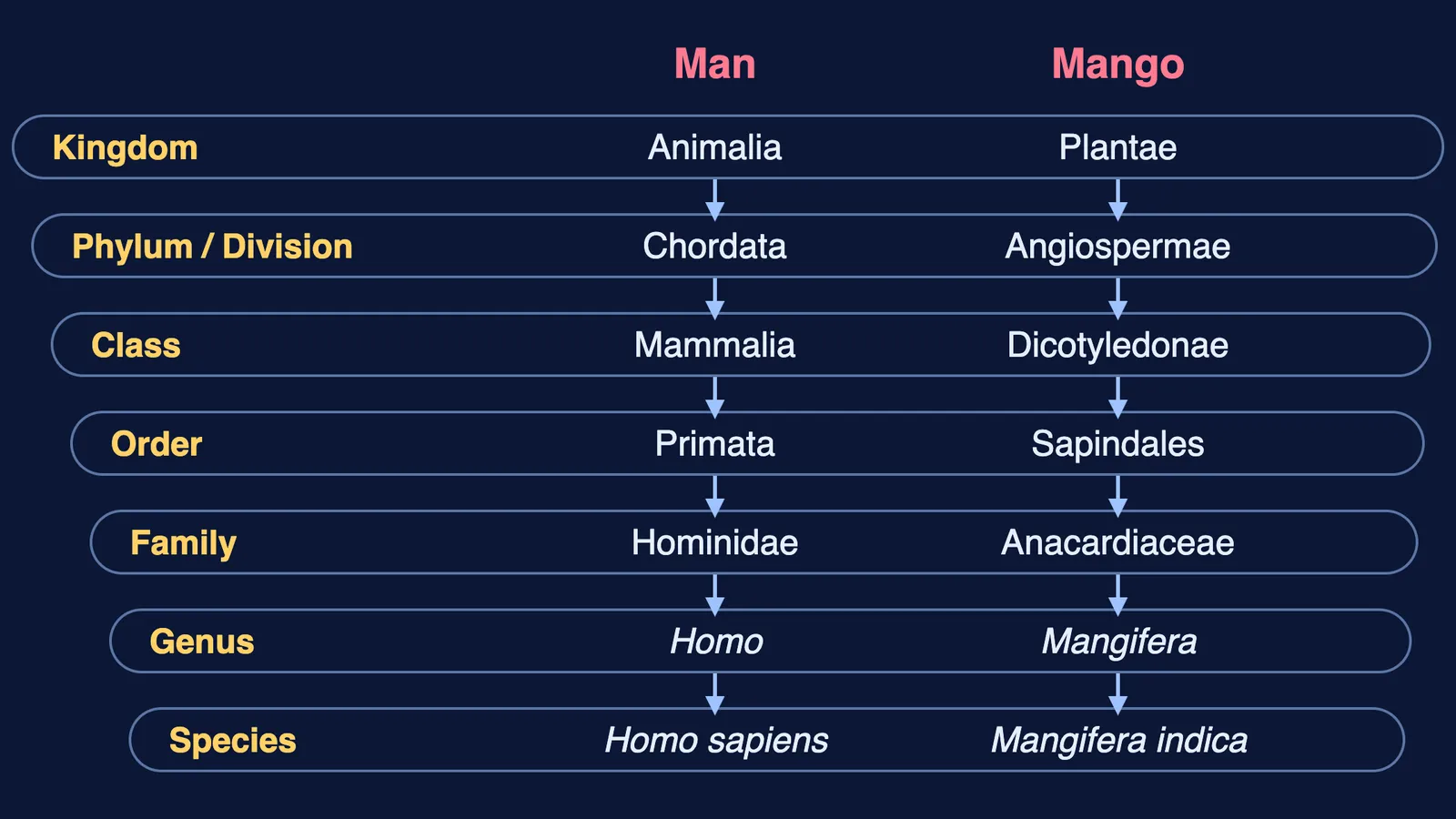
Write out one full ladder each for an animal and a plant, using Table 1.1: man (*Homo*, Hominidae, Primata, Mammalia, Chordata) and mango (*Mangifera*, Anacardiaceae, Sapindales, Dicotyledonae, Angiospermae).
Practise the naming rules by hand: write five scientific names, underline each word separately, and check the capitals.
Say the order of ranks from both ends, species upwards and kingdom downwards, until it is automatic.
If a term still feels abstract, the Fermi Concept Library gives each concept in biology its own lesson. For more, see our NEET notes on taxonomic categories and naming and the next chapter, Biological Classification Class 11: five kingdoms compared.