On this page
Chapter 6 of NCERT's *An Introduction to Indian Art* Part II traces Indian painting from Company painting to early modernism. This guide follows the current NCERT chapter (Reprint 2026-27) and maps it to Unit 2 of the CBSE Class 12 Fine Arts curriculum 2026-27.
What does the Bengal School chapter cover?
The NCERT chapter moves in five steps.
Company painting. English officers hired local painters to record life around them; the mix of traditional methods with European close observation became the Company School. It faded once photography arrived in the mid-nineteenth century.
Academic realism. Raja Ravi Varma, a self-taught painter at the Travancore court, used European oil technique for scenes from the epics; prints of his work reached homes as calendar images. By the late nineteenth century, the chapter notes, nationalist thinking came to see this style as too western.
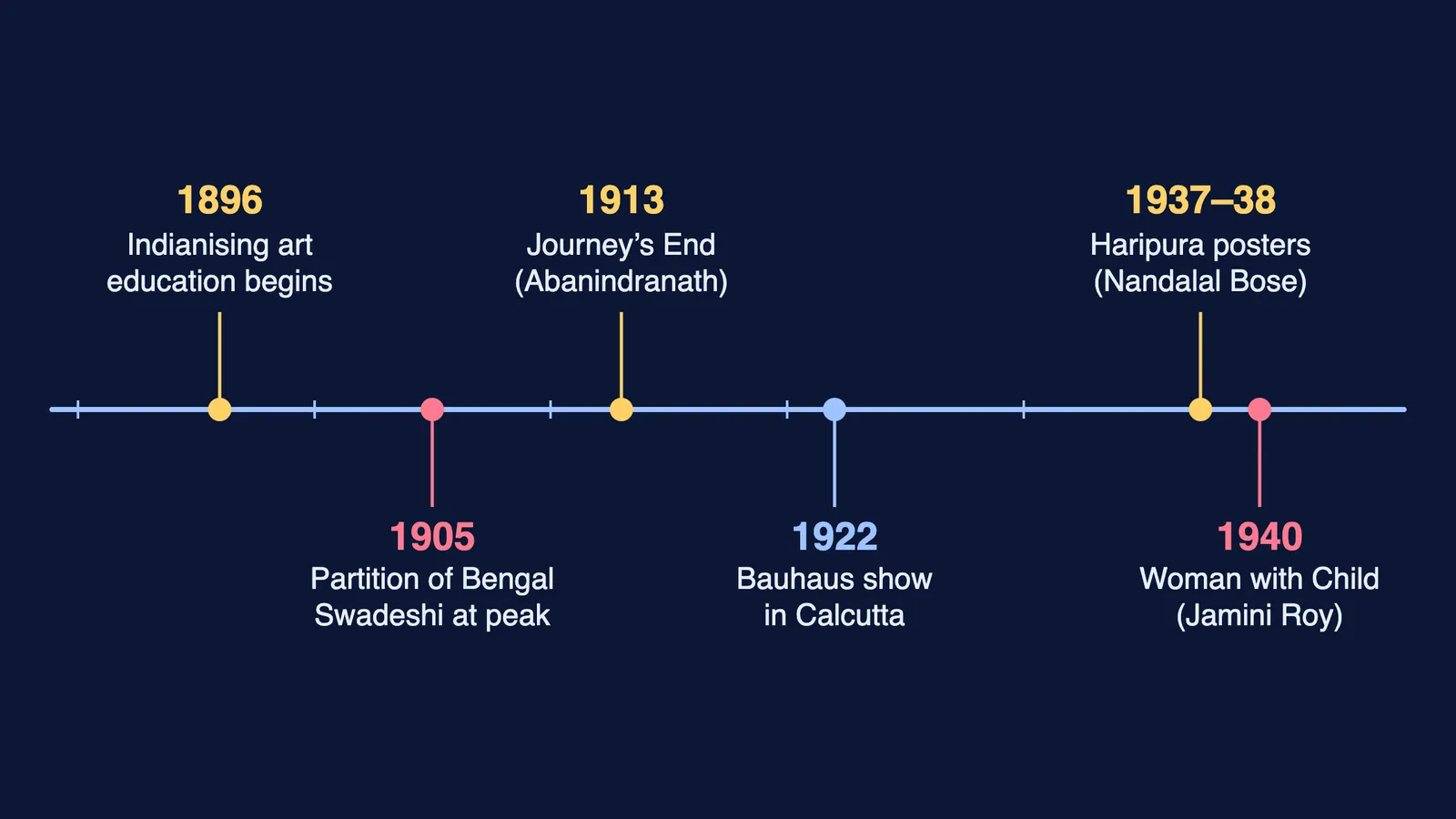
The Bengal School. Led by Abanindranath Tagore (1871–1951) with the support of E. B. Havell (1861–1934), principal of the Calcutta School of Art, it looked to Mughal and Pahari miniatures rather than colonial art-school methods. The book dates their push to Indianise art teaching to 1896 and links the movement to Swadeshi.
Shantiniketan. Nandalal Bose headed painting at Kala Bhavana, which the book calls India's first national art school, at Visva-Bharati. At Gandhi's invitation he painted the Haripura posters of farmers, drummers and other rural workers.
Pan-Asianism and modernism. The book links the 1905 Partition of Bengal to the peak of the Swadeshi movement. Two Japanese artists who came with Kakuzo Okakura taught wash technique at Shantiniketan. In 1922 a Bauhaus exhibition reached Calcutta, and Gaganendranath Tagore painted in a Cubist style.
Who are the key artists and works?
The book discusses these works:
Journey's End (1913), Abanindranath Tagore, watercolour in his wash technique: a fallen camel against a red dusk sky, read as the close of a journey and of a day.
Radhika, Abdul Rehman Chughtai (1899–1975), wash and tempera: Radhika walking away from a lit lamp, with a calligraphic line the book traces to Mughal and Persian painting.
Rasa-Lila, Kshitindranath Majumdar (1891–1975), wash: Krishna dancing with Radha and the sakhis.
Tiller of the Soil (1938), Nandalal Bose, a Haripura panel in thick tempera.
City in the Night (1922), Gaganendranath Tagore, watercolour in a Cubist idiom.
Woman with Child (1940), Jamini Roy, gouache: flat forms and thick outlines drawn from Bengal's pat paintings.
A note on dates: the book gives 1937 for the Haripura session and the poster Dhaki (page 88) but 1938 for Tiller of the Soil (page 91), so the timeline shows 1937–38.
What does CBSE 2026-27 ask from this chapter?
The Class 12 theory paper carries 30 marks over 2 hours. Unit 2 carries 15 marks for the Indian National Flag, the Bengal School and modern trends together. The 15 marks are shared by the whole unit, not split by chapter. Painting, Graphics, Sculpture and Applied Art use the same theory table.
The curriculum's Bengal School list has four works: Journey's End by Abanindranath Tagore, Shiv and Sati by Nandlal Bose, Radhika by M.A.R. Chughtai, and Meghdoot by Ram Gopal Vijaivargiya.
Gaps. The chapter does not discuss Shiv and Sati, Meghdoot or the National Flag's forms and colours; use your teacher's notes for these. From the modern-trends list it does cover Rama Vanquishing the Pride of the Ocean by Raja Ravi Varma, and Jamini Roy (the curriculum lists Mother and child; the book's example is Woman with Child).
Spellings. The curriculum writes "Nandlal Bose" and "M.A.R. Chughtai"; the book writes Nandalal Bose and Abdul Rehman Chughtai. They are the same artists.
How do you write an appreciation answer?
The curriculum asks you to judge works on origin, features, aesthetics, symbolism, technique, emotion and respect for life. Here is that frame applied to Journey's End:
Artist, date, medium: Abanindranath Tagore, 1913, watercolour.
Context: the Bengal School's search for an Indian style.
Technique: wash, which the book says he invented; it gives a soft, misty effect.
What you see: a fallen camel against a red evening sky.
Symbolism: the end of a day standing for the end of a journey, and of a life.
Emotion (your reading): quiet tiredness and closure; link it to respect for life.
For background on wash and tempera as media, see our guide to mediums and techniques in visual art.
Practice questions (marks are our suggestion)
Why did Abanindranath Tagore and E. B. Havell turn to Mughal and Pahari miniatures as sources? (2 marks)
Name the technique Japanese artists taught at Shantiniketan and explain why it mattered to the Bengal School. (2 marks)
Appreciate Radhika by M. A. R. Chughtai, covering medium, line and mood. (4 marks)
How did the Haripura posters show ordinary people as part of building the nation? (4 marks)
Compare Raja Ravi Varma's academic realism with the Bengal School's approach. (6 marks)
For question 4, see our guide to Mahatma Gandhi and the national movement.
Not sure which Unit 2 topic to revise first? Fermi's AI tutor works out what you already know and builds a plan for the session.