On this page
What does this chapter cover in 2026-27?
Theme 11 (Part III) follows Gandhi's work in India from his return in January 1915 to his death in January 1948 and how historians reconstruct it. The current NCERT chapter (reprint 2026-27) is titled "Mahatma Gandhi and the Nationalist Movement: Civil Disobedience and Beyond".
The CBSE 2026-27 History curriculum gives Part III 25 marks, shared by four themes: colonialism and the countryside, the 1857 revolt, this chapter and the framing of the Constitution. No separate figure is given for this chapter. Part III carries seven 1-mark MCQs, two 3-mark short answers, one 8-mark long answer and one 4-mark source-based question. The map list names national movement centres such as Champaran, Kheda, Chauri Chaura, Bardoli and Dandi.
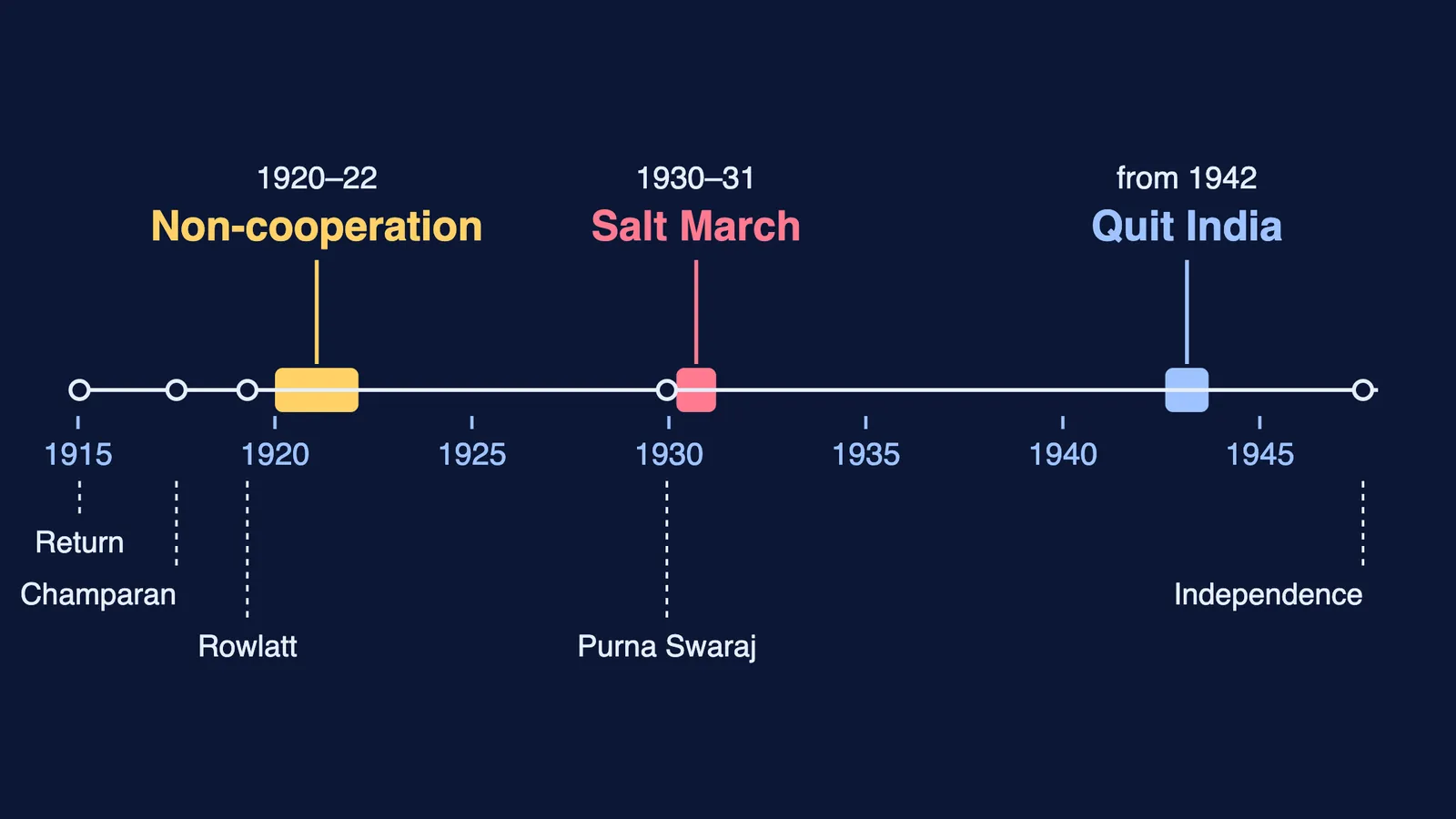
How did non-cooperation, the Salt March and Quit India differ?
From the NCERT text:
Non-cooperation (1920-22). After the Rowlatt satyagraha of 1919 and the Jallianwala Bagh firing in Amritsar that April, Gandhi asked Indians to leave government schools, colleges and courts and to stop paying taxes, linking the campaign to Khilafat. Official figures for 1921 counted 396 strikes with 600,000 workers taking part. He called it off after the violence at Chauri Chaura in February 1922.
Salt March (1930-31). After the Lahore Congress adopted Purna Swaraj in December 1929, Gandhi set out from Sabarmati on 12 March 1930 and broke the salt law at Dandi about three weeks later. Nearly 60,000 people were arrested. At the Round Table Conferences that followed, the Muslim League, the princes and B.R. Ambedkar challenged Gandhi's claim to speak for all India.
Quit India (from August 1942). Launched after the Cripps Mission failed, it ran without Gandhi, who was jailed at once. Younger activists such as Jayaprakash Narayan led strikes and sabotage, parallel governments arose in Satara and Medinipur, and suppressing it took over a year.
The pattern: the call came from the top, but peasants, workers and students joined for their own reasons, often going further than leaders planned.
How do historians read Gandhi through letters, reports and newspapers?
The chapter ends with sources, each with its own slant.
Speeches and letters. Speeches are public; letters look private but were often written expecting print. The chapter's example is a 1936 dispute in which Gandhi mediated between Jawaharlal Nehru and Rajendra Prasad, printed in Nehru's A Bunch of Old Letters.
Autobiographies. Written later from memory, they frame the author's chosen picture; notice what is left out.
Police and Home Department reports. The confidential fortnightly reports on the Salt March played down public response, even as police on the route reported large crowds of all castes, women included.
Newspapers. Time magazine first mocked Gandhi and doubted he would finish the march, then within a week called the British anxious. Local papers in eastern Uttar Pradesh, studied by historian Shahid Amin, recorded rumours of Gandhi's miraculous powers in 1921.
For any source box, ask: who wrote it, for whom, was it public, and what did the writer want to believe?
How do you write an 8-mark answer on this chapter?
The 2026-27 sample paper set its 8-mark question on Gandhi as a choice: his appeal to peasants, or a biographer's verdict on non-cooperation. The marking scheme lists eight separate points for each. Plan eight clear points. Our own question: "The Salt March showed both Gandhi's tactical skill and the limits of colonial understanding. Examine."
Context: Purna Swaraj at Lahore and Independence Day on 26 January 1930.
Why salt: needed in every home, yet a state monopoly.
Lord Irwin had advance notice but missed its significance.
The march from Sabarmati to Dandi, March to April 1930.
Spread: parallel marches, forest-law breaches, strikes.
Response: nearly 60,000 arrests.
Significance: world press attention, and women joining in large numbers after Kamaladevi Chattopadhyay persuaded Gandhi.
Outcome: the Gandhi-Irwin Pact and Round Table talks, which radicals criticised for winning no promise of independence.
End with a judgement.
Practice questions
(1 mark) Which pair is correctly matched? (a) Champaran: mill workers (b) Kheda: tax remission after crop failure (c) Ahmedabad: indigo planters (d) Bardoli: Rowlatt Act. Answer: (b).
(3 marks) Why did Gandhi link non-cooperation with the Khilafat movement?
(3 marks) Give three reasons a Home Department fortnightly report may misread public feeling.
(4 marks, source-based) Given an extract from a colonial report on civil disobedience, name the writer, one claim it makes and one reason to doubt it.
(8 marks) Compare the roles of leaders and ordinary people in non-cooperation and Quit India.
How should you revise it?
Draw a 1915-1948 timeline with the three movements as anchors, and map centres. Then read Framing the Constitution debates and speakers, the next theme in Part III, and reuse the source-reading habits from our Kings, Farmers and Towns guide.
If maths or a science paper sits on the same timetable, Fermi's AI tutor can work out what you already know and build a plan for the session, so you sit down to a clear next step.
Start today: test the four source questions on one source box.