

On this page
Framing the Constitution is Theme Twelve of NCERT's Themes in Indian History Part III, and it rewards students who can hear an argument rather than recite articles. The NCERT chapter asks you to explain why members of the Constituent Assembly disagreed, so learn the speakers, their positions and how each debate ended.
What does Framing the Constitution cover?
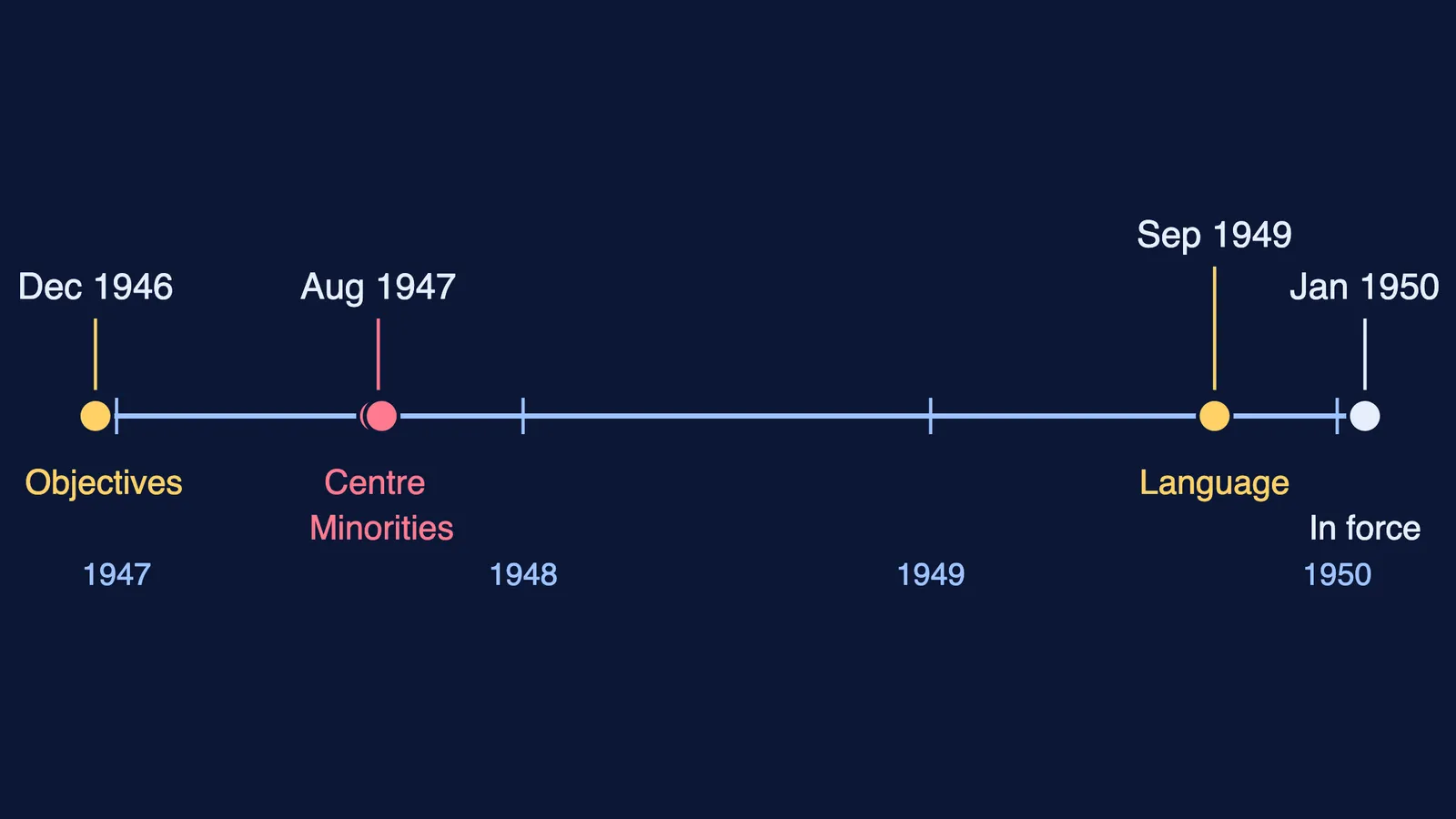
The Constitution of India was framed between December 1946 and November 1949, according to the NCERT chapter. The Assembly held eleven sessions with sittings spread over 165 days, and 114 of those days went on the Draft Constitution, says the Lok Sabha's page on the Constituent Assembly. The Constitution came into effect on 26 January 1950.
Its members were not elected by universal franchise: provincial legislatures chosen in the 1945-46 elections picked them, and 82 per cent were also Congress members (NCERT). Even so, the house argued fiercely over rights, minorities, the powers of the Centre, and language. The work began on 13 December 1946, when Jawaharlal Nehru moved the Objectives Resolution. It proclaimed India an "Independent Sovereign Republic" and promised "adequate safeguards" for minorities, backward and tribal areas, and Depressed and Other Backward Classes.
Who said what in the Constituent Assembly debates?
Examiners reward a named speaker with a clear position. Each line below comes from the NCERT chapter, which quotes the Assembly debates, a letter from Nehru and an article by Gandhi.
Minorities and rights:
B. Pocker Bahadur (Madras), 27 August 1947: wanted separate electorates kept so Muslims had a meaningful voice.
Govind Ballabh Pant: "I believe separate electorates will be suicidal to the minorities."
Vallabh Bhai Patel: separate electorates were a "poison that has entered the body politic of our country".
N.G. Ranga: the real minorities were the poor and downtrodden. "They need props. They need a ladder."
Jaipal Singh: tribals needed protection and reserved seats, not separate electorates.
J. Nagappa: the Depressed Castes were 20 to 25 per cent of the population, marginalised rather than few.
Hansa Mehta: "We have never asked for privileges"; she wanted social, economic and political justice for women.
The Centre and the states:
Nehru, in a letter to the Assembly's President: after partition, a weak central authority would be "injurious to the interests of the country".
K. Santhanam: "There is almost an obsession that by adding all kinds of powers to the Centre we can make it strong."
B.R. Ambedkar: wanted "a strong and united Centre", stronger than under the Government of India Act of 1935.
Language:
R.V. Dhulekar: Hindi as the national language, not merely the official one.
G. Durgabai: non-Hindi areas feared the push for Hindi would cut at the root of their own languages.
Mahatma Gandhi, outside the Assembly: Hindustani, a blend of Hindi and Urdu.
How was each debate settled?
The endings, also from the NCERT chapter, turn a list of speakers into an answer:
Separate electorates lost their support: by 1949 most Muslim members opposed them, and Ambedkar had dropped the demand. The Assembly instead recommended abolishing untouchability, opening Hindu temples to all castes, and reserving seats in legislatures and government jobs for the lowest castes.
The Centre won: three lists (Union, State, Concurrent), Article 356, and "a distinct bias towards the rights of the Union".
Language ended in compromise: Hindi in Devanagari as the official, not national, language, English for all official purposes for the first fifteen years, and each province free to choose a regional language for its own official work.
Universal adult franchise was the one point of substantial agreement.
How do you write a 250-300 word answer on this chapter?
Take the chapter's own question: "How did the Constituent Assembly seek to resolve the language controversy?" Write one short paragraph per C:
Context: the Congress had accepted Hindustani by the 1930s, but Hindi and Urdu grew apart as communal conflict deepened.
Claim: Dhulekar wanted Hindi as the national language, "a consummation of a historic process".
Counter-claim: Durgabai warned that non-Hindi areas felt their languages were threatened.
Compromise: the Language Committee's formula; add Shankarrao Deo and T.A. Ramalingam Chettiar, who urged accommodation.
Comment: one line on give-and-take, the chapter's phrase for how the Constitution was made.
The same frame answers the separate-electorates and Centre-versus-states questions; only the names change.
How should you revise it before the board exam?
Build a one-page grid of debate, speaker, quoted phrase and outcome; our guide to a cause-and-effect chart for history shows a layout.
Practise the chapter's source boxes as source-based questions; see how to handle case-based questions in board exams.
Write one timed answer a day with the five Cs, and check it against our advice on board answer writing after MCQ prep.
If maths or a science paper sits on the same timetable, Fermi's AI tutor can work out what you already know and build a plan for the session, so you sit down to a clear next step.
Start today: pick one debate, name two speakers and write the five Cs in ten lines.


