On this page
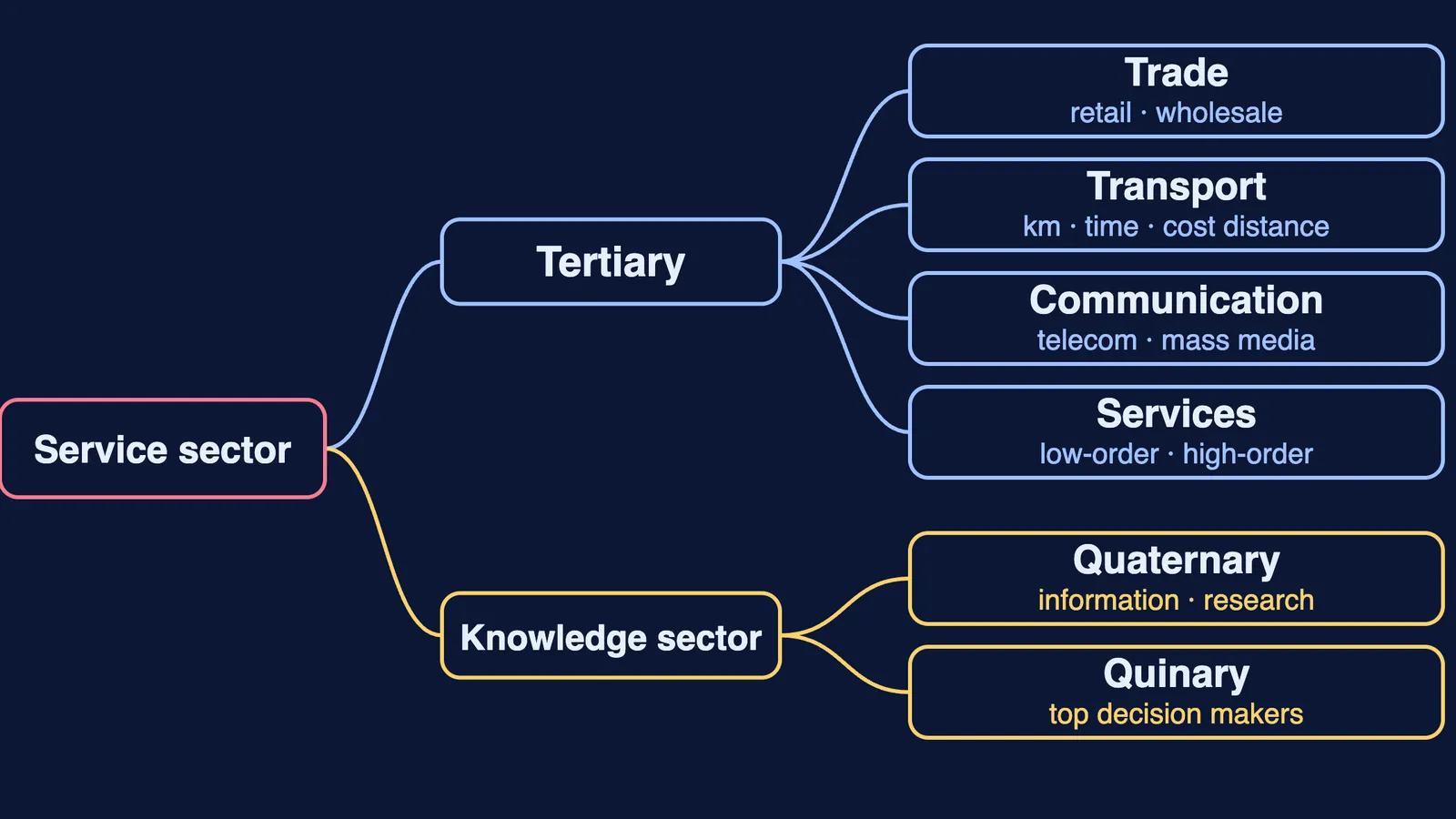
Tertiary activities sell services rather than make goods: trade, transport, communication and services such as teaching, law and health care (NCERT Class 12 Fundamentals of Human Geography, Chapter 6, Reprint 2026-27). The same chapter then climbs into the knowledge sector, where quaternary and quinary work begins. Below: the 2026-27 syllabus, a sorting drill, and the BPO-versus-KPO answer.
How many marks is this chapter worth in 2026-27?
The CBSE Geography curriculum for 2026-27 gives Unit III a combined weightage of 19 marks. That unit holds five chapters, from Primary Activities to International Trade, and there is no separate figure for this one. The map list shows "Nil" for this chapter.
The curriculum's content list keeps every section of the chapter, from trade and transport to tourism, medical services for overseas patients, quaternary and quinary activities and the digital divide. Outsourcing is not a separate bullet, but NCERT teaches it inside the quaternary pages and the sample paper tests it.
What are tertiary activities, and how are they classified?
NCERT's chapter draws the key distinction: secondary work depends on machines and factory processes, while tertiary work depends on the skills, experience and knowledge of the worker.
Trade is buying and selling goods made elsewhere. Rural marketing centres are quasi-urban, with mandis and few professional services; periodic markets meet where there is no regular market. Retail sells straight to consumers, in stores or through non-store channels such as vending machines and the internet. Wholesale is bulk business through intermediaries, and wholesalers often extend credit to retailers.
Transport distance is measured three ways: in kilometres, in time, and in cost. Isochrone lines join places that take equal time to reach. Networks are made of nodes and links.
Communication began by riding on transport; mobile telephony and satellites have now made it independent of transport.
Services run from low-order (grocery shops, laundries) to high-order (accountants, consultants, physicians). Mumbai's dabbawalas, NCERT's example of an unorganised personal service, serve about 1,75,000 customers across the city.
Tourism is travel for recreation rather than business, drawn by climate, landscape, history and art, and culture and economy. The chapter records about 55,000 patients from the USA visiting India for treatment in 2005, and links medical tourism to outsourcing of medical tests, such as reading radiology images and MRIs.
What is the difference between quaternary and quinary activities?
Both belong to the knowledge sector, as the diagram above shows.
Quaternary: collecting, producing and spreading information, with research and development at the centre. Mutual fund managers, tax consultants, software developers and statisticians are NCERT's examples. Not tied to resources, it can be outsourced.
Quinary: the highest level of decision makers and policy makers, who create and interpret ideas and evaluate new technologies. NCERT calls these "gold collar" professions: senior executives, government officials, research scientists, and financial and legal consultants. Their importance far outweighs their numbers.
How do you answer a BPO versus KPO question?
CBSE's 2026-27 sample paper set a 3-mark question asking which kind of outsourcing suits research-heavy work, with digital divide as the internal choice. The paper prints its marks as "1+2=3", and the marking scheme gives 1 for naming KPO and 2 for the reason. A clean structure:
Name it: KPO, knowledge process outsourcing.
Why: it employs highly skilled workers on information-driven work such as R and D, legal and business research, and e-learning.
Contrast: BPO handles routine, process-based tasks such as customer support, data entry and payroll, as the marking scheme puts it.
For depth, add NCERT's point that comparative advantage keeps outsourcing going, drawing work to countries with cheap, skilled workers. Moving work overseas is called off-shoring.
For the digital divide, define it as the uneven spread of ICT benefits, then give one example between countries and one within a country, such as metropolitan centres versus rural areas in India.
Which sector does each job belong to?
A drill we built from NCERT's examples. Cover the answers and sort:
A barber in Pune: tertiary, a personal service.
A wholesaler supplying kirana shops on credit: tertiary, trade.
A medical transcriptionist in Bengaluru: knowledge sector (NCERT's own example).
A software developer: quaternary.
A senior government official setting digital policy: quinary.
Saying why for each prepares you for assertion-reason questions.
What practice questions should you try?
These are our own, in the paper's formats:
(1 mark) What does an isochrone line join?
(3 marks) Distinguish between rural and urban marketing centres.
(3 marks) Explain how periodic markets serve a large rural area.
(5 marks) Explain four factors that attract tourists to a region, with one example each.
(5 marks) Explain the advantages and problems of outsourcing for the countries that receive it.
Unit III opens with Primary Activities for Class 12 geography, and this chapter's trade ideas continue in international trade for Class 12 geography.
If you do not know where to start, Fermi's AI tutor can work out what you already know and build a plan for the session.