On this page
Chapter 12 of Khel Praveen, the new NCERT Physical Education and Well-being book for Class 9 (NCERT, First Edition April 2026), opens Unit 4, Sports for All. It sets up the vocabulary the rest of the unit uses.
What does "Sports for All" mean in Class 9 PE?
The chapter opens with a sports-day race in which runners stop to help a fallen boy finish: sport is about unity and fairness, not only winning. The chapter then treats sport as a right. It cites UNESCO's 2015 international charter on physical education and sport, which calls physical education and sport a fundamental right for everyone, and the European Sports Charter, which speaks of a right to access sport in a safe setting (NCERT Chapter 12).
Inclusiveness in sports, in the book's sense, means making sure every person, whatever their background, ability, gender, age or social standing, gets the chance to take part in sport and gain from it.
The book also gives four reasons this matters: a human-rights view (no child should be kept out because of gender, caste or disability), sport as a tool for social development and peace, an ethical view built on dignity, and cultural preservation through ethnosport, the book's word for traditional and indigenous games such as Kabaddi, Kho-kho and Mallakhamb.
What are the five dimensions of inclusiveness?
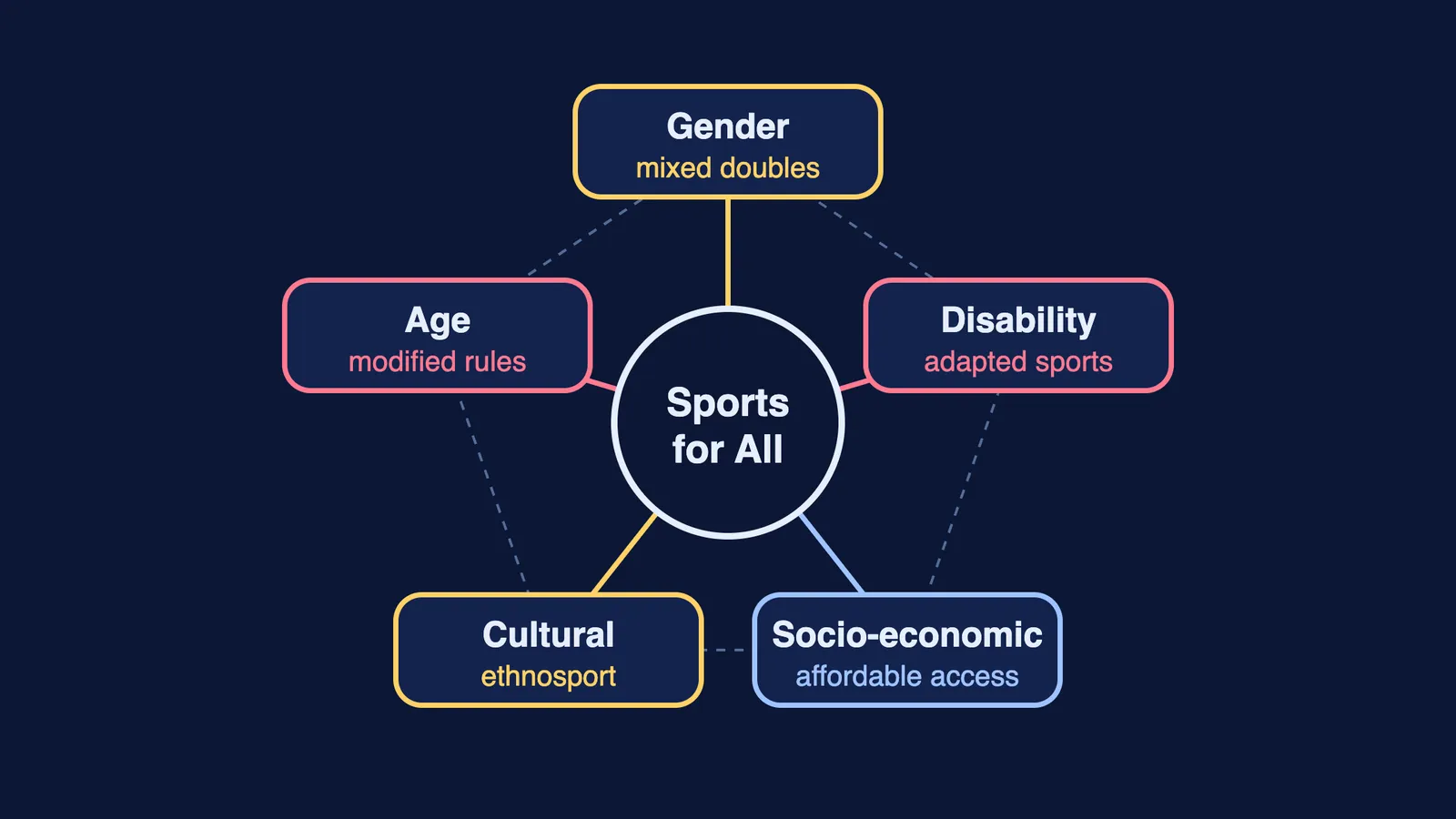
The book lists five. Learn one example for each:
Gender: equal chances for women and men to play, coach and lead. Examples in the book: the "This Girl Can" campaign, Korfball, Ultimate Frisbee and mixed doubles.
Disability inclusion: adapted sports let persons with disabilities take full part. The Paralympic Games and Special Olympics are the book's examples.
Socio-economic: free or low-cost facilities, equipment and coaching, so family income does not decide who plays.
Cultural and ethnic: ethnosports alongside mainstream sports, such as Kabaddi and Kho-kho in India.
Age: programmes for every age, from children to older adults, using modified rules, suitable equipment and non-competitive formats.
What stops people from playing, and what helps?
The chapter names five barriers: low family income (no facilities, kit or coaching); fewer opportunities, less media coverage and less funding for women and girls; venues that are not accessible and adaptive programmes that are thin on the ground; social attitudes and traditional restrictions; and rural or remote areas without sports infrastructure.
It then pairs them with seven measures:
Accessible parks, playgrounds and stadiums: ramps, wheelchair-accessible seating, tactile walkways for people with visual impairments, gender-neutral restrooms.
Rules that clearly open sport to all, backed by anti-discrimination policy.
Grassroots events: street sports, school competitions, community tournaments.
Training coaches and referees in inclusive practice, such as equal playing time, adapted rules and positive language.
Awareness and media campaigns that feature women athletes and para-athletes.
Support for traditional games like kabaddi, kho-kho and wrestling, which need little costly equipment.
Scholarships, travel allowances, reduced fees and free equipment for athletes from low-income families.
To revise, match each barrier to a measure: cost to scholarships, inaccessible venues to infrastructure, attitudes to media campaigns.
How is this chapter assessed in 2026-27?
In the CBSE 2026-27 curriculum, Grade 9 Physical Education and Well-being has 100 marks: 20 for theory and 80 for practical. Theory is set as 2 marks for each unit (MCQ, objective or short answer), "2 Marks × 8 Units = 16 Marks", plus a 4-mark viva.
Those 2 marks belong to the whole unit, not to this chapter alone. The curriculum calls this unit "Sports for All" and numbers it Unit 5, while the book numbers it Unit 4. Its topic list starts with the meaning of inclusiveness in physical education and sports, then moves on to disability, disability etiquette and the STEP model, women's participation, master athletes, and community sports including Khelo India and Fit India (CBSE curriculum).
Not sure where to begin your revision? Fermi's AI tutor works out what you already know and builds a plan for the session.
Practice questions
These are our own questions; the mark labels are our suggestion.
(1 mark) Which of these is an ethnosport: Kho-kho, Korfball or Ultimate Frisbee?
(2 marks) Define inclusiveness in sports and give one example of age inclusion.
(2 marks) Your school's football ground has only stairs and no seating. Suggest two changes that would make it more inclusive.
(2 marks) Explain why traditional games such as kabaddi help socio-economic inclusion.
Model answer for Q4: Kabaddi needs almost no costly equipment, so children from low-income families can play it. Valuing such regional games also treats local customs with respect, which supports cultural inclusion.
For the Class 11 version of the disability theme, read our guide to physical education and sports for CWSN in Class 11; for the values side of sport, see Olympism, Olympic values and symbols for Class 11.
This is a study summary of the NCERT chapter, not medical or health advice.