On this page
This short chapter rewards exact terms. Here is what the 2026-27 syllabus keeps, with practice questions.
What does the 2026-27 syllabus keep from this chapter?
CBSE gives Unit VII, Social Influence and Group Processes, 6 of the 70 theory marks in 2026-27 (CBSE Psychology curriculum 2026-27). It lists groups, their types, social loafing and group polarisation.
The current NCERT Chapter 7 (Reprint 2026-27) matches, with groupthink and Tajfel's experiments in boxes (NCERT Chapter 7). Conformity, compliance and obedience have no sections in the current chapter or in the Class 12 syllabus, so skip them if an older guide still teaches them.
In the CBSE 2026-27 sample paper, this chapter carries a 1-mark question on the stage where leadership emerges, a 2-mark question on primary and secondary groups, and a 1+2 mark case on group polarisation (sample paper, marking scheme).
What is a group, and how does it form?
NCERT defines a group as an organised system of two or more people who interact, depend on each other, share motives, hold roles and follow norms (NCERT). A crowd has no structure or belonging; an audience can turn into a mob; a team adds complementary skills and shared accountability.
Why people join: security, status, self-esteem, social needs, goals and information.
What forms them: proximity, similarity, and common motives and goals.
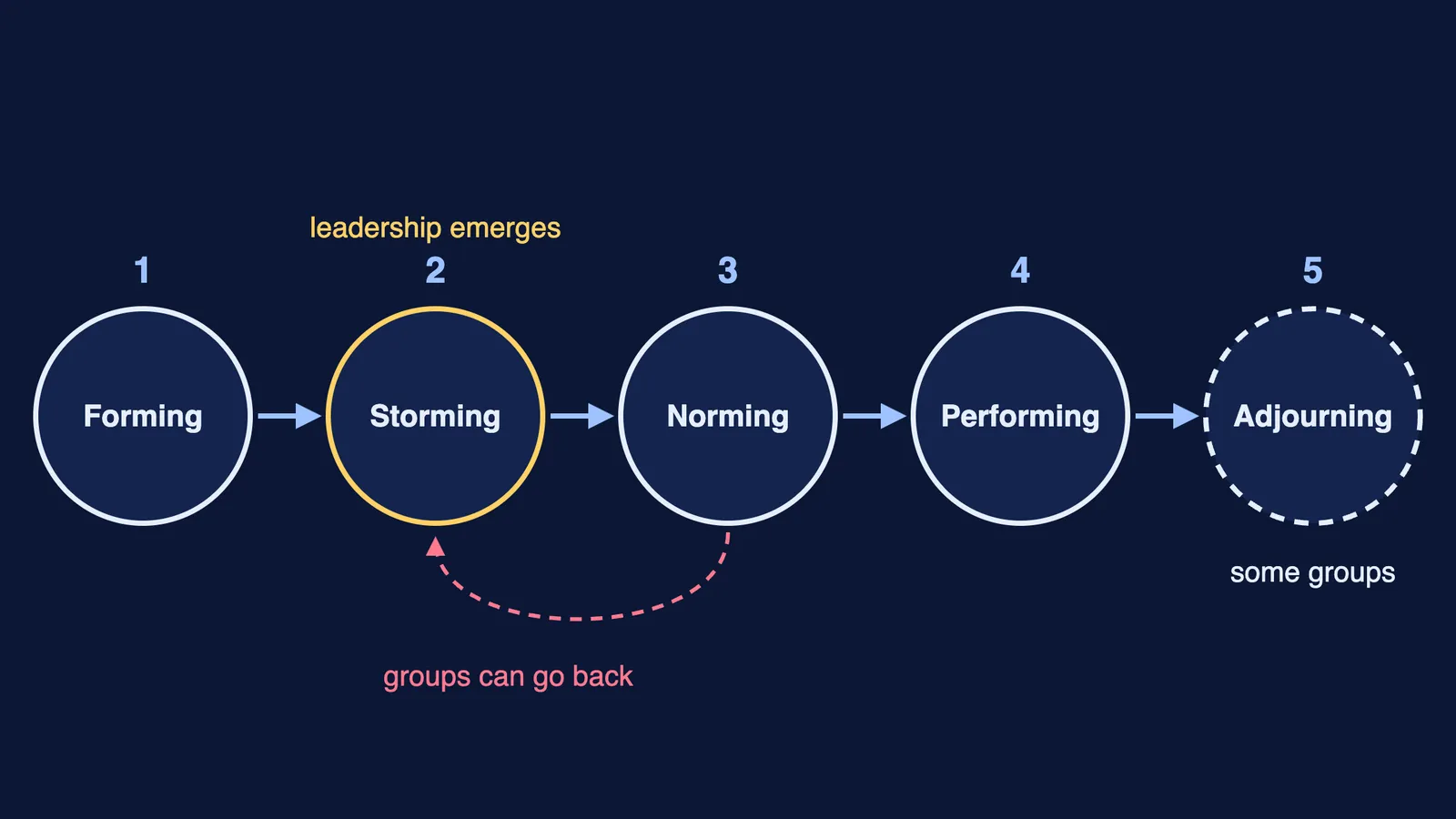
Tuckman's five stages: forming (uncertainty), storming (conflict over goals, control and tasks), norming (shared norms), performing (working towards the goal) and adjourning (disbanding, for some groups only). Groups may skip stages.
Group structure: roles, norms, status (ascribed or achieved) and cohesiveness.
What are the types of groups?
Primary and secondary: family is given to you, face to face and close; a political party is joined by choice and more impersonal.
Formal and informal: a university runs on stated rules and roles; an informal group has no such rules and close relationships.
Ingroup and outgroup: "we" versus "they". Ingroup members are usually seen as similar and favourable.
Tajfel's minimal group experiment shows how little it takes. Schoolboys split only by liking Kandinsky or Klee paintings still favoured their own group when sharing out money (NCERT). In NCERT's sample matrix, one end gives the ingroup member 7 and the outgroup member 1; the other gives 19 and 25. The first end pays your group less, but more than theirs.
How do groups influence individual behaviour?
Social loafing is a reduction in individual effort when people work on a collective task whose outputs are pooled, such as tug-of-war (NCERT). In Latané's studies, male students clapped or cheered alone or in groups of two, four and six: total noise rose with group size, while each person's noise fell. It happens when members feel less responsible or unevaluated. Reduce it by making each person's effort identifiable, showing each contribution matters and building cohesiveness.
Group polarisation is the strengthening of a group's initial position through discussion, so groups take more extreme decisions than individuals. NCERT gives three reasons: like-minded people offer new arguments for your view, agreement feels like validation (bandwagon effect), and you start treating them as your ingroup and conform.
Groupthink, described by Irving Janis, is when a cohesive group's wish for unanimity overrides realistic appraisal. NCERT's example is the US escalation of the Vietnam War from 1964 to 1967, which NCERT says cost about 56,000 American lives and over a million Vietnamese lives (NCERT). Remedies: reward disagreement, present alternatives, invite outside experts and seek feedback from trusted people.
How do you tell loafing, polarisation and groupthink apart?
Is someone putting in less effort because their share can't be seen? Social loafing.
Did discussion push the group further in the direction it already leaned? Group polarisation.
Did a close-knit group hide doubts to stay unanimous and ignore warnings? Groupthink.
Worked example: a hostel committee that already dislikes the mess contractor talks for an hour, then votes to ban him rather than ask for a better menu: polarisation.
Which questions should you practise?
(1 mark) In which stage do members agree on norms and build a positive group identity?
(2 marks) Your school's student council and your lunch-break friends: which is the formal group and which the informal one? Give one reason for each.
(3 marks) In a five-member science project, only one student's name goes on the final report. Two members do almost nothing. Name the phenomenon and suggest two ways to reduce it.
(Case, 1+2) A class debate club already favours a longer school day; after a week of discussion, members demand Saturday classes too. Name the phenomenon and explain how it differs from groupthink.
Answers to check: norming; the council is formal (stated rules and roles), the friends informal (close ties, no set rules); social loafing; group polarisation (it hardens an existing view; groupthink hides doubts to keep unanimity).
Revise alongside Attitude and social cognition Class 12 and Self and personality Class 12. For the case questions, use our guide to answering case-based questions in CBSE board exams.
If you do not know where to start, Fermi's AI tutor can work out what you already know and build a plan for the session.