On this page
Here are the key results from the two opening chapters of the Reprint 2026-27 NCERT Class 11 Mathematics textbook, with conditions, a worked example per group and one slip to watch for. For the chapter explained first, see our Sets Class 11 guide with solved examples.
The CBSE Mathematics syllabus for 2026-27 does not list power sets in Class XI, and it puts practical union-intersection problems and composition of functions in a separate list outside Unit I, so they are left out here.
What are the set formulas and laws in Class 11?
U is the universal set, A, B, C are subsets of U, φ is the empty set and A′ is the complement of A. Source: NCERT Chapter 1, Sets.
Union: A∪B = {x : x ∈ A or x ∈ B}
Intersection: A∩B = {x : x ∈ A and x ∈ B}; disjoint means A∩B = φ
Difference: A−B = {x : x ∈ A and x ∉ B}; usually A−B ≠ B−A
Complement: A′ = {x : x ∈ U and x ∉ A} = U−A
Equality: A ⊂ B and B ⊂ A ⇔ A = B; φ ⊂ A and A ⊂ A always
If B ⊂ A: A∪B = A and A∩B = B
Commutative and associative: A∪B = B∪A, A∩B = B∩A, (A∪B)∪C = A∪(B∪C), (A∩B)∩C = A∩(B∩C)
Identity and idempotent: A∪φ = A, U∪A = U, φ∩A = φ, U∩A = A, A∪A = A∩A = A
Distributive: A∩(B∪C) = (A∩B)∪(A∩C) (∩ distributes over ∪)
Complement laws: A∪A′ = U, A∩A′ = φ, (A′)′ = A, φ′ = U, U′ = φ
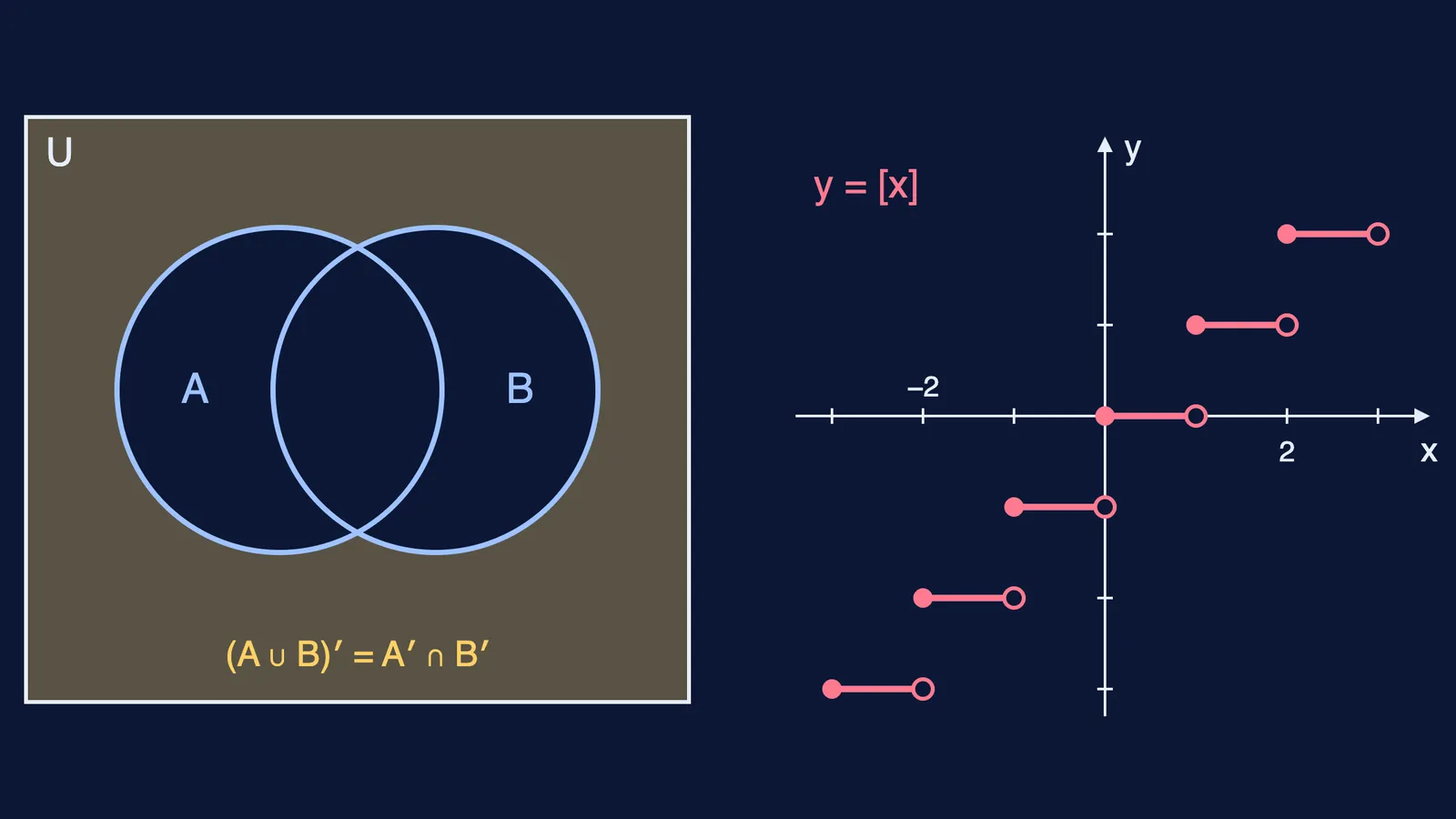
De Morgan: (A∪B)′ = A′∩B′ and (A∩B)′ = A′∪B′
Intervals, real a < b: (a, b) = {x : a < x < b}, [a, b] = {x : a ≤ x ≤ b}, [a, b) = {x : a ≤ x < b}, (a, b] = {x : a < x ≤ b}; each has length b − a
Worked example: U = {1, 2, ..., 12}, A = multiples of 2, B = multiples of 3. A∪B misses only 1, 5, 7 and 11, so (A∪B)′ = {1, 5, 7, 11}. A′ = {1, 3, 5, 7, 9, 11} and B′ = {1, 2, 4, 5, 7, 8, 10, 11} also meet in {1, 5, 7, 11}. A−B = {2, 4, 8, 10} but B−A = {3, 9}.
Watch for: {φ} has one element, so it is not empty. [−2, 5) contains −2 but not 5.
How many elements and relations does A × B have?
p = n(A) and q = n(B) for finite sets A and B. Source: NCERT Chapter 2, Relations and Functions.
A×B = {(a, b) : a ∈ A, b ∈ B}; A×φ = φ
(a, b) = (x, y) ⇔ a = x and b = y
n(A×B) = pq, and in general A×B ≠ B×A
R×R = {(x, y) : x, y ∈ R}; R×R×R = {(x, y, z) : x, y, z ∈ R}
A relation from A to B is any subset of A×B; there are 2^(pq) of them
Domain = first elements, range = second elements, codomain = B, range ⊂ codomain
A function f : A → B gives every element of A exactly one image
Worked example: A = {1, 2, 3}, B = {x, y}. n(A×B) = 6, so there are 2^6 = 64 relations. If (2a − 1, b + 3) = (5, −2), then 2a − 1 = 5 and b + 3 = −2, so a = 3, b = −5.
Watch for: the count is 2^(pq), not 2^(p+q); here 64, not 32.
What are the domain and range of each standard function?
x ∈ R unless stated. Source: NCERT Chapter 2. The 2026-27 syllabus also names exponential and logarithmic functions, but the Reprint 2026-27 chapter does not define them, so they are not on this sheet.
Identity f(x) = x: domain R, range R
Constant f(x) = c: domain R, range {c}
Linear f(x) = mx + c and polynomial a₀ + a₁x + ... + aₙxⁿ (n a whole number): domain R
Square f(x) = x²: domain R, range [0, ∞)
Rational f(x)/g(x), f and g polynomials: domain is all x with g(x) ≠ 0
Reciprocal 1/x: domain and range R − {0}
Modulus |x| = x for x ≥ 0, −x for x < 0: range [0, ∞)
Signum: 1 for x > 0, 0 at x = 0, −1 for x < 0; range {−1, 0, 1}
Greatest integer [x] = n for n ≤ x < n + 1, n ∈ Z: range Z
Worked example: (x + 2)/(x² − 7x + 12) has denominator (x − 3)(x − 4), so its domain is R − {3, 4}. And [−2.4] = −3.
Watch for: chopping off the decimal gives −2, which is wrong.
Algebra of real functions
f, g are real functions on a common domain X ⊂ R; α is real. Source: NCERT Chapter 2.
(f + g)(x) = f(x) + g(x) and (f − g)(x) = f(x) − g(x)
(αf)(x) = α f(x)
(fg)(x) = f(x) g(x)
(f/g)(x) = f(x)/g(x), provided g(x) ≠ 0
Worked example: f(x) = x² − 1, g(x) = x + 3. At x = 2: f + g = 8, f − g = −2, 3f = 9, fg = 15, f/g = 3/5. Generally (f/g)(x) = (x² − 1)/(x + 3), x ≠ −3.
Watch for: f/g excludes every zero of g, though f(−3) = 8 exists.
How to revise this formula sheet
Shade both sides of each De Morgan law on a Venn diagram; they must match.
Check counts on a tiny case: A = {1}, B = {a, b} gives 4 relations, matching 2^(pq).
Sketch |x|, signum and [x] from memory, then read off the ranges.
Factor the denominator before writing any rational function's domain.
Practise deciding whether a relation is a function with our Relations and Functions Class 11 guide and questions.
If codomain versus range still feels shaky, the Fermi Concept Library gives each mathematics concept its own lesson.